

Steel Century Groove: When Rhythm, Rust, and Revolution Collide
In an industry crowded with familiar genres and predictable mechanics, Steel Century Groove arrives as something defiantly different. It is not merely a rhythm game, nor purely an action title, nor even a straightforward narrative experience. Instead, it fuses music-driven gameplay, industrial world-building, and a striking retro-futurist aesthetic into a singular experience that feels both experimental and strangely nostalgic.
Set in a decaying mechanized world powered by steam, steel, and sound, Steel Century Groove asks a bold question: what if rhythm wasn’t a layer on top of gameplay, but the foundation of the world itself? The answer is a game that moves to its own beat — sometimes exhilarating, sometimes abrasive, but rarely forgettable.
A World Built on Iron and Tempo
Steel Century Groove takes place in Ferrum City, a sprawling industrial metropolis at the tail end of what the game calls the “Steel Century” — a hundred-year era of relentless mechanization. Factories loom over residential districts, pistons hammer endlessly, and massive engines pulse like metallic hearts beneath the streets. This is a world where progress has come at the cost of humanity, and where rhythm is more than music: it is infrastructure.
Machinery runs on tempo. Elevators rise in time with percussion. Conveyor belts lurch forward on downbeats. Even streetlights flicker according to repeating measures. The city feels alive, but not in an organic way — it breathes in loops, patterns, and grooves.
This setting is one of the game’s greatest strengths. Steel Century Groove commits fully to its industrial theme, blending art deco geometry, grime-soaked steel textures, and neon accents that pulse with the soundtrack. The visual identity is bold and cohesive, evoking equal parts early 20th-century futurism and late-20th-century synth culture. It is a world that feels oppressive, stylish, and strangely musical.
Story: Fighting the Machine with Music
You play as Rhea Calder, a former factory tuner — a specialist whose job was to calibrate the rhythmic engines that keep Ferrum City running. After a catastrophic system failure blamed on her, Rhea is cast out into the city’s underbelly. There, she discovers the truth: the city’s governing authority, known as the Conductorate, has been manipulating tempo itself to control labor, suppress dissent, and maintain power.
The narrative unfolds as Rhea joins an underground movement known as the Groovebreakers, rebels who believe that reclaiming rhythm is the key to reclaiming freedom. Rather than overthrowing the system with brute force, they aim to disrupt it by introducing new rhythms — unpredictable, human, and alive.
Storytelling in Steel Century Groove is delivered through a mix of environmental detail, stylized dialogue sequences, and musical motifs that evolve as the plot progresses. Characters have distinct rhythmic signatures, and key narrative moments are often tied to shifts in tempo or instrumentation rather than lengthy exposition.
While the story itself follows a relatively familiar arc of rebellion against authoritarian control, it is elevated by how deeply it is woven into the game’s mechanics and presentation. The idea that rhythm can be a tool of oppression — and liberation — gives the narrative a thematic cohesion that many games struggle to achieve.
Gameplay: Rhythm as a Mechanical Language
At its core, Steel Century Groove is built around rhythm-synchronized action. Unlike traditional rhythm games that ask players to hit notes on a fixed track, this game integrates rhythm directly into movement, combat, and exploration.
Every action Rhea performs — running, jumping, attacking, dodging — is most effective when executed on the beat. The game does not strictly punish off-beat inputs, but it rewards precision in subtle and meaningful ways. Attacks hit harder, dodges carry more momentum, and traversal feels smoother when aligned with the groove.
Combat System
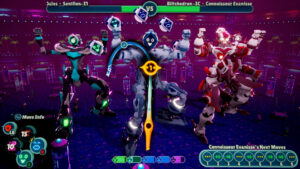
Combat encounters are structured like dynamic songs. Enemies telegraph attacks in rhythmic patterns, forcing players to listen as much as they watch. Heavier foes move on slower, crushing beats, while agile enemies dart in syncopated rhythms that require quick adaptation.
Rhea wields a modular weapon called the Resonance Rig, which can shift between melee and ranged forms. Each configuration has its own rhythmic profile, encouraging players to switch styles mid-fight to maintain flow. Landing consecutive actions on beat builds a “Groove Meter,” unlocking powerful tempo-based abilities such as time dilation, area-wide shockwaves, or rhythm-breaking dissonance attacks.
The result is combat that feels less like button-mashing and more like performance. When everything clicks, fights become exhilarating, almost dance-like sequences of motion and sound.
Exploration and Platforming
Outside of combat, rhythm plays an equally important role. Environmental hazards move in repeating patterns, and platforming challenges often require players to read and internalize the tempo of the world. Massive gears rotate in time, steam vents erupt on predictable beats, and collapsing walkways follow musical phrases.
Rather than feeling restrictive, this design encourages a meditative state. Players learn to listen, to anticipate, and to move with intention. Exploration becomes less about speed and more about timing, reinforcing the game’s core philosophy.
Music: The Beating Heart of the Experience
It is impossible to discuss Steel Century Groove without talking about its soundtrack, which is nothing short of essential. The music blends industrial percussion, analog synths, brass stabs, and distorted basslines into a sound that feels mechanical yet emotional.
What sets the soundtrack apart is its adaptive composition. Tracks are not static; they evolve based on player performance. Staying on beat introduces additional layers, harmonies, and counter-rhythms, while repeated mistakes strip the music down to bare percussion. The city itself seems to respond to how well you play, reinforcing the sense that rhythm is power.
Boss encounters are especially memorable, each featuring bespoke compositions that reflect the personality and ideology of the enemy. These battles feel like duels between competing musical philosophies, with the player literally fighting to impose their rhythm on the world.
Even in quieter moments, the soundtrack never fully disappears. Distant machinery hums in key, footsteps echo with subtle reverb, and ambient noises form percussive textures that keep the player grounded in the groove.

Visual Design and Presentation
Steel Century Groove’s art direction is unapologetically stylized. Characters are rendered with exaggerated silhouettes and sharp angles, giving them a graphic, almost poster-like quality. Animations are deliberately rhythmic, with movements snapping into place on beats rather than flowing continuously.
The user interface deserves special mention. Instead of static HUD elements, meters pulse, icons bounce, and menus slide in time with the music. Even loading screens are interactive, allowing players to tap along and subtly influence the tempo of the next area.
Color plays a crucial role in readability and mood. Warm oranges and deep reds dominate factory zones, while cooler blues and purples mark underground spaces and rebel hideouts. During high-intensity sequences, the palette shifts dynamically, creating a sense of escalating pressure without overwhelming the player.

Difficulty and Accessibility
Steel Century Groove walks a delicate line when it comes to difficulty. Mastery of rhythm is undeniably central to success, which may intimidate players who feel uncomfortable with music-based mechanics. However, the game includes thoughtful accessibility options that broaden its appeal.
Players can adjust beat windows, enable visual rhythm cues, or slow the global tempo without disabling achievements. There is even a “Flow Assist” mode that subtly nudges off-beat actions toward the nearest valid beat, allowing newcomers to learn without constant punishment.
On higher difficulties, the game becomes demanding but fair. Enemy patterns grow more complex, beats become less predictable, and improvisation is required. Importantly, failure rarely feels arbitrary; mistakes are understandable, and improvement comes naturally with practice.
Themes: Control, Expression, and Humanity
Beyond mechanics and aesthetics, Steel Century Groove explores deeper themes with surprising nuance. Its central metaphor — rhythm as both a means of control and a form of expression — resonates strongly in a world increasingly shaped by systems, algorithms, and enforced efficiency.
The Conductorate’s obsession with perfect tempo mirrors real-world fixations on productivity and uniformity, while the Groovebreakers represent the messier, unpredictable nature of human creativity. The game does not present rebellion as easy or glamorous; it is exhausting, risky, and often discordant. But it is also deeply human.
Rhea herself is a compelling protagonist precisely because she is not a natural rebel. She begins the story aligned with the system, only gradually realizing the cost of order without freedom. Her journey is less about overthrowing an enemy and more about rediscovering her own sense of rhythm — her place in the world.
Flaws and Limitations
Despite its ambition, Steel Century Groove is not without shortcomings. The heavy reliance on rhythm can feel overwhelming during longer sessions, particularly for players sensitive to audio fatigue. Some late-game areas lean too heavily on visual effects, occasionally obscuring critical cues.
Narratively, while the world-building is strong, certain supporting characters lack depth, serving more as thematic symbols than fully realized individuals. The ending, though emotionally resonant, leaves some plot threads underexplored, suggesting either deliberate ambiguity or missed opportunities.
There are also moments where the game’s commitment to rhythm limits player expression. Those who prefer improvisational or chaotic playstyles may find the emphasis on precision constraining, especially in high-stakes encounters.
 Steel Century Groove is not a game designed to please everyone. It is bold, opinionated, and deeply committed to its core idea. In doing so, it pushes the medium forward, demonstrating how mechanics, music, narrative, and aesthetics can be fused into a unified artistic statement.
It challenges players to listen — not just to the soundtrack, but to the world, the systems, and themselves. It argues that rhythm is not merely entertainment, but a language through which power is exercised and resisted.
In a landscape where many games chase trends, Steel Century Groove feels refreshingly singular. It may frustrate, challenge, and even alienate some players, but for those willing to surrender to its beat, it offers an experience unlike anything else.
Steel Century Groove is a game that lives and dies by its rhythm — and proudly so. It transforms music from background accompaniment into the very fabric of play, world, and story. Its industrial setting, adaptive soundtrack, and rhythm-driven mechanics combine to create something both mechanical and soulful.
This is not just a game you play; it is a game you perform. And when you finally find your groove — when movement, sound, and intent align — Steel Century Groove delivers moments of pure, electrifying harmony.
In the end, it reminds us that even in worlds built of steel, humanity still finds ways to move to its own beat.
