
Manchester City 2-1 AFC Bournemouth: Late drama at the Etihad as Maresca’s new era begins with a breathless comeback
You could feel it in the air before a ball was kicked. A big “WELCOME BACK ENZO” tifo stretched across the stands. Fireworks cracked. The sun was out, the sky that familiar Manchester blue. Enzo Maresca, three-year deal signed, third spell at the club in different roles, stood on the touchline in a baggy suit that somehow made him look both nervous and ready. Across the way, Marco Rose was beginning his own new chapter at Bournemouth after Andoni Iraola’s departure to Liverpool. Two managers, two clubs in transition, one fixture that felt heavier than a standard opening-day game.
What followed was pure Premier League chaos of the best kind. Bournemouth led for most of the afternoon through Marcus Tavernier’s first-half strike. City huffed, puffed, missed a litany of chances, looked disjointed under their new coach, then scored twice in the final seven minutes through Marc Guéhi and Joško Gvardiol. Rayan Cherki, thrown on from the bench, provided both assists. VAR had its say on the winner. The Etihad exploded. Maresca punched the air. Rose looked sick. And the 2026/27 season was properly underway.
This is the story of that afternoon – the preview that never quite prepared anyone for the drama, the analysis of how a game that looked lost was suddenly won, the top moments that will live in the memory, and the summary of what it all might mean for two sides trying to write new chapters.
The Preview: New bosses, old habits, and a fixture loaded with history
In the days leading up to the match, the narrative wrote itself. This was the first Premier League game of the post-Guardiola era at Manchester City. Guardiola had walked away after a decade that redefined English football – six titles, a Champions League, the lot. Maresca, the Italian who had previously coached City’s Elite Development Squad to a title and served as an assistant during the treble season, was the chosen successor. He arrived via Chelsea (where things ended messily) and Leicester (where he delivered promotion). The expectation was clear: keep the ball, keep winning, keep the standards. Easier said than done when the midfield general Rodri had left for Barcelona and other familiar faces had moved on.
City’s pre-season had been mixed. A Community Shield hammering by Arsenal the previous weekend left a sour taste. Jeremy Doku was nursing a calf injury. The squad looked a little light in places. Erling Haaland was back with a new buzz cut after the World Cup, ready for his 200th City appearance. Phil Foden, Antoine Semenyo, and a host of younger or newer faces were expected to shoulder more responsibility. Elliot Anderson, the big-money signing from Nottingham Forest, was handed a midfield role. Marc Guéhi was experimented with higher up the pitch. Nico O’Reilly, player of the year previously, was given a creative brief. It was a work in progress, and Maresca was open about it.
Bournemouth arrived with their own story. Under Iraola they had finished sixth the previous season – their best ever – and qualified for Europe for the first time. Rose, the German who had managed at Salzburg, Mönchengladbach, Dortmund and Leipzig, inherited a side that had gone 18 league games unbeaten. The football under Iraola had been high-energy, aggressive, and fun to watch. Rose’s brief was evolution rather than revolution. He kept much of the same core: Adam Smith at right-back, the defensive unit including new signing António Silva, Lewis Cook and Alex Scott in midfield, and the attacking threat of Tavernier, Justin Kluivert, Rayan and Evanilson. They had scored freely in pre-season. An away trip to the Etihad was never going to be easy – City had won all nine previous Premier League home meetings against them by an aggregate of 34-6 – but Rose’s side carried belief.
The bookies still made City heavy favourites. Most previews tipped a home win, probably by a couple of goals. The more cautious voices noted City’s transitional state and Bournemouth’s organisation and counter-attacking threat. Few predicted the exact script that unfolded.
Kick-off approached under clear skies. Attendance would eventually be recorded at 60,645. Jarred Gillett had the whistle. The new season felt properly real.
Analysis: Control without cutting edge, then chaos
From the first whistle City did what City do. They monopolised the ball. Possession finished at 66 per cent. They completed hundreds of passes. They generated an expected goals figure north of 2.2 while restricting Bournemouth to around 0.6. On paper it looked like dominance. On the pitch it looked laboured for long spells.
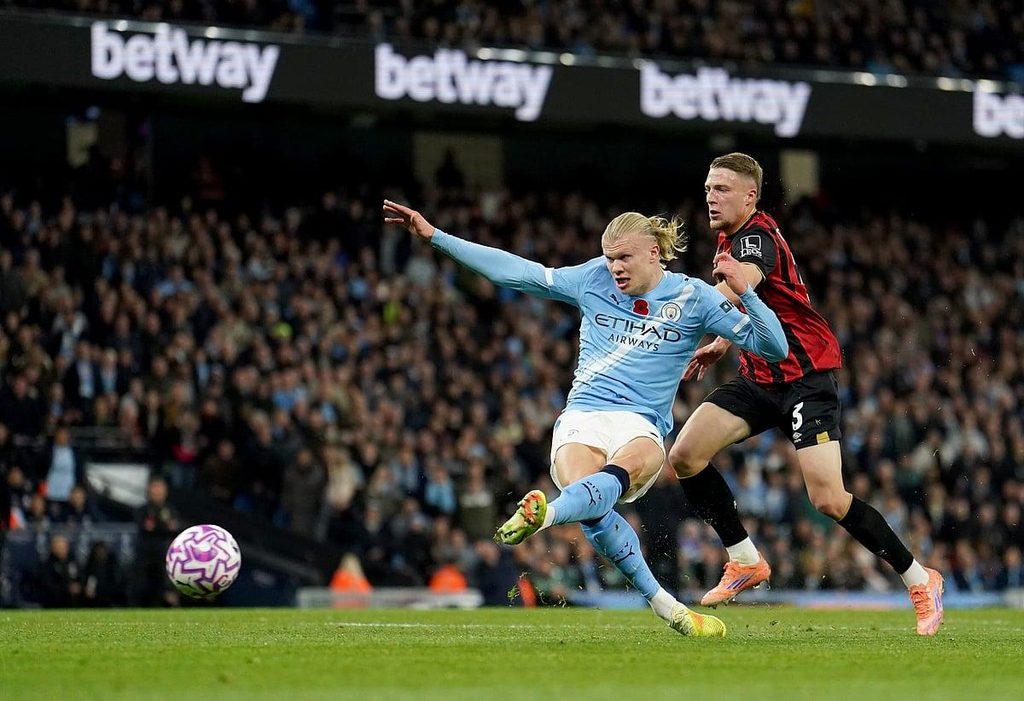
The early chances came. Rico Lewis forced a smart save from Đorđe Petrović inside five minutes. Then, around the quarter-hour mark, Nico O’Reilly produced a surging run down the left and floated a perfect ball into the box. Haaland, unmarked, somehow failed to connect properly with the goal gaping. It was the kind of miss that makes a stadium groan in collective disbelief. On his landmark appearance, with the new haircut, the Norwegian looked a fraction off the pace.
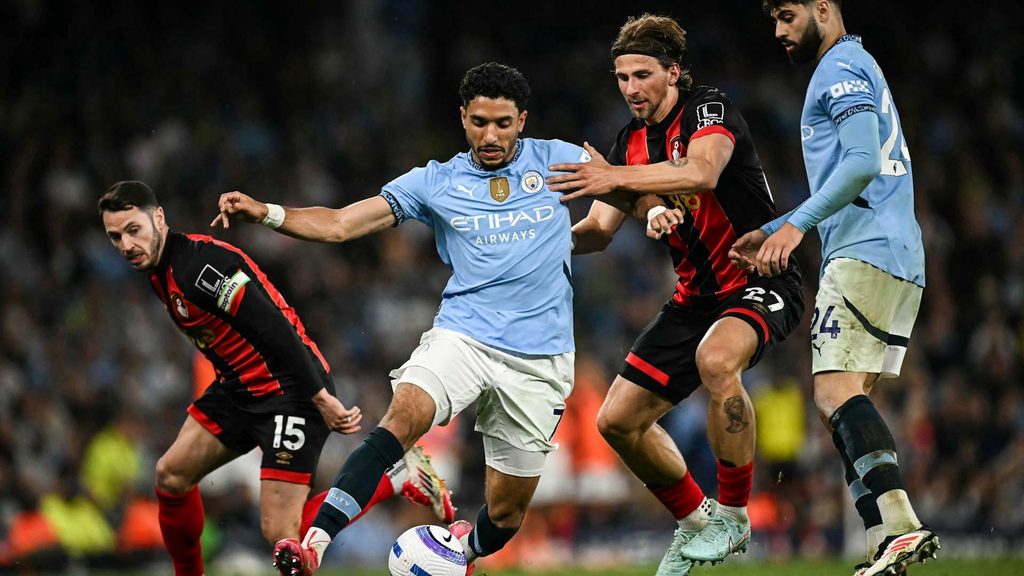
Bournemouth absorbed the pressure and then struck. In the 26th minute a long ball was played forward. Rúben Dias and Abdukodir Khusanov got themselves into a tangle. Rayan seized the moment, laid it off to Evanilson on the right, and the Brazilian’s low driven cross found Tavernier at the back post. The finish was composed, left-footed, past Gianluigi Donnarumma. 0-1. The Etihad fell quiet for a moment. Rose’s side had their dream start. City’s defence had been caught napping in a way that would have been rarer under Guardiola.
The rest of the first half followed a pattern. City continued to push. Bournemouth stayed compact, pressed selectively, and looked dangerous on the break. Donnarumma had to be alert to deny Kluivert near the interval. Haaland headed one wide or forced another save. Guéhi, deployed in a more advanced or midfield role by Maresca, was industrious but not yet decisive. Elliot Anderson, on his debut, showed composure in deeper areas but the midfield lacked the usual control. Foden was quiet. Semenyo offered width and energy but the final ball or the clinical finish kept missing.
Half-time arrived with the score 0-1 and the home crowd growing restless. Maresca made no immediate changes. The second half began in similar fashion. Guéhi missed a gilt-edged chance from an Anderson corner, heading wide from six yards when it looked easier to score. Petrović continued to produce important stops, including one from Semenyo after Cherki’s introduction.
The game needed a spark. Maresca provided it with substitutions around the hour mark. Matheus Nunes replaced Lewis. Then, crucially, Rayan Cherki and Mateo Kovačić came on for O’Reilly and the injured Anderson. Cherki, the French talent with quick feet and vision, immediately lifted the tempo. Suddenly City’s attacking play had more zip. Haaland had another effort saved. Donnarumma denied substitute Daniel Jebbison at the other end. The pressure built.
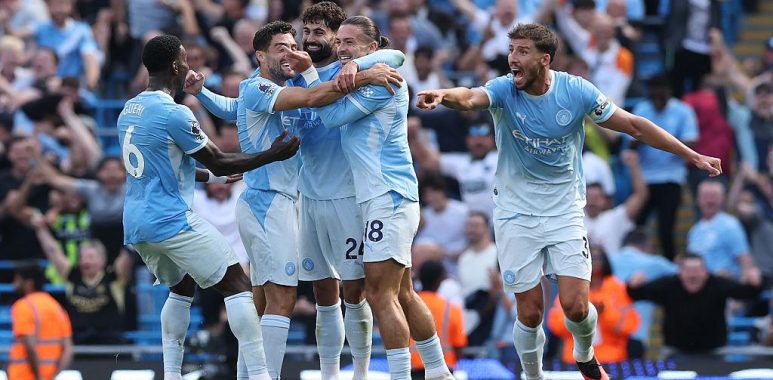
Still the equaliser would not come. Time ticked past 80 minutes. Bournemouth looked set for a famous result – their first-ever win at the Etihad, a perfect start for Rose. Then, in the 84th minute, it arrived. Cherki swung in a corner from the right. Guéhi rose highest, powered a header goalwards, and a slight deflection off Adrien Truffert helped it past Petrović. 1-1. The stadium erupted. Guéhi, who had earlier missed a similar chance, had atoned in the best possible way. Maresca, who had looked tense for most of the afternoon, allowed himself a fist pump.
City smelled blood. They kept throwing numbers forward. In the first minute of stoppage time Cherki again was the architect. A clever pass found Gvardiol, who controlled it, swivelled, and slotted the ball into the bottom corner from close range. The assistant’s flag went up for offside. The celebrations were frozen. Then the long VAR check began. After what felt like an eternity the decision was overturned. Goal. 2-1. Gvardiol wheeled away. The Etihad went wild. Maresca celebrated like a man who had just been handed a lifeline. Rose stood stunned. Bournemouth’s players sank to their knees.
The final minutes were about managing the clock. City saw it out. Full time. A dramatic, imperfect, thoroughly entertaining opening-day win.
Tactically, Maresca’s experiment with Guéhi in midfield paid off in the end through that goal and the defender’s overall contribution, but the side still looked short of the fluidity of peak Guardiola years. The reliance on a super-sub in Cherki highlighted both squad depth and the need for more consistent starters in creative roles. Bournemouth, for their part, executed Rose’s plan almost perfectly for 84 minutes – organised, aggressive in transition, clinical with their one clear chance – only to be undone by two set-piece and transitional lapses late on. Their unbeaten league run was over. The pain of those final minutes will linger, but the performance offered plenty of encouragement for a side that now has European football to balance as well.
Top Highlights
Several moments will be replayed for days and weeks.
The Haaland miss early on remains one of the season’s first genuine “how did he miss that?” clips. O’Reilly’s delivery was perfect. The goal was open. The Norwegian’s connection was all wrong. It set a tone of frustration that lasted until the late surge.
Tavernier’s goal was pure quality in construction. The mix-up at the back for City, the quick thinking by Rayan, Evanilson’s delivery, and the clinical finish. For a side looking for belief under a new manager, it was the perfect statement.
Guéhi’s equaliser carried narrative weight. He had missed a similar chance earlier. Deployed in an unfamiliar midfield role, he kept working and then produced the header that changed everything. Cherki’s delivery was inviting; the leap and contact were decisive.
Gvardiol’s winner, complete with the VAR drama, was pure theatre. The composure to control and finish under pressure, the agonising wait for the technology to confirm it, and the explosion of noise that followed. Defenders scoring late winners always feel special. This one felt seismic for Maresca’s start.
Cherki’s overall impact from the bench deserves its own highlight reel. Two assists in a short period of time. Quick feet, vision, and the ability to change a game’s momentum. Maresca later called it “unbelievable.” Few disagreed.
Individual defensive moments also stood out – Donnarumma’s saves, particularly the one to deny Jebbison, and the late blocks that protected the lead. On the other side, Petrović’s first-half and early second-half stops kept Bournemouth in it far longer than the underlying numbers suggested they deserved.
Summary: Relief, lessons, and the long road ahead
When the final whistle blew, the scoreboard read Manchester City 2, AFC Bournemouth 1. The points went to the home side. The emotions were more complicated.
For City and Maresca this was a win that papered over some cracks while revealing others. They dominated the ball and the chances. They showed character to come from behind late. The introduction of Cherki proved decisive. Guéhi and Gvardiol delivered when it mattered most. Yet the first-half vulnerability, the early profligacy in front of goal, and the sense that the attacking patterns are still being bedded in will give the new manager plenty to work on. Haaland will score many more this season; this was simply not his day. Foden needs to find his rhythm. The midfield, without Rodri, is a work in progress even with Anderson’s promise and Kovačić’s experience.
Maresca was measured afterwards. He spoke about the spirit being fantastic and the result being deserved based on the chances created. He also acknowledged it is a work in progress. The relief was palpable. A defeat on the opening day would have invited far harsher scrutiny. Three points, secured in the most dramatic fashion, buys time and goodwill.
For Bournemouth and Rose the afternoon was cruel. They were six minutes from a historic result. They defended resolutely for long periods, created the game’s first goal with real quality, and limited City’s clear-cut chances until the very end. Two defensive lapses – one from a corner, one from a transition – cost them everything. Rose was honest in his assessment: the basics were good, the effort was there, but the details in those final moments let them down. An 18-match unbeaten league run ended in painful fashion. Yet there was enough in the performance – the organisation, the threat on the break, the spirit – to suggest Rose has inherited a side capable of competing and progressing. European football will test their squad depth, but the foundation remains strong.
Looking at the wider picture, this was classic Premier League opening-day theatre. New managers, high stakes, a game that refused to follow the expected script until the very last moments. City sit with three points and a win under their belt. Bournemouth have a hard-luck story and lessons to take into the next fixtures. The season is long. Both sides will have better days and worse ones.
For now, the memory that lingers is of those final minutes at the Etihad. Guéhi rising to head home. Gvardiol slotting the winner. Cherki the common thread. Maresca celebrating. The crowd roaring. A new era beginning not with a statement of dominance but with a reminder that football, at its best, still thrives on drama, character, and the refusal to accept defeat until the whistle has finally blown.
City head next to Crystal Palace. Bournemouth will regroup and look for their first points of the campaign. The 2026/27 Premier League is up and running, and if this match is any indication, it is going to be one hell of a ride.
