
Maheshate’s Short-Notice Guillotine Steal: How China’s Hometown Fighter Snapped Flowers’ Momentum in Shanghai
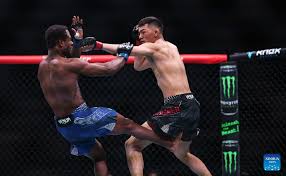
Shanghai’s Oriental Sports Center was loud on Friday night, August 28, 2026. The Road to UFC Season 5 semifinals were rolling, tournament hopefuls were advancing, and then the main event hit like a reminder that the UFC can still produce those sharp, unexpected moments even on a card built around prospects. Hayisaer Maheshate, stepping in on roughly a week’s notice for teammate Taiyilake Nueraji, submitted Darrius “Beast Mode” Flowers with an arm-in guillotine at 2:31 of the first round. Flowers tapped with his hand and his foot. The Chinese crowd erupted. Maheshate improved to 12-5 overall and 3-4 inside the UFC. Flowers fell to 13-9-1 and 1-4 in the Octagon.
What follows is the full story of how this lightweight bout came together, the styles and stakes that shaped the preview, a breakdown of what actually happened, the moments that stood out, and what it means going forward. No filler, no robotic recap—just the fight as it played out in front of a home crowd that finally got something to roar about.
The Preview: Short Notice, High Stakes, and a Tale of Two Paths
Going into the week, this was never supposed to be Maheshate versus Flowers. Taiyilake Nueraji was the original opponent for the American. When Nueraji pulled out, the UFC turned to Maheshate, a product of the Shanghai Performance Institute who had been off the roster after a rough stretch. He had just scored a second-round TKO on the regional scene in China a month earlier. Suddenly he was back in the Octagon, headlining a card that mixed Road to UFC tournament semifinals with two official UFC bouts. The co-main was Yilizhati Maimaitijiang versus Tre’ston Vines, which ended in a split draw. The rest of the night belonged to the young prospects chasing contracts.
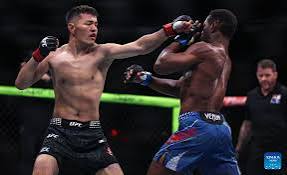
Maheshate, 26, born December 1, 1999, in Xinjiang, stands 6-foot with a 71.5-inch reach. Orthodox stance. He came up through boxing and wrestling as a kid, transitioned to MMA around 17 after watching Lawler-MacDonald, and became the first Chinese fighter to earn a UFC contract on Dana White’s Contender Series. His early UFC run included a highlight-reel knockout of Steve Garcia at UFC 275, but the losses piled up—decision losses to Rafa Garcia and Nikolas Motta, a TKO to Viacheslav Borshchev, another decision setback to Gauge Young in 2025. The promotion cut him. He stayed active at home, stayed sharp, and when the call came he took it without hesitation.
Flowers, 32, out of the Chicago-to-Iowa pipeline, carries the “Beast Mode” nickname for a reason. He is 5-foot-9 with power in his hands and a reputation for violent slams. He earned his UFC deal on Contender Series with a spectacular slam finish of Amiran Gogoladze that looked like something out of a highlight reel. His UFC start was rocky—submission losses to Jake Matthews and Evan Elder, a decision loss to Michael Johnson—before he stopped Lando Vannata by TKO in April 2026. That win, even with a weight miss attached to it, gave him a bit of momentum. He walked into Shanghai looking for a second straight win and a chance to stabilize his spot on the roster.
The stylistic preview wrote itself. Maheshate is longer, more of a boxer-wrestler hybrid who has historically preferred to keep fights standing or work from his back when forced down. Flowers is the shorter, stockier pressure fighter who likes to close distance, clinch, and look for those big lifts and ground-and-pound sequences. Most expected Flowers to try to take the fight to the mat early and test Maheshate’s defensive wrestling and submission game. Maheshate’s camp, working out of the Shanghai PI, emphasized composure and capitalizing on any overextension. Short notice or not, the Chinese fighter had the home advantage and the fresher recent finish. Betting lines had Maheshate as a moderate underdog in some books, which only added to the underdog narrative for a guy who had already been written off once.
Both men made weight cleanly—155.5 pounds each. The atmosphere in the building was electric for the tournament fights, and by the time the main event walked it felt like a hometown statement was possible. Maheshate had something to prove after the cut. Flowers had something to protect after finally getting a UFC win. That was the setup.
Analysis: Why the Guillotine Made Sense and Where Flowers Went Wrong
On paper, Flowers’ path to victory was clear: close the distance, avoid extended striking exchanges with the taller man, secure a takedown, and either smash or climb into dominant positions. He has the athleticism and the lifting power to do damage once he gets ahold of hips. Maheshate’s path was different. Keep the fight at range where his length and boxing could work, or, if taken down, stay active off his back and look for opportunistic submissions. He has only two career submissions—one early triangle years ago and now this guillotine—but the threat was always there if an opponent got careless.
What played out was a short, sharp illustration of the second path. The two men spent the opening moments feeling each other out, pawing with jabs and measuring distance. Flowers initiated the clinch and managed to off-balance Maheshate, putting him on the mat. That was the moment most expected Flowers to start imposing. Instead, as he tried to advance position, his neck became available. Maheshate locked in an arm-in guillotine, squeezed, and refused to let go even as Flowers tried to slam his way free. The choke was tight enough that Flowers panicked and tapped with both hand and foot. Referee Marc Goddard stepped in at 2:31.
From a technical standpoint, the sequence highlights a classic risk-reward problem for aggressive wrestlers and pressure fighters. When you force the fight to the mat against someone with length and a willingness to attack from the bottom, the window for a neck attack opens quickly if the top man is not careful with posture and head position. Maheshate had threatened a kimura first according to some accounts before transitioning cleanly into the guillotine. That ability to chain attacks off his back under pressure is the kind of detail that separates a short-notice filler from a guy who belongs back on the roster.
Flowers’ recent win over Vannata had been built on pressure and finishing ability. Here the same aggression that produces highlight-reel moments also created the opening. He got the takedown he wanted and still lost in under three minutes. For Maheshate, the win is more than a W. It is validation that the time away and the regional work kept him sharp. He looked calm, patient, and opportunistic rather than frantic. That composure under short notice is the story of the night as much as the finish itself.
Looking at the broader context, Maheshate’s first UFC run was marked by youth and inexperience. He has said as much. At 26 he is still young for the division. A clean, emphatic finish in front of Chinese fans changes the narrative. For Flowers, the loss drops him to 1-4 in the UFC with four of his last five going the wrong way. Momentum is fragile in this sport. One good night can be erased in two and a half minutes if the details are not right.
Top Highlights: The Moments That Defined the Night
The fight was short, so the highlights are concentrated and vivid.
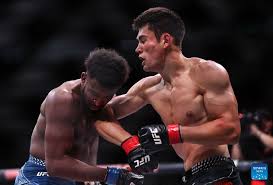
First, the early striking. Both men traded heavy shots in the opening exchanges. Maheshate used his length; Flowers tried to close. It was competitive and physical without becoming wild. The crowd was already into it.
Second, the takedown. Flowers forced the clinch, off-balanced Maheshate, and put him on the canvas. For a second it looked like the American was about to impose his preferred game. The Shanghai crowd held its breath.
Third, the transition. From his back Maheshate threatened the kimura, then switched seamlessly into the arm-in guillotine. The lock was sudden and deep. Flowers tried to slam out of it—classic desperation move—but Maheshate held the grip and the squeeze.
Fourth, the tap. Flowers tapped with his hand. Then he tapped with his foot. That dual tap became the visual of the night. It told every viewer how tight the choke was and how quickly the fight had flipped. Maheshate released and the arena exploded.
Fifth, the celebration. Maheshate, back in the UFC on short notice in his home country, soaking in the moment. For a fighter who had been cut and had to grind back, it landed with extra weight.
Those five sequences—feeling-out, takedown, transition, tap, celebration—tell the entire story of the bout in under three minutes of action. Everything else on the card mattered for the tournament, but this main event belonged to the finish.
Summary and What Comes Next
Maheshate versus Flowers on August 28, 2026, at the Road to UFC Season 5 semifinals in Shanghai was a short-notice opportunity seized completely. Maheshate walked into the Octagon as a replacement, absorbed the early pressure, and finished the fight with a guillotine that forced a panicked dual tap at 2:31 of round one. He is now 12-5 overall and has his third UFC win. Flowers drops to 13-9-1 and faces the reality of another setback after finally getting on the board in the promotion.
The co-main draw between Yilizhati Maimaitijiang and Tre’ston Vines and the various tournament advancements provided the undercard depth, but the main event delivered the cleanest narrative of the night: a Chinese fighter returning home, stepping up, and ending the fight on his terms.
For Maheshate the path forward is clearer. A finish like this keeps him employed and raises the possibility of more opportunities in front of Chinese audiences. He has spoken about being too young during his first UFC stint. This performance suggests the gap is closing. For Flowers the questions are harder. The power and the slam ability are still there, but the defensive details against bottom players need work if he wants to climb out of the early-loss hole.
In the end it was a classic UFC moment. One fighter got the call, showed up ready, and turned a potentially tricky short-notice assignment into a highlight-reel statement. The Shanghai crowd got what it came for. Maheshate got his redemption. And the lightweight division got another reminder that the next fight is always the one that matters most. The rest of the Road to UFC story will play out in the finals next year. This particular chapter closed with a Chinese arm locked around an American neck and a foot tapping the mat in surrender. That image will linger.