
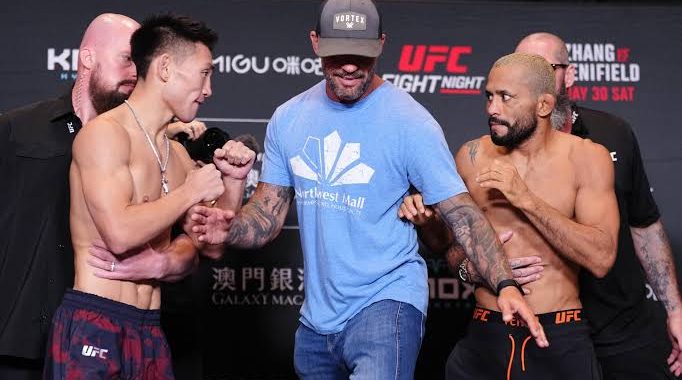
Song Yadong’s Homecoming Guillotine: How the Kung Fu Kid Locked Up Figueiredo and Reignited China’s Bantamweight Dream in Macau
There’s a particular kind of pressure that only hits when you’re the last Chinese fighter standing on a card in China. By the time Song Yadong walked out at Galaxy Arena on May 30, 2026, the local contingent had already taken some heavy punches. Zhang Mingyang got finished. Other Chinese names came up short. The crowd that had shown up expecting a night of national pride was sitting on its hands, waiting for someone—anyone—to give them a reason to roar.
Then the Kung Fu Kid delivered.
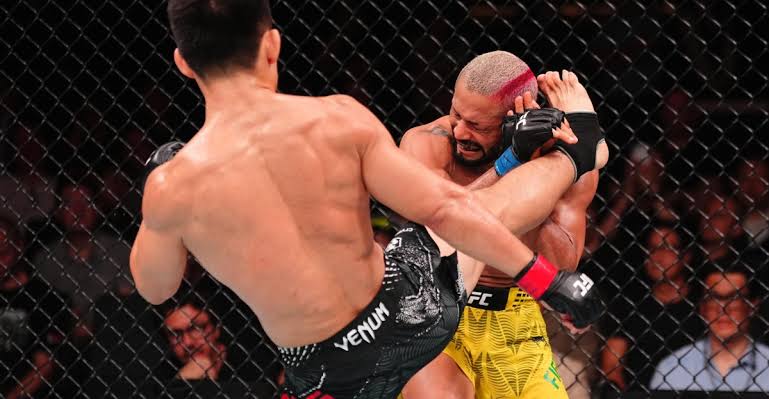
Song Yadong submitted former two-time UFC flyweight champion Deiveson Figueiredo with a guillotine choke at 4:42 of the second round in the main event of UFC Fight Night 277. It was the kind of finish that felt both sudden and inevitable once it happened, the kind that makes an entire arena forget every disappointment that came before it. For Song, it was more than a win. It was proof that the version of him who had been stuck in the “almost” category for years still had something left to say at the top of the bantamweight division.
The Preview: A Matchup Built on Different Timelines
Going into the fight, the narrative wrote itself. Song, 28, was the younger, bigger, sharper striker looking to reassert himself after a loss to Sean O’Malley at UFC 324. Figueiredo, 38, was the grizzled former champion who had moved up from flyweight years earlier and found the going significantly tougher at 135. The Brazilian had won three straight after the move, then dropped four of his next five. The age gap was real. The size difference was real. The betting odds reflected it—Song was a massive favorite, somewhere in the -550 to -600 range depending on the book.
But Figueiredo had never been an easy out. “Deus da Guerra” still carried the kind of pressure and grappling threat that could turn a fight in one scramble. His guillotine was legendary. His durability was proven. And on paper, a five-round main event in Macau against a striker who sometimes got distracted by the highlight-reel shot felt like the kind of fight where the older man could make things ugly and steal rounds.
Song had his own questions to answer. He had beaten Henry Cejudo. He had lost to Petr Yan and O’Malley. The ceiling was clearly high, but the consistency was still being debated. This was supposed to be a statement fight on home soil, the first time he had headlined in China in a long time, and the first time many of the younger fans in the building had seen him perform live since his early UFC days.
The card itself carried that familiar Macau energy. Sergei Pavlovich needed just 39 seconds to flatten Tallison Teixeira. Kai Asakura knocked out Cameron Smotherman in the first. Alonzo Menifield stopped Zhang Mingyang in the co-main. The prelims had their share of finishes and one messy no-contest. By the time the main event arrived, the arena was ready for something decisive.
Analysis: Styles, Stakes, and the Grappling Question Mark
On the surface, this was a classic striker-versus-grappler matchup with a twist. Song’s boxing and kicking game had always been his calling card. He could sit down on the right hand, he could chop legs, and he could make opponents pay for every step forward. Figueiredo’s path to victory was always going to involve closing distance, forcing scrambles, and looking for the kind of front-headlock situations he had finished so many times before.
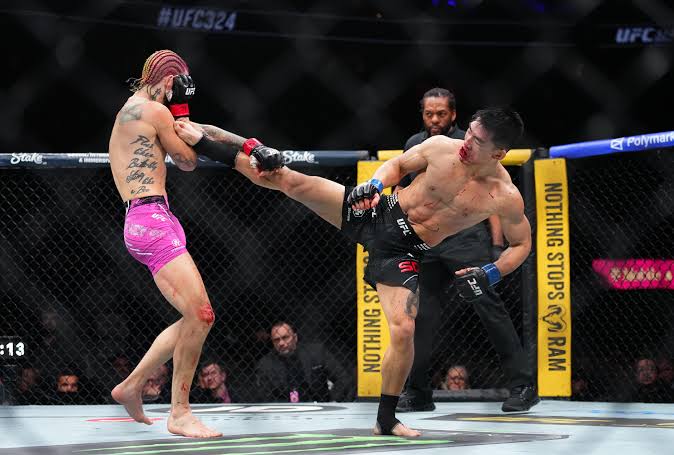
What made the fight interesting was that Song had been working hard on the other side of the equation. Training out of Team Alpha Male under Urijah Faber, he had been drilling the exact kind of defensive and offensive grappling that Figueiredo specialized in. The guillotine that ended the fight was not an accident. It was a practiced answer to a specific problem. Song said afterward that the choke had been a “secret weapon” in camp. When the moment came, he didn’t hesitate.
The stakes were clear for both men. For Song, a win kept him in the thick of the title conversation at a time when the bantamweight division was as crowded as it had been in years. For Figueiredo, another loss would push him further from any realistic path back to a title shot and raise the inevitable questions about whether the move up in weight had simply run its course.
Age was the unspoken character in the room. At 38, Figueiredo was still dangerous for short bursts, but the longer the fight went, the more the physical advantages tilted toward Song. The Chinese fighter’s size, youth, and ability to maintain output over five rounds were supposed to be the difference. The question was whether he would fight with the kind of patience required to force those advantages, or whether he would go looking for the highlight that had sometimes cost him in the past.
The Fight: A Slow Burn That Exploded
The first round was, by almost every account, a strange one. Both men came out cautious. Song established the center early and began working the lead leg with kicks. Figueiredo answered with body kicks and the occasional crisp counter. There were long stretches where neither man threw much of consequence. The crowd, already a little deflated from earlier results, grew restless.
Song stuffed a couple of early takedown attempts. He continued to chop at the legs. Late in the round he threw a high kick, slipped, and ended up on his back. Figueiredo jumped into his guard with under 30 seconds left, but there wasn’t enough time to do anything meaningful. The horn sounded on a tentative, low-output round that most observers scored for Song on volume and control, though some felt Figueiredo’s cleaner power shots and the late top position might have stolen it on certain scorecards.
Round two opened with more of the same feeling-out process, then slowly tilted. Song started landing with more authority—the right hand found a home, the leg kicks continued to accumulate, and Figueiredo began switching stances more often as the damage to his lead leg mounted. The Brazilian was still dangerous in transition, but he was having a harder time getting clean entries.
With just under a minute left in the round, Figueiredo shot for a double-leg. It was the moment he had been looking for all fight. Song met it with a front headlock, locked his hands, and dropped to the mat with the guillotine already tight. The squeeze was immediate and decisive. Figueiredo tapped frantically. Referee Jason Herzog stepped in at 4:42. The Galaxy Arena erupted.
It was Song’s first submission victory since his UFC debut in 2017, when he finished Bharat Khandare with the same choke. The symmetry was not lost on anyone who had followed his career. The striker who was always supposed to win with his hands had just finished a grappling specialist with a grappling move on the biggest stage of his life.
Top Highlights and the Moments That Defined the Night
The finish itself sits at the top of the highlight reel, and for good reason. The speed with which Song transitioned from defending the takedown to locking the choke was textbook. There was no scramble, no second chance, no wild recovery. One moment Figueiredo was shooting; the next he was tapping. The crowd’s reaction—pure, unfiltered release—captured everything the night had been building toward.
Earlier in the second round, Song’s right hand started finding its range with increasing frequency. Those shots, combined with the relentless leg kicks, visibly slowed Figueiredo and forced him into the kind of desperate entries that eventually cost him the fight. The slip at the end of round one was a minor scare that ultimately meant nothing, but it served as a reminder that even the better fighter can give away a moment if he gets too ambitious with the high kicks.
On the undercard, Pavlovich’s 39-second demolition and Asakura’s first-round knockout provided the kind of early energy the main event eventually matched. Menifield’s stoppage of Zhang was a reminder that home-crowd pressure cuts both ways. The card as a whole delivered more finishes than decisions, which is exactly what a Macau Fight Night should do.
Summary: What the Win Means Going Forward
Song Yadong walked out of Galaxy Arena with more than a win. He walked out with renewed momentum, a signature finish, and the kind of hometown glow that can carry a fighter for a long time. Beating a former champion—even one on the downside of his career—still counts. Doing it by submission, in China, after a slow start, counts even more. The victory pushed his record to 23-9-1 and kept him firmly in the mix of ranked contenders.
Figueiredo’s path is less clear. Four losses in five fights at bantamweight is a hard trend to ignore. At 38, the physical tools that once made him nearly unstoppable at flyweight are not what they were. He remains dangerous, and a smart matchmaker could still find him competitive fights, but the championship window that once seemed wide open now looks mostly closed.
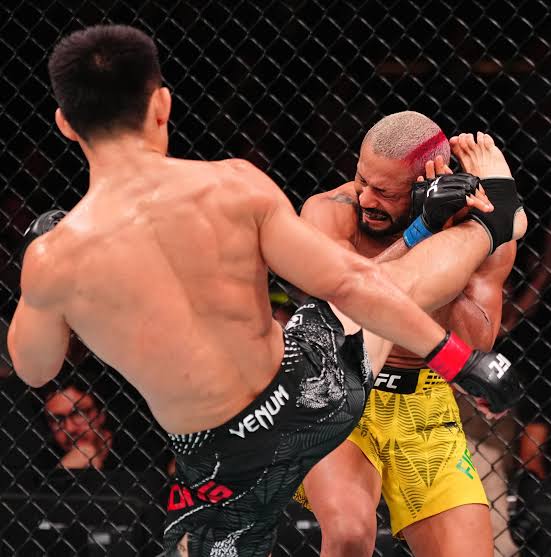
For Song, the post-fight comments were pure Kung Fu Kid. He credited Team Alpha Male and Urijah Faber for the grappling work. He said he didn’t care who came next. He just wanted the next fight. Later he floated the idea of a rematch with Petr Yan, the man who had beaten him previously. Whether that happens or whether the UFC points him toward another ranked name remains to be seen. What is clear is that Song is still very much in the conversation at 135 pounds.
The broader picture for Chinese MMA got a much-needed boost. One night does not make a movement, and the earlier losses on the card were real. But nights like this—when the local favorite rises to the moment and delivers a highlight-reel finish in front of a partisan crowd—are the ones that stick. They create new fans. They keep the ones already there engaged. They remind everyone that the talent pipeline is real even when the results are mixed.
Song Yadong did not reinvent himself in Macau. He simply showed a more complete version of the fighter he has always been. The hands were still sharp. The kicks still landed. And when the moment required something else, the guillotine was there, tight and ready. For one night in May 2026, that was more than enough.
The Kung Fu Kid is still here. And the division has been put on notice once again.