
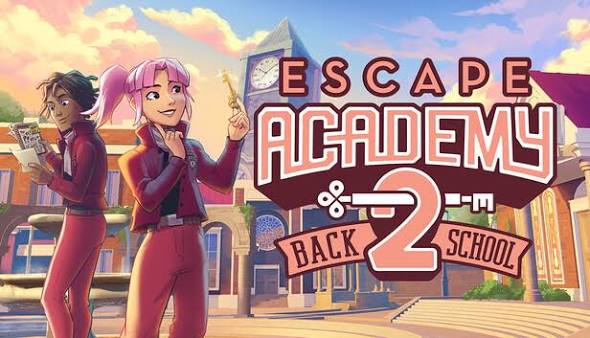
Escape Academy 2: Back 2 School ( Sophomore Year Delivers Bigger Puzzles, Broader Campus, and a Few Lingering Growing Pains)
Escape Academy 2: Back 2 School is the kind of sequel that knows exactly what made the first game click and then decides to build an entire campus around it. Released today, November 5, 2026, on PlayStation 5, Xbox Series X|S, and PC (with day-one Game Pass support), Coin Crew Games and iam8bit have taken the clever, co-op-friendly escape-room formula of the 2022 original and blown it out into something bigger, stranger, and occasionally more frustrating.
If you loved the first game’s mix of real-world escape-room logic, ridiculous school-themed set pieces, and constant puns, you’re going to feel right at home. If you wanted that experience stretched into a proper 10–15 hour adventure with actual exploration between the big rooms, this is mostly what you’ve been waiting for. It just comes with a few extra homework assignments you might not have asked for.
Back on Campus
You return as the same customizable student from the first game, starting a new year at Escape Academy. The place still exists purely to teach people how to escape things—padlocks, rooms, conspiracies, common sense. Classes cover arts, sciences, and whatever other subject can be twisted into a puzzle. Between the formal “exams” (the big timed escape rooms), you now get to wander the grounds.
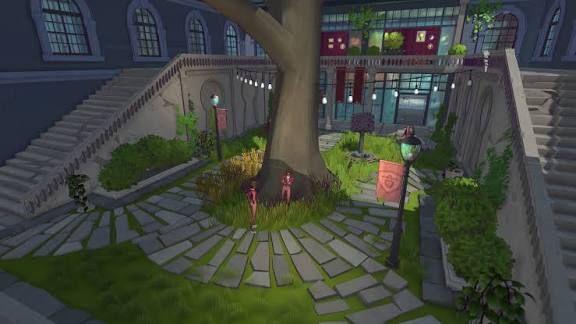
That’s the big change. The original was mostly a series of discrete rooms strung together with light narrative glue. Back 2 School turns the entire campus into a living hub. Different wings and outdoor areas unlock as you progress. Courtyards, dorms, libraries, science buildings, a lighthouse-looking structure by the water, ziplines for faster travel once you earn the currency for them—there’s a surprising amount of space to poke around in. Side quests (Extra Credit) and smaller environmental puzzles are scattered everywhere. You’ll find students who need help with something weird, hidden collectibles, and little brainteasers that don’t have a timer breathing down your neck.
It works better than I expected most of the time. The low-pressure exploration gives your brain a chance to reset between the high-intensity main rooms. Talking to the colorful NPCs, many of whom return from the first game with new dialogue and outfits, keeps the world feeling inhabited. The art style is still that bright, cartoonish, slightly exaggerated look that makes every hallway and classroom feel like it belongs in a very specific kind of animated show. Keyhole motifs are everywhere if you start looking for them. The whole place has personality.
The story leans into a conspiracy about the academy’s founding and some disappearances. It’s light enough that it never overwhelms the puzzles, but it has enough twists and character moments to keep you interested. There are visual-novel-style cutscenes with limited voice work. The writing stays firmly in the “dad-joke and absurd school rules” lane while occasionally dipping into something a little darker. It works if you buy into the tone. If the constant puns start grating, you’re going to feel it more over this longer runtime than you did in the shorter original.
The Rooms Still Rule
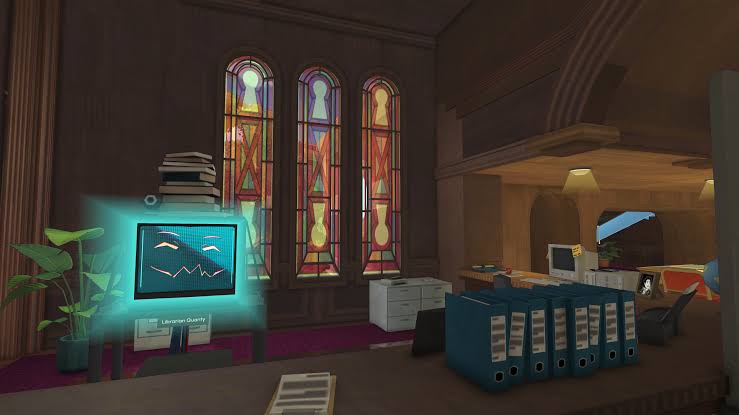
The main escape rooms remain the star of the show. There are more of them this time—around fifteen core ones—and they feel more varied and ambitious. Coin Crew’s team has real escape-room design experience, and it shows. You’re not just hunting for keys and codes. You’re reading the environment, noticing patterns, combining objects in ways that feel logical once you crack them, and sometimes dealing with proper hazards like spiked ceilings or other theatrical threats that real-world rooms can’t get away with.
Difficulty is well balanced for the most part. Some rooms are straightforward crowd-pleasers. Others make you grab a notepad and start scribbling. Hints are available if you need them, and there’s a proper No-Timer Mode if the pressure of the clock ruins the fun for you or your co-op partner. I mostly played with the timer on because that tension is part of the appeal, but it’s nice that the option exists.
The satisfaction of finally figuring out a multi-step solution and watching the exit unlock is still excellent. These rooms feel handcrafted. They reward observation and lateral thinking more than pure trial-and-error. When a room clicks, it’s one of those pure “hell yes” gaming moments that puzzle fans live for.
Co-op remains a highlight. Local split-screen and online both work. Exploring the open campus together is genuinely fun—one person can chase a side quest while the other scours a different building for clues. Inside the main rooms, communication is key, just like a real escape room. You talk through theories, split up to check different areas, and share discoveries. It makes for great couch sessions or voice-chat nights with a friend.

It’s not perfect in co-op, though. Some important items or tools effectively lock to one player, which can leave the other person standing around waiting. Certain puzzles that rely on specific viewpoints or inventory can sideline one player more than feels ideal. It’s rarely a deal-breaker, but it happens often enough that you’ll notice. Solo play is completely viable if you prefer that. The game doesn’t punish you for going it alone.
The Open World Growing Pains
Here’s where the ambition starts to show its seams. The campus is big and full of things to do, but it can also feel a bit empty or directionless at times. Side puzzles are plentiful, which is great until you hit a stretch where you’re just wandering looking for the next thing while the main story waits. Puzzle fatigue is real if you try to 100% everything in one go. Some of the environmental challenges and platforming bits feel like padding rather than essential design.
Performance is the bigger issue right now. On PS5 especially, reviews have noted stuttering, frame-rate drops when moving between areas, and the occasional crash. Even on stronger PC hardware, the open-world sections aren’t always smooth. It’s not constant, but it’s frequent enough to pull you out of the experience. For a game this colorful and otherwise polished, the technical rough edges stand out. Hopefully patches arrive quickly—this is the kind of problem that can improve a lot post-launch.
Item scaling and some of the progression systems also feel a little off. Money (or whatever the campus currency is called) is used for supplies and ziplines, and the economy doesn’t always feel perfectly tuned. A few mandatory purchases can interrupt the flow. These are smaller complaints, but stacked on top of the performance issues they add up.
The story, while serviceable and often funny, doesn’t quite stick the landing for everyone. Some of the later revelations and character beats land better than others. The jokes that were charming in a four-hour game can start to feel repetitive when the runtime stretches past ten hours. The PA announcements and certain recurring gags will either make you smile every time or make you want to mute the audio.
Who This Is For
If you bounced off the first Escape Academy because it was too short or too linear, this is the expanded version that fixes those complaints. If you loved the first game, you’ll find more of what you liked, plus a whole campus to explore. Puzzle fans, co-op enthusiasts, and anyone who enjoys that specific mix of clever design and goofy presentation should have a good time.
It’s not a revolutionary open-world game. The exploration is secondary to the rooms, and it sometimes feels like the team is still figuring out how to balance the two. But the core loop—walk around, talk to people, solve weird little puzzles, then dive into a carefully crafted escape room—holds up for most of the runtime.
At its best, Escape Academy 2: Back 2 School delivers pure puzzle joy. The “aha” moments are frequent and well-earned. The world has charm. Playing with a friend makes the weaker sections more bearable and the strong ones better. At its worst, you’re dealing with frame drops while hunting for another side puzzle that doesn’t quite justify the walk, or watching your co-op partner monopolize the one key item the room needs.
I came away liking it a lot more than I disliked it. The rooms are strong enough to carry the experience, and the expanded structure gives the series a real sense of place it didn’t fully have before. It’s a solid sophomore effort that mostly earns its place on the curriculum. Just go in knowing that the open campus is both the biggest improvement and the source of most of the remaining headaches.
If you’re the type who lights up at the sight of a complicated lock or a room full of cryptic notes, enroll. The final grade isn’t perfect, but the best lessons here are still worth showing up for. Class is back in session.
