

Sri Lanka Dominate Pakistan in Lahore as Dilshan Madushanka’s Five-Wicket Haul Seals a Stunning Eight-Wicket Victory
Sri Lanka produced a commanding performance against Pakistan in the fifth match of the ODI Tri-Series on Tuesday, 27 October 2026, registering a comprehensive eight-wicket victory at the Gaddafi Stadium in Lahore. A brilliant bowling performance led by left-arm pacer Dilshan Madushanka dismantled Pakistan’s batting line-up, restricting the hosts to just 110 runs in 25.3 overs. Sri Lanka then chased down the modest target with remarkable ease, finishing at 114/2 in just 18.1 overs, with 191 balls remaining.
The victory was particularly impressive because it came against a Pakistan side playing on home soil, in front of its supporters. Sri Lanka displayed discipline, confidence and excellent teamwork throughout the contest. Madushanka was the standout performer, claiming five wickets for 34 runs and earning the Player of the Match award for his match-winning contribution.
The result also proved significant for Sri Lanka’s campaign in the tri-series, as the victory secured their place in the final and ended England’s hopes of progressing further in the competition.
Sri Lanka win the toss and choose to bowl
The match began with Sri Lanka winning the toss and electing to field first, a decision that eventually proved to be the right one. Sri Lanka’s bowlers immediately showed their intentions, putting pressure on Pakistan’s opening batters and preventing them from building a strong foundation.
Pakistan entered the contest with a powerful batting line-up featuring experienced names such as Fakhar Zaman and Babar Azam, alongside promising players including Maaz Sadaqat, Saad Baig and Hasan Nawaz. With home advantage and a strong bowling attack at their disposal, Pakistan would have hoped to put up a competitive total.
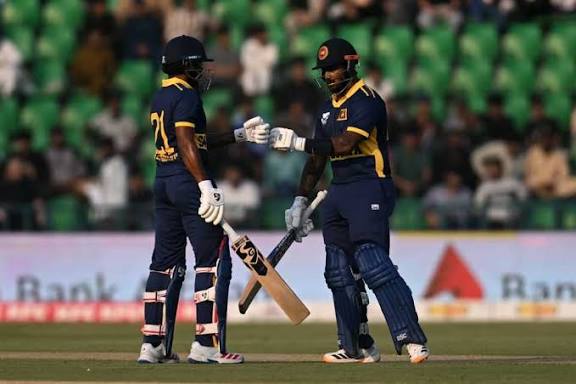
However, Sri Lanka had other plans. Their bowlers maintained excellent discipline, attacked the stumps and made life difficult for the Pakistani batters. Rather than allowing Pakistan to settle into the innings, Sri Lanka continued to pick up wickets at regular intervals.
Pakistan’s batting line-up collapses under pressure
Pakistan’s innings got off to a disappointing start when opening batter Fakhar Zaman was dismissed for just five runs from 13 deliveries. Dilshan Madushanka provided the early breakthrough, with Pavan Rathnayake taking the catch. The early dismissal immediately put Pakistan under pressure.
Maaz Sadaqat also failed to make a significant contribution. He managed eight runs from 11 balls before being trapped leg-before-wicket by Asitha Fernando. Pakistan had lost both opening batters with only 23 runs on the scoreboard, leaving the middle order with considerable responsibility.
All eyes then turned towards Babar Azam, who was expected to provide stability. The experienced batter looked more comfortable than his teammates and attempted to rebuild the innings. He scored 29 runs from 33 deliveries, including five boundaries. His innings offered Pakistan a brief period of hope, but the support from the other end was not enough.
Saad Baig was dismissed for five after being caught by Janith Liyanage off Madushanka’s bowling. Salman Ali Agha followed with nine runs, falling to Sahan Arachchige, with wicketkeeper Kusal Mendis completing the catch.
Pakistan’s situation became increasingly difficult as wickets continued to fall. Hasan Nawaz attempted to hold the innings together, scoring 17 runs from 31 balls, including one six. However, his innings lacked the acceleration Pakistan desperately needed.
Shadab Khan contributed only two runs before being dismissed by Sahan Arachchige. Arafat Minhas added 10 runs, while captain Shaheen Afridi managed 15 runs from 13 deliveries, including two sixes. His brief counterattack provided some entertainment, but it could not rescue Pakistan from their difficult position.
Madushanka continued to dominate the lower order, dismissing Haris Rauf for one run. Naseem Shah remained unbeaten on two, but Pakistan were eventually bowled out for just 110 runs in 25.3 overs.
The collapse was a reflection of Sri Lanka’s disciplined bowling rather than one isolated mistake from the Pakistani batting unit. Pakistan never managed to establish a substantial partnership, and the frequent fall of wickets prevented the team from developing any momentum.
Babar Azam’s 29 was the highest individual score for Pakistan, followed by Hasan Nawaz’s 17 and Shaheen Afridi’s 15. The overall batting performance, however, fell well below expectations for a team playing at home.
Dilshan Madushanka delivers a career-best performance
The biggest highlight of the match was undoubtedly Dilshan Madushanka’s exceptional bowling display. The Sri Lankan left-arm fast bowler produced a memorable spell, finishing with figures of five wickets for 34 runs in 8.3 overs, including one maiden.
Madushanka’s performance was a perfect example of how an effective fast bowler can change the direction of an entire match. He attacked the Pakistani batters with pace, movement and accuracy, making it difficult for them to play their natural game.
His first major contribution came when he dismissed Fakhar Zaman early in the innings. The breakthrough gave Sri Lanka the perfect start and established the tone for the remainder of the contest.
He later removed Saad Baig, adding further pressure on Pakistan’s middle order. As the innings progressed, Madushanka continued to find ways to trouble the batters. His dismissal of Arafat Minhas further weakened Pakistan’s chances of recovering.
The most significant phase of his spell came towards the end of the innings. He removed Haris Rauf and then captain Shaheen Afridi, completing an outstanding five-wicket haul.
His figures of 5/34 were particularly impressive because he maintained control while consistently taking wickets. His career-best performance earned him the Player of the Match award.
Speaking after the match, Madushanka explained that the team had followed its bowling plan successfully, which allowed Sri Lanka to restrict Pakistan to a low total. His comments reflected the collective effort behind the performance rather than focusing solely on individual achievements.
Sri Lanka’s bowlers make it a complete team effort
Although Madushanka received most of the attention, Sri Lanka’s bowling success was the result of contributions from several players.
Sahan Arachchige played an important role by claiming two wickets for 24 runs in his five overs. His dismissals of Salman Ali Agha and Shadab Khan prevented Pakistan from establishing a useful partnership in the middle overs.
Eshan Malinga also delivered an economical spell, taking one wicket for just eight runs in four overs. His dismissal of Babar Azam was particularly valuable because the Pakistani batter was the only player who appeared capable of building a substantial innings.
Asitha Fernando picked up one wicket for 34 runs in six overs, removing Maaz Sadaqat. Dunith Wellalage also contributed with the ball, dismissing Hasan Nawaz for 17 runs while conceding only four runs in two overs.
The combined bowling performance ensured that Pakistan never found an opportunity to recover. Every bowler contributed to the pressure, and Sri Lanka’s fielding supported the effort with important catches.
It was this balance between pace, spin, control and wicket-taking ability that made Sri Lanka so effective throughout the first innings.

Sri Lanka begin the chase with confidence
Chasing a target of 111 runs, Sri Lanka had a relatively straightforward task ahead of them. However, the team still needed to approach the innings carefully and avoid giving Pakistan an opportunity to return to the contest.
Sri Lanka’s opening batters, Avishka Fernando and Kamindu Mendis, began positively. They showed good intent and took advantage of the modest target, finding the boundaries whenever opportunities appeared.
The opening partnership quickly reduced Pakistan’s hopes of defending their total. Avishka Fernando played an aggressive role, scoring 16 runs from 17 deliveries with two boundaries.
Pakistan captain Shaheen Afridi eventually provided a breakthrough by dismissing Avishka, who was caught by Fakhar Zaman. However, the wicket came too late to create any serious pressure on the Sri Lankan batting line-up.
Sri Lanka had already reached 50 runs in just 6.5 overs, demonstrating how comfortably they were progressing towards the target.
Captain Kusal Mendis joined Kamindu at the crease, but his stay was brief. He scored eight runs from six deliveries, hitting two boundaries before being bowled by Arafat Minhas.
At 62/2, Pakistan had another opportunity to create some pressure. However, the required target was so small that Sri Lanka remained firmly in control.
Kamindu Mendis leads the successful chase
Kamindu Mendis was the star of Sri Lanka’s batting performance. While the bowlers had already placed the team in a commanding position, Mendis ensured there would be no unnecessary complications during the chase.
He played a confident and composed innings, remaining unbeaten on 62 runs from 60 deliveries. His innings included eight boundaries and two sixes, demonstrating a good combination of patience and attacking cricket.
What made his performance particularly impressive was his ability to adjust to the situation. Rather than taking unnecessary risks, he focused on rotating the strike and punishing loose deliveries.
Mendis looked comfortable against both pace and spin. His shot selection was sensible, and he maintained a healthy scoring rate throughout the innings.
His partnership with Pavan Rathnayake proved decisive. Rathnayake joined him after the dismissal of Kusal Mendis and contributed an unbeaten 23 runs from 26 deliveries, hitting two boundaries.
The pair ensured that Pakistan’s bowlers could not produce another breakthrough. Their partnership added 52 runs for the third wicket, comfortably taking Sri Lanka towards victory.
Kamindu Mendis reached his half-century and continued batting with confidence until the winning runs were scored.
Pavan Rathnayake provided excellent support at the other end, ensuring that the chase remained smooth and controlled.
Sri Lanka eventually reached 114/2 in just 18.1 overs, winning the contest by eight wickets with 191 balls remaining.
Pakistan’s bowling attack fails to defend the target
Pakistan’s bowlers entered the second innings with a difficult challenge. Defending only 110 runs against a confident Sri Lankan batting line-up was never going to be easy.
Shaheen Afridi was the most successful Pakistani bowler, claiming one wicket for 29 runs in six overs. He dismissed Avishka Fernando, providing Pakistan with an early breakthrough, but the wicket did little to change the direction of the match.
Arafat Minhas also picked up one wicket, dismissing Sri Lankan captain Kusal Mendis. He finished with figures of 1/23 in five overs.
Naseem Shah conceded 29 runs in four overs without taking a wicket, while Haris Rauf gave away 27 runs in three overs. Maaz Sadaqat bowled just 0.1 overs, conceding four runs.
Pakistan’s bowlers struggled to create consistent pressure because the target was so small. Sri Lanka’s batters were able to play positively without taking unnecessary risks.
The lack of a competitive total meant Pakistan had very little margin for error. Even after taking two wickets, the visitors remained comfortably ahead.
A significant victory in the ODI Tri-Series
Beyond the match result, Sri Lanka’s victory carried considerable importance for the tournament standings.
The Pakistan ODI Tri-Series featured Pakistan, Sri Lanka and England, with all three teams competing for a place in the final.
Sri Lanka’s win over Pakistan secured their qualification for the final. The result also confirmed England’s elimination from the competition, with the English side having suffered three consecutive defeats earlier in the tournament.
England had experienced a difficult campaign despite showing promising performances in previous international matches. Their inability to maintain consistency in Pakistan ultimately cost them a place in the final.
For Sri Lanka, the victory was an important achievement and a confidence booster ahead of the tournament’s final stages. Defeating the hosts by such a convincing margin also demonstrated that the team was capable of performing under pressure in challenging conditions.
Pakistan, meanwhile, would have been disappointed with their batting performance. Playing at home, they were expected to offer a stronger challenge, particularly with experienced players in their line-up.
The defeat highlighted the importance of batting partnerships, shot selection and maintaining composure when facing quality bowling attacks.
What went wrong for Pakistan?
Pakistan’s defeat was not caused by one particular mistake. It was a combination of batting failures, missed opportunities and Sri Lanka’s outstanding execution.
The first major problem was the early loss of wickets. Losing both opening batters for just 23 runs meant Pakistan were immediately forced into recovery mode.
Babar Azam attempted to stabilise the innings, but his dismissal at 61/5 proved to be a turning point. Once he departed, Pakistan struggled to find another batter capable of building a meaningful partnership.
The middle order failed to take responsibility, while the lower order could not contribute enough runs to make the total competitive.
Another concern was the inability to counter Madushanka’s bowling. His accuracy and movement exposed weaknesses in Pakistan’s batting approach. The batters struggled to rotate the strike consistently and found themselves under increasing pressure.
Pakistan’s bowling attack also faced an almost impossible task. Defending 110 runs required early wickets and exceptional discipline, but Sri Lanka’s batters were too comfortable throughout the chase.
For Pakistan, this match should serve as an important reminder that strong individual players cannot guarantee success without collective contributions.
Sri Lanka’s biggest positives from the match
Sri Lanka will take several positives from this performance.
First, the bowling unit demonstrated excellent coordination. Madushanka led the attack brilliantly, while Asitha Fernando, Sahan Arachchige, Eshan Malinga and Dunith Wellalage supported him with valuable contributions.
Second, the batting unit showed maturity. Kamindu Mendis played an outstanding innings, while Pavan Rathnayake provided the support required to complete the chase.
Third, the team’s overall attitude was impressive. Sri Lanka did not become complacent after restricting Pakistan to a low total. They approached the chase professionally and finished the job without allowing the opposition to gain momentum.
Perhaps the most encouraging aspect was the contribution from different players. Madushanka delivered with the ball, while Mendis and Rathnayake handled the responsibility with the bat.
This balance between the bowling and batting departments could prove extremely valuable in the final.
A memorable day for Dilshan Madushanka
Every cricket match has moments that define its outcome, and this contest belonged to Dilshan Madushanka.
His five-wicket haul was not simply an impressive statistical achievement. It was the foundation of Sri Lanka’s victory.
Taking five wickets against a team like Pakistan, particularly in their home conditions, requires skill, confidence and consistency. Madushanka demonstrated all three.
His career-best figures of 5/34 showed his ability to deliver when the team needed him most. He broke important partnerships, removed key batters and prevented Pakistan from reaching a respectable total.
His performance also highlighted the importance of having a reliable left-arm fast bowler in a one-day international team. The variation in angle, movement and pace gave Pakistan’s batters several problems throughout the innings.
Winning the Player of the Match award was a fitting recognition of his outstanding contribution.
Final verdict: Sri Lanka send a strong message
Sri Lanka’s eight-wicket victory over Pakistan was a comprehensive performance that highlighted the team’s strengths and exposed the weaknesses of their opponents.
From the first delivery to the final runs, Sri Lanka remained in control of the contest. Their bowlers restricted Pakistan to 110 runs, and their batters completed the chase with 191 balls remaining.
Dilshan Madushanka was undoubtedly the hero of the day with his five-wicket haul, while Kamindu Mendis provided the perfect finishing touch with an unbeaten 62.
Pavan Rathnayake also deserves credit for his valuable contribution, ensuring that Sri Lanka crossed the finishing line without further difficulty.
For Pakistan, the match was a disappointing experience. Their batting unit failed to deliver, and their bowlers were left with an extremely difficult task. The team will need to address these concerns and improve its consistency in future matches.
For Sri Lanka, however, the result was a statement of intent. They defeated the hosts convincingly, secured their place in the final and demonstrated the quality of their cricket.
The Gaddafi Stadium witnessed a performance that Sri Lankan supporters will remember for a long time. It was a day when disciplined bowling, sensible batting and outstanding teamwork combined to produce a memorable victory.
Sri Lanka did not just win a match; they delivered a powerful reminder that cricket is ultimately a team sport, where preparation, execution and collective responsibility make all the difference.
The final result said it all: Sri Lanka 114/2 defeated Pakistan 110 by eight wickets, with 191 balls remaining. A dominant victory, a career-best bowling performance and a well-deserved place in the final made this one of Sri Lanka’s most impressive performances of the tournament.
