
Corsair Cove Review: Building a Pirate Haven on the Edge of the World
There’s something about pirates that never quite lets go. Not the real historical ones with the bad teeth and the dysentery, but the ones we carry around in our heads—the ones from the movies, the books, the late-night stories. The ones who live loud, drink hard, and somehow turn a stretch of rock and saltwater into something that feels like freedom. Corsair Cove, the new city-builder from Limbic Entertainment and published by Hooded Horse, understands that fantasy better than most games that have tried to bottle it.
It came out today, July 31, 2026, on Steam, Epic, the Microsoft Store, and day-one on PC Game Pass. I went in expecting a solid but familiar pirate-themed management game. What I got was something that felt fresher than I anticipated, even if it occasionally trips over its own ropes.
Shipwrecked and Starting Over
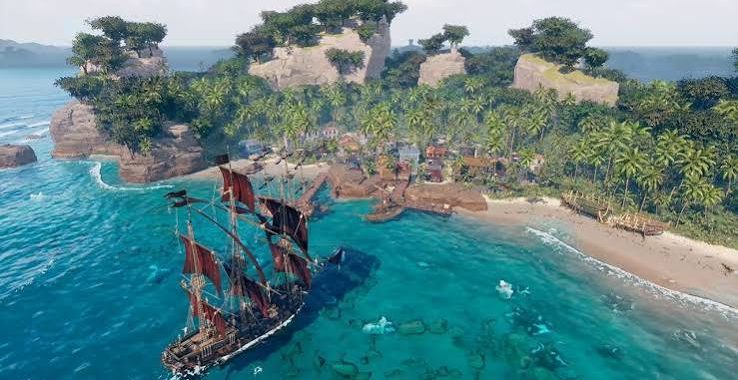
The setup is simple and effective. A group of pirates escapes a prison ship and washes up on a remote tropical island dominated by towering cliffs and a skull-shaped mountain. The Golden Age of Piracy is ending. The Crown’s hunters are closing in. Your job is to turn this hostile scrap of land into a thriving pirate haven before the world decides the age of freebooters is over for good.
You start with almost nothing. A few tents, a campfire, some basic tools, and a rowdy crew that needs food, drink, and purpose. From there the game opens up into two intertwined loops: building and managing your settlement on the island, and eventually sending ships out to raid, explore, and fight.
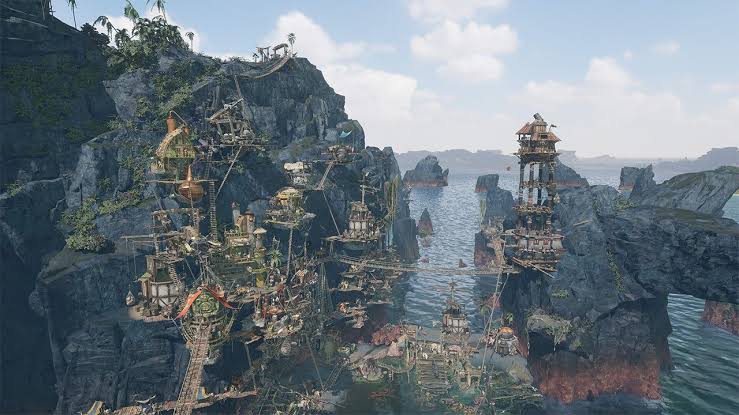
What makes the building unique is the terrain. Most city-builders give you a flat plain or gently rolling hills. Corsair Cove hands you vertical real estate. Sheer cliff faces, narrow ledges, and high plateaus force you to think in three dimensions. Buildings cling to rock walls. Rope bridges and wooden walkways stretch across gaps. Later you get ziplines and elevators that turn the whole settlement into a chaotic, beautiful network of movement.
It looks spectacular. The art direction leans into a vibrant, almost storybook version of the Caribbean. Colors pop. The water sparkles. Little animations play out constantly—pirates dancing on tables, pigs being spun around for entertainment, smoke curling from cookhouses. There’s a genuine sense of life that many more serious city-builders lack. You catch yourself just watching the place tick sometimes.
Logistics with Personality
Under the charming surface sits a surprisingly deep production system. You’ll manage dozens of goods—basic hardtack and fish, turtle soup, clothing, tools, weapons, tobacco, ale, and more specialized items. Production chains stretch across the island and up the cliffs. A sawmill high on a ridge needs logs from the forest below. The tavern wants ale from the brewery halfway across the settlement. Your shipwrights need cannons and spyglasses that require multiple intermediate steps.
The game is good at showing you where the problems are. Click a building and you see the paths feeding it, color-coded for efficiency. Bottlenecks become visible instead of mysterious. Solutions are plentiful: reroute paths, build a new warehouse closer to the action, set up a direct supply link, or install a zipline to cut travel time. It’s the kind of logistical puzzle that feels rewarding rather than punitive. You rarely feel stuck with only one correct answer.
Population management has its own flavor. Your pirates aren’t just generic workers. Different types have different needs and preferences. Keep them happy with food variety, drink, and the right amenities or cohesion—the game’s stand-in for overall colony health—starts to drop. Cohesion is a double-edged resource. You spend it to attract more pirates or resolve certain events, but if it tanks too hard you risk mutiny. Early on the tension between needing more hands and not having enough cohesion to safely take them in can feel tight. Later systems ease that pressure, but the first few hours ask you to be careful.
I appreciated that the game rarely locks you into a death spiral. When things start going wrong it usually gives you windows to fix them. You can feel the pressure without the whole settlement collapsing overnight because one warehouse ran dry.
Taking to the Sea
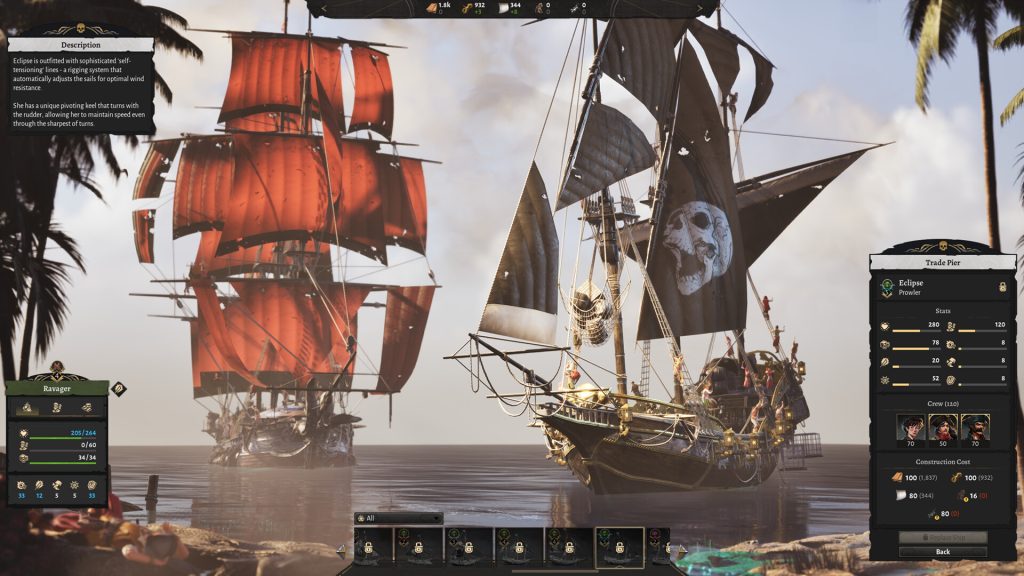
Once you build your first proper ship, the second half of the game opens. You appoint a captain (each with their own abilities), fill out a crew, and set sail for nearby islands and random encounters. These missions range from treasure hunts and smuggling runs to direct fights against Crown ships or rival pirates.
The naval side is more abstract than the settlement building. Combat and exploration use a card-and-dice system. You play cards for attack, defense, utility, or stealth depending on the type of encounter, then dice rolls decide outcomes. It works well enough for short missions, and the different captains and ship upgrades add meaningful choices. Higher-tier ships need better-trained crews with more complex supply demands, which loops neatly back into your production chains.
That said, this is where the game shows its weaker side. The naval encounters can start feeling repetitive after a while. The card system is clever but limited, and the heavy reliance on dice means you sometimes lose for reasons that feel outside your control. Save-scumming is tempting when a valuable ship is on the line. Several critics have noted the same thing: the seafaring is fun in short bursts and important for progression, but it doesn’t match the depth or satisfaction of the island management.
Still, the two halves support each other. Raids bring back resources and unique items you can’t produce at home. Completing deeds tied to the four pirate principles—Empire, Notoriety, Seafaring, and Wealth—unlocks new technology, buildings, and ship types. The progression system is one of the smarter parts of the design. Instead of a traditional tech tree you follow a kind of compass that reflects how you’ve actually been playing. Focus heavily on one principle and you get specialized rewards. Try to do everything at once and you can spread yourself too thin. It creates a real sense of identity for your pirate society.
Story Mode and Sandbox
There are two main ways to play. Story Mode puts you on Skull Rock with a more guided campaign that pushes the narrative of resisting the Crown. Uncharted Mode offers multiple islands with different challenges and less hand-holding. Both have room for dozens of hours. I spent most of my time in Story Mode and still felt like I was only scratching the surface of the production complexity and fleet options.
The writing and worldbuilding stay light and playful. Events, pirate dialogue, and random incidents lean into the romantic, larger-than-life version of piracy rather than grim historical realism. That’s the right call for this game. It wants you to smile when a pirate gets spun around by a pig on a tavern table, not dwell on the brutality of the age.
Presentation and Performance
Visually the game is a treat. The vertical settlements look impressive even when they’re a tangled mess of rope bridges and platforms. The tropical environments are lush without becoming garish. Sound design supports the mood well—creaking wood, distant waves, the occasional sea shanty vibe without overdoing the stereotypes.
On the technical side it ran smoothly on high-end hardware. Steam Deck compatibility is listed as Playable, which matches what I’ve heard from early reports. There were some optimization complaints in pre-release coverage, but nothing that felt like a deal-breaker in the final version I played. Day-one patches are already addressing a few smaller issues, which is typical and welcome.
The Rough Edges
No game is perfect, and Corsair Cove has its share of friction. The naval combat and exploration systems are the clearest weak point—entertaining at first, then increasingly samey. Early population growth can feel artificially constrained. Complex production chains sometimes require more mental bookkeeping than is ideal, especially when you’re juggling multiple new resources at once. And while the vertical building is the game’s strongest identity, it can occasionally make pathfinding and visual clarity a challenge when your settlement gets truly sprawling.
None of these are fatal. They just keep it from being a total knockout.
Final Thoughts
Corsair Cove succeeds because it understands the appeal of its fantasy and commits to it without apology. It is not trying to be a hardcore historical simulation or a pure logistics monster. It is a colorful, systems-rich playground about building a home for outcasts on the edge of a fading era. The vertical construction is genuinely clever. The production management has enough depth to satisfy players who like solving supply puzzles. The seafaring, even when it repeats itself, gives the whole experience a welcome change of pace and a sense of adventure.
It sits in a nice middle ground—more engaging and mechanically interesting than pure cozy builders, less punishing and opaque than the most hardcore management games. If you like watching a settlement grow into something chaotic and personal, and you have even a soft spot for pirate aesthetics, this one is easy to recommend.
I came away wanting to start another island and try a different set of principles. That, more than any score, is the sign that Limbic and Hooded Horse did something right. The Golden Age may be ending in the fiction, but on my hard drive it’s still going strong.
Score: 8/10
Worth sailing for. Just don’t expect the naval battles to be the main event. The real treasure is the home you build on those cliffs.
