
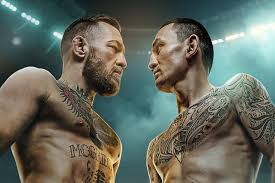
UFC 329: McGregor vs Holloway 2 – The Rematch That Lasted 69 Seconds
There are nights in combat sports that feel like they belong to the history books before the first punch is thrown. UFC 329 was supposed to be one of those nights. Conor McGregor, the most famous mixed martial artist on the planet, stepping back into the Octagon after five full years away. Max Holloway, the durable, high-volume technician who had already rewritten the featherweight division and later claimed the BMF strap, moving up to welterweight for the first time. A rematch thirteen years in the making. Las Vegas. International Fight Week. T-Mobile Arena packed to the rafters. The whole circus was ready.
What we got instead was something closer to a tragic short story. Sixty-nine seconds. One awkward landing. A right knee that gave out. And another chapter in the strange, injury-haunted late career of the Irishman who once seemed unstoppable.
The Long Road Back
To understand the weight of this fight you have to go back to August 17, 2013. TD Garden in Boston. UFC Fight Night 26. McGregor was 25, two fights into his UFC career, already walking out like a rock star. Holloway was 21, skinny, raw, and filling in on short notice. McGregor dominated the decision (30-27, 30-27, 30-26), mixed striking with takedowns, and controlled the younger man on the ground. What most people forget is that McGregor tore his ACL in that fight. He still got the win, but the injury forced him out for nearly a year. He came back, ran through the featherweight division, became the first simultaneous two-division champion, and turned into a global phenomenon. Holloway went on a legendary tear of his own, became featherweight champion, defended it multiple times, and later reinvented himself at lightweight.
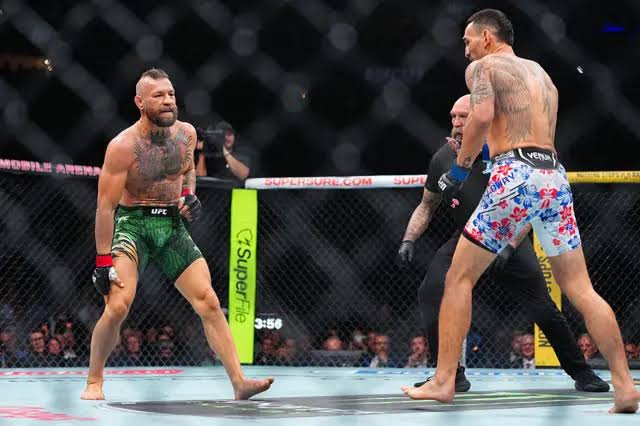
Thirteen years later the roles had flipped. McGregor had not fought since July 2021, when Dustin Poirier broke his left leg in the third fight of their trilogy. The intervening years were a mess of legal troubles, a failed political run in Ireland, missed fights, and endless speculation about whether he would ever return. Holloway had stayed active. He beat Justin Gaethje for the BMF title, lost it to Charles Oliveira, and kept showing up. When the rematch was finally booked for UFC 329 on July 11, 2026 (the card ran into the early hours of the 12th depending on your time zone), it felt like closure, or at least a proper chapter.
The weight class was new territory for both in different ways. McGregor had fought at welterweight before, but never regularly. Holloway was making his debut at 170. Both made weight without drama. The face-offs were intense. Holloway, never one for the theatrical nonsense, still matched McGregor’s energy and delivered one of the better lines of fight week: “If this guy’s a missile, I’m a fucking nuke.” McGregor talked about being sharp, ready, and bringing the old magic back. The betting markets heavily favored Holloway. Most analysts did too. Five years is a lifetime in this sport, and McGregor was about to turn 38.
Style Clash and the Questions Going In
On paper the fight had layers. McGregor’s power and left hand versus Holloway’s volume, cardio, and ability to process information mid-fight. Holloway averages close to seven significant strikes per minute. He is comfortable in the pocket, mixes levels, and has that famous chin. McGregor still carried the threat of ending a fight with one clean shot, and he had the size and strength advantage at welterweight. Some pointed back to 2013 and suggested McGregor could mix in takedowns again to disrupt Holloway’s rhythm. Others noted that McGregor had not scored a takedown in over a decade of fights and that his cardio had looked suspect even in his prime.
The biggest questions hung over McGregor. How much of the old explosiveness remained after five years of relative inactivity and a shattered leg? Would the left leg hold up? Could he survive the early storm if Holloway came out firing? Holloway had his own adjustments to make. Moving up in weight is never simple, especially against a bigger man with knockout power. But Holloway has always been durable and adaptable. Most of the smart money believed that if the fight went past the first couple of rounds, the Hawaiian’s pace would become a problem.
Dana White sold it as a massive event. Paramount+ carried the main card. The undercard had its own intrigue—Paddy Pimblett against Benoit Saint-Denis, Cory Sandhagen versus Mario Bautista, and others—but everyone was waiting for the main event.
The Fight Itself: 69 Seconds of Chaos
The walkouts were pure theater. Holloway came out first, family in tow, focused. McGregor’s entrance had the usual spectacle, the flags, the noise, the sense that something big was about to happen. Referee Mike Beltran called them to the center. The cage door closed.
McGregor came forward immediately. He closed the distance and threw a jumping switch kick. It was the kind of aggressive, highlight-reel opening that has defined parts of his career. He landed awkwardly on his right leg. The knee buckled. He went down. Holloway was on him in an instant, but McGregor scrambled back to his feet. He tried another kick almost immediately. The right leg failed him again. He hit the canvas a second time. Holloway looked at the referee. McGregor insisted he wanted to continue—“Fight! Fight!”—but the instability was obvious. He stumbled once more. Beltran had seen enough. At 1:09 of the first round the fight was waved off. TKO due to injury. Max Holloway wins.
The arena’s reaction was a mixture of confusion, disappointment, and eventual boos directed at the abrupt ending. McGregor left the cage before the official announcement, limping, the night already over. Holloway, to his credit, was classy in the moment. He told the crowd to give it up for McGregor, called him an animal for wanting to continue, and immediately floated the idea of a trilogy. “You guys are lucky because there’s going to be a Holloway vs. McGregor 3 now,” he said. “What can I say? I make them weak in the knees, I guess.”
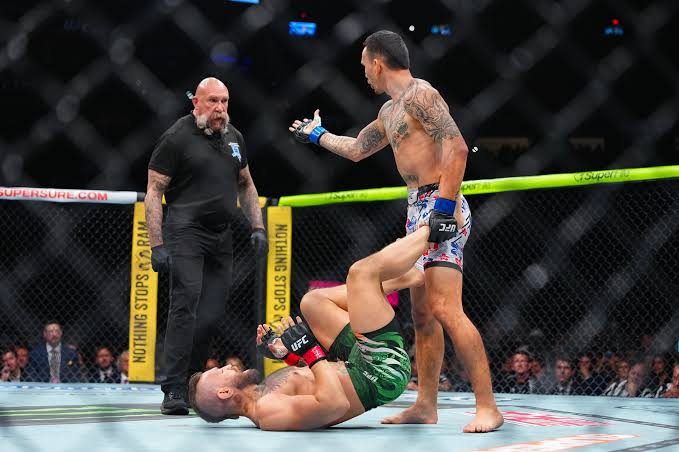
Replays confirmed what everyone suspected. The injury happened on that first aggressive kick. McGregor had drilled the move throughout camp. His coach John Kavanagh later said it had never been an issue in training or even in the backstage warm-up. It just went. Later medical confirmation showed a torn ACL and meniscus in the right knee—the same combination of injuries McGregor suffered in the opposite knee during their first meeting in 2013. History repeating itself in the cruelest way possible.
Top Highlights From the Night
Even though the main event was a non-fight, the card still delivered moments:
- The main event injury sequence: McGregor’s first attack, the awkward landing, the repeated buckling, Holloway’s visible concern, and Beltran’s stoppage. The entire sequence lasted just over a minute but will be replayed for years.
- Paddy Pimblett’s quick work: In the co-main, Pimblett submitted Benoit Saint-Denis with a D’Arce choke in under a minute of the first round. A statement performance after previous setbacks.
- Mario Bautista’s decision win: Bautista took a unanimous decision over Cory Sandhagen in a competitive bantamweight bout that went the distance.
- Brandon Royval’s submission: Royval finished Lone’er Kavanagh with a rear-naked choke in the third round.
- King Green’s late TKO: Green stopped Terrance McKinney with punches in the closing seconds of round one.
- Holloway’s post-fight grace: While the crowd was restless, Holloway’s call for a third fight and his respect for McGregor’s toughness stood out as one of the classier moments of the night.
The rest of the undercard had its share of finishes and decisions, but none of it could overcome the anticlimax of the headliner.
What It All Means
McGregor’s record now sits at 22-7. He has lost three straight and four of his last five. The pattern of lower-body injuries—first the left leg against Poirier, now the right knee against Holloway—is hard to ignore. He later confirmed the full diagnosis and expressed confidence he could return by summer 2027 with modern recovery methods. He has already called for a “Last Dance” trilogy fight with Holloway during International Fight Week next year, framing it as the final bout of his current UFC deal. Holloway has been open to it, though he also has options at lightweight or welterweight for title contention.
Holloway moves to 28-9 and proved once again that he is willing to meet the moment, even when the moment turns strange. His willingness to move up in weight and take the biggest available fight speaks to the same competitive fire that has defined his career. Whether a third fight happens will depend on McGregor’s recovery and the UFC’s appetite for another high-profile McGregor payday.
For fans the night was a gut punch. Five years of waiting, endless promotion, sold-out arena, and it ended before most people had settled into their seats. Combat sports are unforgiving like that. Bodies break. Timing fails. The story you thought you were watching can turn into something else entirely in the space of a single kick.
McGregor has always been larger than life—brilliant, polarizing, capable of both magic and self-destruction. This night belonged more to the latter. Holloway walked away with the win, the respect of the room, and the moral high ground. The trilogy talk will keep the conversation alive, but for now the image that lingers is McGregor on the canvas, right knee compromised, the comeback that never really started already over.
UFC 329 will be remembered less for what happened in the cage and more for what failed to happen. Sometimes the biggest fights are the ones that never get the chance to breathe.