
Islam Makhachev Makes History: How the Dagestani King Turned Back Ian Machado Garry at UFC 330
Philadelphia’s Xfinity Mobile Arena was loud on the night of August 15-16, 2026, the kind of loud that only comes when a sellout crowd of nearly 20,000 knows it’s watching something that might end up in the history books. UFC 330’s main event delivered exactly that. Islam Makhachev, already the undisputed welterweight champion and former lightweight king, walked out with a chance to do what no one had done in more than a decade: break Anderson Silva’s record of 16 consecutive UFC wins. Standing across from him was Ian Machado Garry, the tall, confident Irishman billed as “The Future,” chasing the first Irish UFC title since Conor McGregor and the chance to dethrone the pound-for-pound No. 1 in the process.
By the time the judges’ scores were read—49-46, 49-46, and 48-47, all for Makhachev—the Russian had his 17th straight victory, his first successful defense of the 170-pound belt, and another chapter added to a career that already feels legendary. It wasn’t a clean sweep or a highlight-reel finish. It was a gritty, often ugly, highly technical five-round war that showcased everything that makes Makhachev special and everything that still makes Garry dangerous. Here’s how it all unfolded, from the long buildup to the final horn.
The Buildup: Two Paths to Philadelphia
Makhachev’s journey to this fight felt almost inevitable. After dominating the lightweight division with four successful title defenses and a résumé that included finishes of Charles Oliveira, Alexander Volkanovski (twice, in different ways), and Dustin Poirier, he made the move up to welterweight. In November 2025 he took the vacant (or newly captured) 170-pound strap by controlling Jack Della Maddalena over five rounds. At 34 years old, with only one career loss dating back to 2015, Makhachev carried the aura of a man who simply does not lose. Khabib Nurmagomedov’s influence still hovered over every walkout, every training camp photo, every post-fight interview. The wrestling was elite. The pressure was constant. The calm under fire was unmatched.

Ian Machado Garry arrived with a different kind of momentum. The 28-year-old from Dublin had reinvented himself after a tough unanimous decision loss to Shavkat Rakhmonov in late 2024. He bounced back with decision wins over Carlos Prates and former champion Belal Muhammad, using his length, varied kicking game, and improving grappling defense to climb the rankings. At 6-foot-3 with a significant reach advantage over the 5-foot-10 Makhachev, Garry represented the classic stylistic puzzle: a rangy striker who could keep distance, punish entries, and force the champion to work harder than usual for his takedowns. Pre-fight talk was relatively respectful by modern UFC standards—Garry repeatedly praised Makhachev’s team and skill, while Makhachev acknowledged the challenger’s size and athleticism—but the undercurrent was clear. Garry believed he had the tools. Makhachev believed the tools wouldn’t matter once the fight hit the mat.
The stakes were obvious. For Makhachev it was history plus the chance to prove the move up in weight hadn’t diluted his dominance. For Garry it was the opportunity to become a national hero and the face of a new generation at 170 pounds. Oddsmakers made Makhachev a clear favorite, but the height and reach differential, combined with Garry’s recent form, kept the door open for an upset narrative.
Style Clash and Pre-Fight Analysis
On paper the matchup looked classic. Makhachev’s game is built on chain wrestling, smothering top control, and opportunistic striking that has improved dramatically over the years. He doesn’t need to win the striking exchanges if he can dictate where the fight takes place. His takedown accuracy historically sits around 50-plus percent, and his control time numbers are among the best the sport has ever seen. Once he gets a body lock or a single-leg, the fight often becomes a draining exercise in survival for the opponent.
Garry’s path to victory required keeping the fight standing as much as possible, using his 74-inch reach and diverse arsenal—oblique kicks, body kicks, high kicks, and a sharp jab—to disrupt Makhachev’s rhythm. His takedown defense had been solid enough against good wrestlers, and his cardio had carried him through multiple five-round decisions. The Irishman also carried real power in his hands and kicks; if Makhachev overcommitted on an entry, Garry had the tools to make him pay.
The big questions were simple. Could Garry stuff enough takedowns to force Makhachev into extended striking exchanges? Would Makhachev’s improved stand-up allow him to close distance safely? And how would the champion’s gas tank hold up against a taller, longer opponent who could force him to work for every inch of control? Most analysts expected Makhachev to eventually impose his will, but few predicted an easy night.
Top Highlights and Round-by-Round Breakdown
The fight itself delivered drama almost immediately.
Round 1 belonged to the champion’s wrestling. Early leg kicks from Makhachev set the tone before he shot a single-leg and put Garry on the mat. What followed was classic Makhachev: heavy pressure against the fence, knees to the legs, constant hand-fighting, and the refusal to let Garry stand cleanly. Garry stayed composed and worked back to his feet multiple times, but he spent large chunks of the round defending rather than attacking. Control time piled up. The round was clearly Makhachev’s.
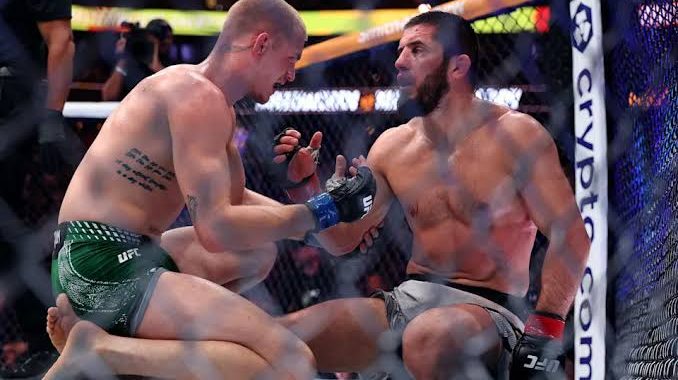
Round 2 produced the fight’s signature moment. After some early kicking exchanges and a brief clinch, the fighters separated. Makhachev stepped in and unleashed a clean left head kick that dropped Garry hard. The arena exploded. Makhachev swarmed, secured a takedown, and moved into side control, raining punches and elbows. Garry somehow weathered the storm, scrambled, and survived the round, but the damage was done—both on the scorecards and psychologically. That knockdown remains the clearest highlight of the night and the moment many thought the fight might end.
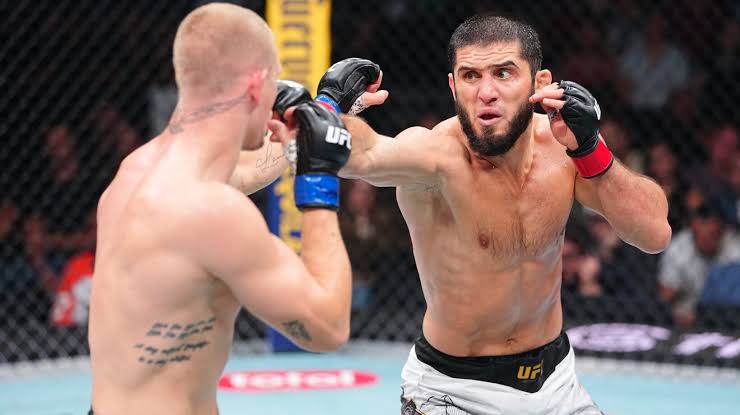
Round 3 saw Garry find his rhythm. Using distance and volume, he landed kicks to the body and legs, mixed in punches, and forced Makhachev to respect the striking. Control time dropped sharply. Garry bloodied the champion’s face in the clinch and won the round on most scorecards. It was the challenger’s best stretch and proof that he belonged at this level.
Round 4 was more competitive and somewhat messy. Garry continued to land the cleaner shots at range and in the clinch. Makhachev hunted takedowns and eventually secured positions, including a notable slam after lifting Garry. Control returned to the champion in stretches, but the striking volume favored the Irishman. Judges split on how to score it; some saw Garry’s activity, others Makhachev’s pressure and the cumulative effect of the wrestling.
Round 5 decided everything. Garry started strong, landing early punches and a body kick, looking like a man who believed the fight was close. Then Makhachev timed a takedown, got Garry down, and transitioned to the back. From there it was pure control—body triangle, short punches, constant pressure—until the final horn. The late surge sealed the decision and the record.
Official numbers told the story clearly: Makhachev landed 7 of 15 takedowns and accumulated 12 minutes and 30 seconds of control time against Garry’s 34 seconds. Significant strikes favored Garry 29-22, and total strikes were close, but the judges valued the wrestling and the big moments. The knockdown in Round 2 and the late back-take in Round 5 loomed largest.
What the Fight Revealed
Makhachev once again showed why he sits atop the pound-for-pound rankings. Even on a night when his striking volume was relatively low and Garry made him work harder than many expected, the champion found a way. The head kick proved his stand-up has real finishing threat. The late-round surge showed championship-level composure and conditioning. And the sheer volume of control time reaffirmed that his grappling remains the best in the sport at 170 pounds. Breaking Silva’s record in a competitive fight against a legitimate contender only adds to the achievement. Silva’s streak was built in a different era against different competition; Makhachev’s has come against modern elite opposition across two divisions.
For Garry the night was bittersweet. He proved he can hang with the absolute best. He outstruck the champion in significant strikes, survived the worst moments, and forced Makhachev into one of his harder nights. The respectful post-fight demeanor—embracing Makhachev, raising his arm, offering no excuses—won him points with many fans and media. At 28 he still has years ahead of him. The loss drops him to 17-2, but the performance should keep him near the top of the division. Questions remain about whether the ultra-respectful approach helps or hurts his marketability and future title opportunities, but the skill is undeniable.
The fight also highlighted the evolution of the welterweight division. Makhachev’s presence raises the bar. Contenders now know that volume striking alone may not be enough; they must solve elite wrestling under championship pressure. Garry’s showing suggests length and technical kicking still have a path, but it requires near-perfect execution for five full rounds.
The Bigger Picture and What’s Next
Makhachev leaves Philadelphia as the clear No. 1 fighter in the world and the owner of the longest win streak in UFC history. At 29-1 overall and 18-1 inside the Octagon, with title wins in two weight classes, the GOAT conversation is no longer premature. Whether he continues at welterweight or eventually eyes bigger challenges, his place among the all-time greats is secure. Potential next opponents include rising threats like Michael Morales or other ranked contenders who can force different looks.
Garry will almost certainly remain a top contender. A bounce-back win against another ranked name should put him back in the title mix relatively quickly. His combination of size, skill, and youth makes him a perennial threat.
UFC 330 itself was a solid card headlined by a historic main event and a successful strawweight title defense by Mackenzie Dern. But the night belonged to Makhachev. In an era of highlight-reel knockouts and social-media rivalries, he continues to win the old-fashioned way: by being better, smarter, and more relentless than the man in front of him.
The head kick that dropped Garry will live in highlight packages for years. The late-round control that locked up the record will be studied by coaches and fighters. And the image of Makhachev standing in the center of the Octagon, still champion, still undefeated in the modern era of his career, will define the night. Anderson Silva’s record is gone. Islam Makhachev’s reign continues. And the welterweight division just got another reminder of how hard it is to take a belt from a Dagestani king.