

A gloriously daft Victorian romp that rewards every stupid idea you can think of
I finished Heir of the Dog last night with a stupid grin on my face and a notebook full of half-legible scrawls about eel passwords and wind currents. That feels about right. This is the sort of game that makes you scribble things down, talk to the screen, and occasionally shout “oh you absolute bastards” when a solution finally clicks. It is also one of the funniest point-and-click adventures I’ve played in years.
Tall Story Games started this whole thing as a two-week game-jam project called Hair of the Dog back in 2020. It was free, fully voiced, and somehow pulled in tens of thousands of players. The response was strong enough that they went back, expanded it, Kickstartered it (Ron Gilbert was among the backers), and turned it into a proper full-length adventure. You can feel that history in the best way. The game has the energy of something that began as pure playful experimentation and then got carefully, lovingly fleshed out without losing the spark.
You play Cummerbund Bandersnatch, a likeable upper-class twit with a name that already tells you everything you need to know. After a mysterious explosion over London, he visits his eccentric uncle’s laboratory, finds a formula promising a “good time,” and does what any reasonable person in a comedy would do: he drinks it. The result is a rather hairy problem. From 8pm to 8am every day he transforms into a dog (top hat still firmly in place, because that’s where the inventory lives). By day he’s the dapper, slightly dim human again. The pocket watch lets you wind time forward and switch forms at will. That dual nature is the heart of the game.
The joy of being wrong
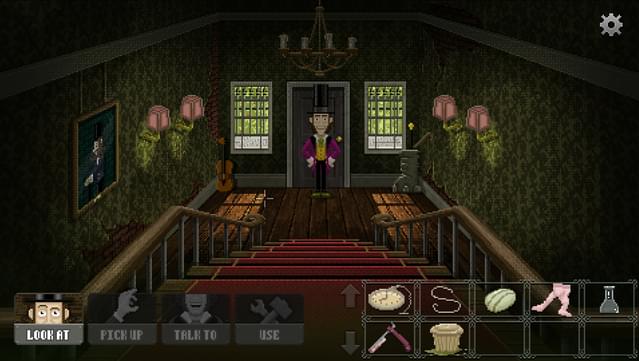
Most adventure games punish curiosity. Try the wrong thing and you get a bland “That doesn’t work” or, worse, a soft-lock. Heir of the Dog does the opposite. Wrong answers are frequently funnier than the right ones. The writing is so thorough that almost every sensible (and plenty of completely absurd) combination of verb and object has a specific, often hilarious response. Experimenting stops feeling like failure and starts feeling like the main event. I spent a solid twenty minutes at one point just combining random objects because the dialogue kept making me laugh.
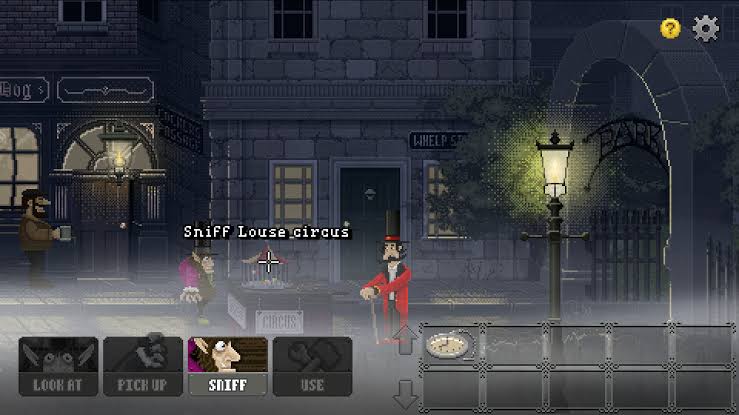
The verb system is old-school. Look, Pick Up, Speak/Sniff, Use. As a human you chat; as a dog you sniff. The difference is more than cosmetic. Locations open or close depending on the form. Clues that polite conversation would never yield become obvious when you’re on all fours. A locked door in daylight can become an open invitation after dark. It forces you to think in layers — time of day, physical form, social access — and the best puzzles exploit all three at once.
There are some proper classics in here. One late-game sequence involving a hot-air balloon and three overlapping maps of wind currents at different altitudes had me muttering to myself for ages before the solution snapped into place. Another requires you to work out a changing animal password for a tug-o-eel contest by cross-referencing a cryptic poster with a set of beach statues. These are the kind of puzzles that feel fair once you see them, even if they demand attention and a bit of note-taking. The game never relies on pure moon logic, but it does expect you to observe, remember, and connect ideas across different times and places.
Not every puzzle is a triumph. A few require very specific verb use that isn’t well signposted, and there is a maths conversion section involving nonsense Victorian measurements that nearly broke me. Pixel-hunting crops up occasionally. The early hours can feel a touch slow while the world is still small and the tone is still finding its feet. But the rough edges never last long, and the humour is usually there to carry you through the sticky bits.
Characters, voice, and pure British nonsense
The cast is excellent. Sally Beaumont, Shaun Mendum (Baldur’s Gate 3), Alasdair Beckett-King and others deliver every line with perfect comic timing. Even the minor characters feel distinct. There’s a louse named Hugo who hitchhikes on Cummerbund early on and becomes your helpful (and endlessly complimentary) assistant. Street urchins, a pompous newspaper editor, a big-game hunter called Sir Reginald Spamhammer, talking dogs, and a host of other oddballs populate the foggy streets. The writing is packed with innuendo, pop-culture winks, visual gags (“Child Labour Available Upon Request”), and that very specific strain of dry, slightly rude British humour that sits somewhere between Blackadder and Monty Python.
The story itself starts simple — find uncle, reverse the transformation, figure out why London’s dogs are vanishing — and then steadily complicates in satisfying ways. There are conspiracies, secret societies, royal connections, and enough red herrings to keep you guessing. I won’t spoil the turns, but the narrative is tighter and more surprising than the setup suggests. It never takes itself seriously, yet it still manages a few genuine emotional beats amid the chaos.
Visually the game sits in the same rough neighbourhood as Thimbleweed Park: detailed pixel art with a muted Victorian palette, lots of dithering, and plenty of environmental storytelling. Animations are smooth and full of personality (watch Cummerbund’s eyes when you select Look). The sound design and music do their job quietly and effectively — jaunty when things are light, more ominous when the plot darkens. Nothing is revolutionary, but everything is done with care.
Length, value, and who it’s for
I took around 15–18 hours to finish, exploring thoroughly and getting stuck a few times. That feels like a generous length for the price. There is a map for fast travel once you unlock it, important dialogue can be repeated, and Hugo will gently remind you of objectives if you ask. The game is happy for you to take your time.
This is very much a love letter to classic point-and-click design with a modern sense of player generosity. If you enjoy Monkey Island, Maniac Mansion, Thimbleweed Park, or Tall Story’s previous game Lucy Dreaming, you will feel right at home. If you bounce off verb interfaces or get frustrated by occasional obtuse moments, you might bounce here too. For everyone else, this is an easy recommendation.
Heir of the Dog is silly, sharp, and endlessly willing to reward curiosity. It started life as a short jam game and grew into something that feels complete without ever losing the playful spirit that made the original special. I laughed a lot, got stuck a few times, and came away genuinely fond of a dim-witted Victorian toff who keeps a top hat on even when he’s a dog. That’s a high bar for any comedy adventure, and Tall Story Games cleared it with room to spare.
Highly recommended. Go on — drink the formula. The worst that can happen is you’ll have a thoroughly good time.
