
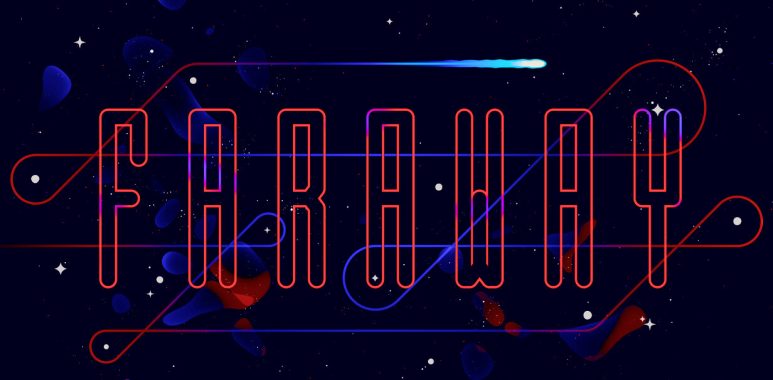
Faraway Review: A Shooting Star That Refuses to Burn Out
I don’t know how many times I’ve said some variation of “less is more” while playing games. Usually it’s a polite way of saying the thing in front of me feels undercooked or half-finished. With Faraway, the phrase finally means something real. Released today, November 5, 2026, on PS5, Xbox Series X|S, Nintendo Switch, Switch 2, and PC, this one-button arcade puzzle game from solo developer Steph Thirion is the rare title that earns its minimalism. It doesn’t feel sparse because the budget ran out. It feels sparse because everything unnecessary got cut away over sixteen years of work until only the purest version of the idea remained.
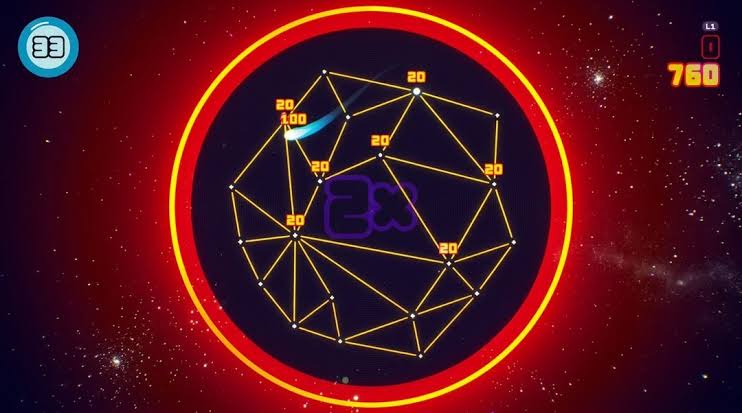
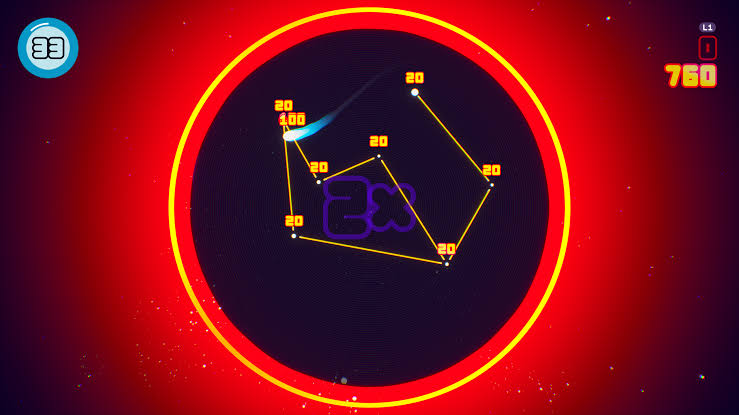
You are a shooting star. Not a metaphor. An actual bright spark streaking through a procedurally generated universe, burning itself out one second at a time. Your only goal is to keep existing a little longer by linking other stars into constellations. Hold the single button as you pass near a star and you latch onto its gravity, orbiting until you release and slingshot yourself in a new direction. Do this well enough, connect enough stars without crossing your own lines, and you harvest energy. That energy buys you more time. More time means bigger zones, higher scores, and the chance to push deeper into stranger regions of space. Fail to keep the chain going and the star simply fades. Game over. Start again from nothing.
That is the entire game. One button. A timer that never stops ticking in the background. A universe that generates itself around how well (or how poorly) you are playing. And somehow, after all these years, it works better than most games that throw a hundred systems at you.
The Long Wait
Steph Thirion is the same person who made Eliss back in 2009, a cult iOS puzzle game that still has a small but devoted following. Faraway was first shown in some form around 2010. Then it vanished into the kind of quiet development hell that usually kills projects. Hardware changed. Trends came and went. Mobile gave way to indie boom and then to whatever we call the current era. Thirion just kept working. Alone. Designing, coding, composing the music. Sixteen years is an absurd amount of time for a game this small. The result is something that feels less like a product and more like a private obsession that finally got invited outside.
Annapurna Interactive picked it up, which makes sense. They have a track record of betting on strange, personal games that don’t scream commercial. Faraway fits right next to the quieter, more contemplative side of their catalog. It is not trying to be the next big narrative experience or a cinematic showpiece. It is trying to be a pure expression of motion, risk, and pattern-making. The fact that it launches on five platforms on day one, including both Switch models, feels almost generous for something this focused.
How It Actually Plays
The core loop is simple to describe and surprisingly hard to internalize. Your star moves forward on its own. Timing the button press is everything. Hold too early or too late and you miss the orbit or latch onto the wrong star in a cluster. Hold too long and you waste energy spinning in place while the clock runs down. Release at the right moment and you can whip yourself across the screen in a graceful arc, lining up the next connection. The physics have a weight to them that feels intentional. Momentum matters. You can feel the difference between a clean slingshot and a clumsy bounce.
When you enter one of the red circular zones scattered through space, the real game begins. Inside these pockets you can draw lines between stars. A constellation forms when you close a shape without crossing existing lines. Points come from every segment you place, but the real juice is in closed loops and complex patterns. The more elegant and risky the shape, the bigger the score multiplier and the more energy you get back. There is a constant tension between playing safe (link a few stars, top up the timer, move on) and going for glory (attempt a huge multi-loop constellation that could either set a new personal best or strand you in empty space with nothing left).
The 16 handcrafted puzzle stages act as a long, patient tutorial. Each one isolates a specific idea or technique. Some force you to think about negative space. Others teach you how to build outward from the center of a zone so you have room to grow. A few are pure spatial logic puzzles that would work even without the timer. Completing them unlocks new possibilities and, more importantly, trains your hands and eyes for the endless mode where the real addiction lives.
Endless mode is where Faraway reveals its arcade soul. Every run starts the same: one lonely spark in an empty field. The universe builds itself in response to your performance. Play well and the starfields get denser, the zones larger, the possible scores higher, and the regions of space more demanding. Play poorly and things stay sparse and punishing. There are leaderboards. There is the quiet pressure of knowing someone else has gone farther than you. The game never shouts about any of this. It just lets the numbers and the growing complexity speak for themselves.
The Feel of It
Visually, Faraway is clean to the point of severity. Dark space, glowing points of light, thin luminous lines that form as you connect stars, soft color shifts that pulse with your actions. Everything is generated in real time. There is no pre-rendered anything. The starfields rearrange, the abstract shapes drift, and the whole thing reacts to how you move. It never tries to be spectacular in a conventional sense. Instead it aims for that particular late-night clarity where the screen feels like a living diagram of something important.
The music is interactive in a subtle way. It starts sparse and grows more structured as you form patterns and keep the run alive. There are little synth cues when you close a loop or hit a high multiplier. Nothing is overbearing. The soundtrack never demands attention; it simply accompanies the motion. After a while the combination of sound, light, and movement creates a genuine flow state. Time disappears. You stop thinking about the button and start thinking in arcs and closures. That is when the game is at its best.
There is almost no narrative. A few lines of text appear now and then, poetic fragments about being a spark that refuses to vanish, about marking trails across firmaments. You can read them as existential, or ignore them entirely. The game does not push either interpretation. The meaning, if there is any, sits in the act of connecting things before they (and you) burn out.
The Friction
It would be dishonest to pretend Faraway is pure bliss from the first second. The learning curve has teeth. The single-button control scheme is elegant once it clicks and frustrating until it does. Early runs often end in stupid ways: you latch onto the wrong star, overshoot a zone, or freeze up trying to plan a constellation while the timer bleeds out. The game is not particularly good at telling you why you failed. It just ends and asks you to try again. Some players will bounce off that opacity hard.
There is also a quiet monotony that can set in during longer sessions. The aesthetic is consistent almost to a fault. The color palette and visual language do not change dramatically even as the difficulty ramps. If you are the kind of player who needs constant novelty or narrative payoff, the endless mode can start to feel like the same beautiful problem repeated. The handcrafted stages help break that up, but once you have cleared them the game becomes a pure high-score chase.
Difficulty options exist. An easier mode slows things down and offers more guidance. It is a smart inclusion. Faraway never feels like it is gatekeeping. It simply asks for patience while your hands learn the timing.
Why It Works Anyway
What keeps pulling me back is the purity of the expression. In an industry that often confuses scale with ambition, Faraway is a reminder that a single tightly tuned idea can still feel vast. The procedural generation is not there to pad length. It exists so that every run can surprise you with new spatial problems. The one-button control is not a gimmick. It is a deliberate constraint that forces creativity. The long development time shows in the balance. Nothing feels accidental. The energy costs, the score multipliers, the way zones scale with performance—all of it has been sanded down until the friction that remains is productive rather than annoying.
There is something almost meditative about the good runs. You stop fighting the physics and start dancing with it. You see a cluster of stars and your hands already know the sequence of orbits that will turn them into a clean constellation before the timer forces you to move on. Those moments of competence feel earned in a way that flashier games rarely manage. When a run finally ends, the quiet that follows is not empty. It is the satisfaction of having drawn something temporary and beautiful in a place that will forget it the second you start over.
Who This Is For
If you like Thumper, or the better Jeff Minter games, or the pure mechanical poetry of classic arcade design, Faraway will feel like home. If you enjoy the quiet focus of Gorogoa or the systemic elegance of Cocoon (both Annapurna titles, not coincidentally), the same sensibility is at work here, just expressed through motion and score instead of story. If you need cutscenes, character arcs, or constant novelty, this will probably feel too thin. That is fine. Not every game needs to be for everyone.
At a price that appears to sit around the ten-dollar mark on PC, the barrier to entry is low. The game supports both short sessions and the kind of “one more run” spiral that can eat an entire evening. It is the sort of title you can leave installed and return to months later, still finding new ways to draw better shapes or push a personal best a little higher.
Final Thoughts
Sixteen years is a long time to spend on a game that asks so little of the player on the surface. The result is something rare: a work that feels complete on its own terms. Faraway does not try to impress you with systems or spectacle. It simply offers a clear idea, executes it with unusual precision, and then gets out of the way so you can lose yourself in the act of making constellations before the light goes out.
There will be bigger, louder, more narratively ambitious games this year. Most of them will not stick with me the way a clean, hard-won constellation does. Faraway is small, stubborn, and quietly excellent. In a medium that keeps chasing scale, that feels like its own kind of rebellion.
It is out now. Go draw some stars while they last.
