

inKONBINI: One Store. Many Stories – Finding Magic in the Midnight Shift
I’ll be honest: I went into *inKONBINI* expecting a cute little cozy sim to unwind with after stressful days. What I got instead was something that quietly snuck up on me and left me staring at the credits with a weird lump in my throat. Released on April 30, 2026, by Nagai Industries (with publishing help from Beep Japan Inc. and others), this game is a short, meditative slice-of-life experience set in a small-town Japanese konbini in the early ‘90s. It’s not trying to blow your mind with systems or drama. It’s about the small stuff—the fluorescent hum, the rustle of plastic bags, the way a regular’s shoulders relax when you remember their usual. And somehow, that’s enough.
You play as Makoto Hayakawa, a college student home for the summer to cover night shifts at her Aunt Hina’s store while Hina takes a much-needed vacation. The konbini—called something like Honki Ponki in the game, I believe—is your entire world for about a week of in-game nights. It’s a one-level building with aisles of snacks, drinks, magazines, and everyday necessities that feel lovingly detailed. No grand quests, no timers breathing down your neck most nights, just you, the store, and whoever wanders in under the streetlights.
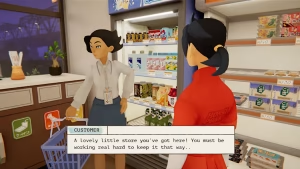
The gameplay loop is deceptively simple. Each shift starts with you prepping the store: checking sticky notes from the day crew (which are charmingly handwritten and full of personality), stocking shelves from the back room, tidying displays, ordering deliveries via the old landline phone, and cleaning up little messes. Then you flip the sign, and customers start trickling in. You scan their items, chat if they’re up for it, and make choices in branching conversations that actually matter. There’s a gachapon machine for capsule toys that adds these tiny dopamine hits of surprise. It sounds basic, and mechanically it is, but the tactile feel of grabbing products off shelves, rotating them into place, and hearing the satisfying little sounds makes it weirdly meditative. Like real-life ASMR retail therapy.
I found myself getting genuinely invested in keeping the place looking nice. Not for points or unlocks, but because the customers notice. They’ll comment if a shelf looks fuller, or if you swapped in a new seasonal item. One night I spent extra time arranging the ramen section just right, and it paid off in the quietest, most rewarding way. There are light friction points—some items can be fiddly to place, and Makoto occasionally gets caught on corners in the back—but they never ruined the vibe for me. They felt like part of the imperfect charm of a real small store.
What elevates *inKONBINI* far beyond a simple store sim is the writing and characters. There’s a small cast of regulars, but each one gets room to breathe across the week. My favorites were Chief, this older guy with decades of history tied to the store and Hina, and young Satoshi, a 12-year-old hustling with his own tiny delivery service so he can afford more gacha toys. Their stories unfold naturally through late-night conversations. You learn why Chief always buys the same ramen, what’s weighing on the night-shift reporter, or how the delivery driver feels about his routes. Choices feel meaningful because they’re about listening, recommending, or just being present—not heroic interventions.
 The game leans hard into the Japanese concept of *ichi-go, ichi-e*—one time, one meeting. Every interaction carries this gentle weight that this moment, with this person, under these buzzing lights, might not come again in quite the same way. It’s nostalgic without being saccharine. The ‘90s setting nails that pre-smartphone quiet: landline calls to Aunt Hina for advice, no constant notifications, just the world slowing down after dark. I caught myself thinking about my own late-night convenience store runs as a younger person—those weirdly intimate chats with the cashier that stuck with me longer than they should have.
Visually, it’s a treat. The art style is cartoonish and vibrant but grounded, with soft lighting that makes the transition from deep night to early dawn feel magical every single time. The konbini itself is packed with interactive details—pick up almost anything and you get a little blurb about it, or a memory. The overhead train tracks visible from the windows hint at a bigger world without ever leaving the store. It’s intimate, like stepping into a slice-of-life anime episode where the real plot is human connection. The soundtrack—soft synth, gentle rock, ambient store hums—perfectly captures that era. I left the game running sometimes just to listen.
At around 6-8 hours for a full playthrough, it’s short by modern standards. Some players have called it too brief or repetitive, and yeah, the core loop doesn’t evolve dramatically. But that brevity works in its favor. It respects your time and delivers a complete, focused experience without padding. I finished it in a few evenings and felt satisfied, not cheated. There are multiple endings or variations based on your choices and how well you connect with people, plus collectibles and achievements to chase if you want. A digital artbook DLC adds extra appreciation for the visuals.
Performance-wise, it runs smoothly on most setups and is Steam Deck Verified, though I saw reports of occasional frame drops that didn’t bother me much during my play sessions. It’s also available on Switch, PS5, and Xbox, making it easy to pick up wherever you like to chill.
There’s been some online chatter about the developer (Dima Shen and team) not being Japanese by birth but living and working in Japan, drawing deep inspiration from the culture. To me, it shows. The game radiates sincere love and respect for the setting—food details, customer habits, the quiet rhythms of konbini life all feel authentic. It reminded me that games are global, and passion plus immersion can create something genuine. I’m glad they addressed the noise directly; the work speaks for itself.
What lingers with me most is how *inKONBINI* made me slow down. In a world of endless notifications and optimization-obsessed games, here’s one that says: stock the shelf properly. Listen to the old man talk about his ramen. Watch the sunrise through the windows while the fan whirs. Appreciate the people who pass through your life, even briefly. It’s not preachy; it just *is*, and that quiet confidence hits hard. I caught myself being kinder in my own daily interactions afterward, like recommending a snack to a friend with extra enthusiasm or just pausing to notice small things.
 Is it perfect? No. The mechanics stay light throughout, so if you crave deep management or replayability galore, you might finish and move on quickly. Some dialogue can feel a touch repetitive near the end, and a couple of interactions lean predictable. Minor typos pop up here and there, which is common in smaller indies. But these feel like nitpicks against the overwhelming warmth.
At its launch price (with a nice intro discount), it delivers excellent value for what it sets out to do. This isn’t a game you “grind”; it’s one you sink into like a warm bath after a long day. Fans of *Coffee Talk*, *Spiritfarer*’s relationship moments, or even chill sims like *Unpacking* will find a lot to love. It’s also a perfect entry point for anyone curious about cozy games who doesn’t want farming or decorating pressure.
Playing *inKONBINI* felt like a brief, meaningful visit to a place that doesn’t exist but somehow feels more real than many triple-A worlds. Makoto’s week behind the counter reminded me that community often lives in the mundane: the shared nod with a regular, the perfect onigiri at 2 a.m., the satisfaction of a well-stocked shelf. In the end, the store thrives not because of perfect efficiency, but because one person cared enough to show up and listen.
If you’re burned out, overwhelmed, or just need proof that games can still capture the poetry of ordinary life, step behind the counter at this little konbini. Flip the sign, stock the shelves, and let the night unfold. You might just walk away remembering why the small stories are the ones that matter most.
I already miss the hum of those fluorescent lights. Highly recommended.
**Score: 8.5/10** – A heartfelt gem that proves less can be so much more.
