
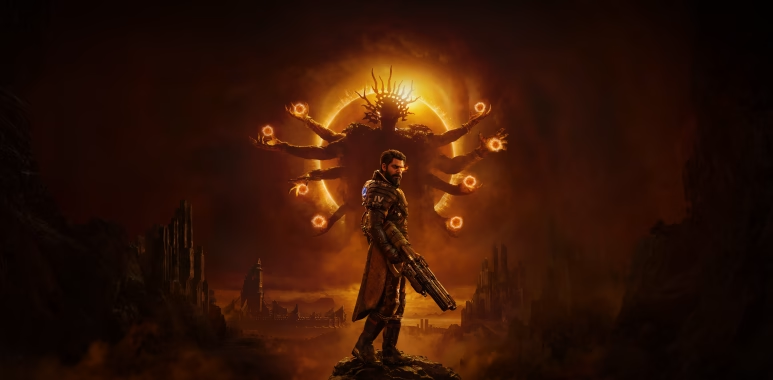
SAROS: Come Back Stronger, But At What Cost?
I’ll admit it right up front: when *SAROS* dropped on April 30, 2026, I was equal parts excited and nervous. Housemarque had already given us *Returnal*, one of those rare games that burrowed into my brain and refused to leave. A spiritual successor (or whatever you want to call it) had big shoes to fill. Would it just be more of the same punishing bullet-hell roguelike on a weird alien planet, or had they actually evolved the formula? After sinking around 28 hours into it on my PS5 Pro, dying more times than I care to count, and finally rolling credits with a head full of questions, I can say this: *SAROS* is better than *Returnal* in almost every way that matters to me. It’s not perfect, but damn if it isn’t one of the most compelling games I’ve played this year.
You play as Arjun Devraj, voiced brilliantly by Rahul Kohli (who absolutely kills it with a performance full of raw desperation and quiet regret). Arjun is a Soltari Enforcer sent as part of Echelon IV to investigate a lost mining colony on the planet Carcosa. The place is under a perpetual, ominous eclipse that twists the environment, drives people mad, and wakes up hostile… things. The story draws from *The King in Yellow* vibes—cosmic horror, lost civilizations, the seductive and destructive pull of power—without feeling like a cheap rip-off. It’s personal. Arjun isn’t just there for corporate profit; he’s searching for his wife Nitya, who was on an earlier expedition. That emotional anchor makes every loop hit harder.
The core loop will feel immediately familiar if you played *Returnal*. You venture out from the central hub (called The Passage), fight through shape-shifting biomes filled with aggressive wildlife and ancient ruins, tackle tough bosses, and eventually die—only to wake up back at base, a little wiser, a little stronger. But here’s where *SAROS* improves things significantly: permanent progression. Every death gives you resources to upgrade your suit, weapons, and abilities back at The Passage. You’re not starting from zero each time. This “come back stronger” philosophy isn’t just marketing fluff; it transforms the frustration of dying into genuine anticipation for the next run.
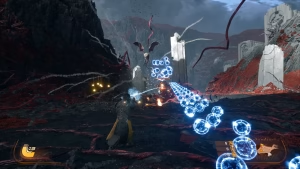
 Combat is pure Housemarque magic. It’s a fluid, third-person bullet ballet where dodging, shielding, and parrying feel incredible. The Soltari Shield is a game-changer—you absorb incoming projectiles, convert that energy, and unleash devastating Carcosan power weapons with your right arm. Adaptive triggers on the DualSense make every gun feel weighty and distinct. One moment you’re laying down suppressive fire with human tech; the next you’re channeling alien corruption into explosive, reality-bending attacks. Enemy patterns are readable but punishing, especially during eclipse shifts when the planet goes full nightmare mode. Boss fights are multi-phase spectacles that had me yelling at the screen in equal parts rage and joy.
What surprised me most was how accessible they made it without watering down the challenge. There’s a “Second Chance” feature that revives you on the spot the first time you die in a run. You can tweak difficulty modifiers, and the permanent upgrades mean even if you’re not a bullet-hell god, you can power through with smart builds. I started on a tougher setting and eventually dialed in some assists because the story pulled me in so hard I didn’t want repeated walls to kill my momentum. Veterans can crank it up and suffer beautifully. That balance feels thoughtful.
Visually, *SAROS* is stunning. Unreal Engine 5 pushes the PS5 (and especially Pro) hard. Carcosa feels alive and wrong in the best way—biomes that rearrange themselves, ruins that pulse with eerie light, particle effects during big fights that fill the screen with beautiful chaos without ever becoming unreadable. The eclipse transitions are breathtaking; the sky darkens, colors invert, and suddenly everything wants you dead in new, creative ways. Sound design is next-level too. Sam Slater’s score mixes dark electronic pulses with haunting ambience that gets under your skin. 3D audio on good headphones lets you track bullets and beasties from every direction. I played a lot of it at night with lights off, and it genuinely messed with my head.
 The hub, The Passage, is where a lot of the heart lives. Between runs you talk to your surviving crew. As the eclipse’s influence grows, people change. Trust erodes. Conversations branch based on your choices and how many times you’ve died. Some characters feel like stepping stones for Arjun’s arc, sure, but others stuck with me—quiet moments of vulnerability amid the corporate sci-fi madness. The game rewards dying in the early game because you get more of these interactions. It’s smart storytelling for a roguelite.
Story-wise, *SAROS* swings for the fences. It’s ambitious, layered, and sometimes a bit opaque. Themes of regret, addiction (Arjun’s past isn’t clean), the cost of power, cycles of abuse, and letting go are woven through logs, visions, and encounters. It’s not always clear, and some players will bounce off the deliberate ambiguity. I loved piecing it together, even if the ending left me staring at the credits thinking for a long time. It’s more emotionally driven than *Returnal*’s isolation, and that contrast works. Rahul Kohli sells Arjun’s pain and determination so well.
Length-wise, a focused run might take 12-15 hours, but chasing full story, all biomes, upgrades, and secrets pushed me to 25+. There’s solid replayability for different builds and higher difficulties. No multiplayer, which is fine—this is a solo journey.
Now, the criticisms. It does feel very much like *Returnal* 1.5 at times. If you were burned out on that formula, this might not convert you. Some traversal sections drag a bit between big set pieces. A few enemy types overstay their welcome. The narrative can feel pretentious in spots, trading clarity for mystery. Dialogue animations outside cutscenes are occasionally stiff. And while permanent progression helps, early runs can still feel like a slog if you’re not clicking with the combat yet.
But those are nitpicks. What *SAROS* gets right outweighs them massively. It respects your time better than its predecessor while keeping the intensity. It looks and sounds phenomenal. The gunplay is addictive as hell. And the story, for all its weirdness, actually made me care about Arjun’s fractured quest for redemption and reunion. In a year full of big releases, this one carved out space in my brain. I kept thinking about it during the day, itching to load back in for “just one more run.”
Housemarque has proven they’re not a one-trick pony. They took what worked, refined the hell out of it, added meaningful progression and a stronger narrative backbone, and delivered something special. *SAROS* isn’t just for hardcore roguelike fans—it’s for anyone who wants intense action wrapped in atmosphere, mystery, and heart.
If you have a PS5, especially a Pro, this is a must-play. It’s the kind of game that reminds you why we love this medium: the rush of mastering chaotic combat, the quiet moments that linger, the satisfaction of finally overcoming something that kicked your ass repeatedly. Every death hurt, but every comeback felt earned.
I’m already thinking about jumping back in on a higher difficulty. The eclipse is calling, and I’m not quite ready to leave Carcosa behind yet.
Score: 7.7/10 – A haunting, exhilarating evolution that sticks with you long after the cycle breaks. Highly recommended.
