

Psycho-Sleuth Review: When You Can’t Trust Your Eyes, Your Ears, or the Corpse on the Floor
I finished Psycho-Sleuth at 3:17 a.m. on a weekday, staring at the credits with the kind of hollowed-out brain fog you only get from a game that has spent the last twenty-something hours rearranging the furniture inside your skull. It’s a death-game visual novel that wears its Danganronpa and Ace Attorney influences openly, then spends most of its runtime quietly undermining the very idea that you can trust anything those games taught you about evidence, testimony, or even your own eyes.
That is not marketing fluff. The central mechanic is called Pathosync, and it is the single best reason this game exists.
The Setup, Without the Usual Death-Game Clichés
Thirteen people with rare cognitive disorders have been summoned to a gothic cathedral controlled by a powerful cult called Li (sometimes referred to as the Logic Church). The rules are simple and brutal: one of you is the “Werewolf.” Kill someone without getting caught and you become a god. Get caught and you are “purified.” The rest of the group has to figure out who did it before the next round begins.
What makes the whole thing feel different is that these disorders are contagious in a very specific way. An Afflicted One can project their distorted perception onto the people around them. A character with a severe form of OCD that makes lying physically impossible can force everyone in the room to tell the truth. Someone with spatial neglect can erase the left side of a crime scene from collective awareness. Prosopagnosia turns every face into a blank. Alien limb syndrome makes people feel their own arms and legs are foreign objects that need to be removed. You get the idea.
These are not just flavor. They are the puzzle. The crime scenes you investigate are already filtered through someone else’s broken sensory machinery, and the testimonies you hear in Debate Mode are filtered through it again. You are never just asking “who is lying?” You are asking whether the body you are looking at is even complete, whether the face you think you recognize belongs to the person speaking, or whether the room itself has a wall that only some people can see.
I have played a lot of mystery games. Very few of them make me second-guess the evidence I just collected because the evidence might literally not exist for half the cast.
Lyle and Lena, and Why the Protagonist Is Not Your Usual Straight Man
You play as Lyle, a young man with an extreme form of synesthesia that has been weaponized into Pathosync. His senses are so overclocked that he can sometimes manifest hallucinations into temporary reality. He is also a professional liar and manipulator who has spent years using that ability to stay alive and protect his younger sister, Lena. Lena’s Pathosync is the truth compulsion—she cannot lie, and under the right conditions she can force the people near her to stop lying as well. Their relationship is the emotional spine of the game, and the game is not subtle about the siscon jokes. It leans into them hard, then later uses that same closeness for some of the darker character work.
Lyle is not an audience-insert everyman. He is actively unreliable. There are stretches where you realize the reason a piece of evidence seemed contradictory is because Lyle’s own Pathosync was quietly rewriting parts of the scene without him (or you) fully noticing. That kind of protagonist is rare in this genre, and PHOSEPO mostly sticks the landing. When the writing is sharp, Lyle feels like a man who has been performing normalcy for so long that he no longer knows where the performance ends. When it is less sharp, he just feels like a walking collection of trauma tropes and one-liners. Both versions show up.
The rest of the cast starts as colorful eccentrics and gradually becomes people. Some of them take longer to land than others. A couple of the more extreme personalities never quite escape their initial “look at my disorder” presentation. Most of them do. By the midpoint I was invested enough that a particular character’s breakdown in chapter three actually made me put the controller down for a minute. The game cares about these people, even when it is busy using their brains as murder weapons.
Debate Mode and the Investigation Loop
Investigation is classic point-and-click with a few Pathosync twists. You poke around environments, talk to the remaining Afflicted, and fill a clue list that will later become ammunition. The environments themselves sometimes change depending on whose perception is currently dominant. It is a clever idea that the game does not always exploit as hard as it could, but when it works it is memorable—finding a bloodstain that only exists if you are standing in the right perceptual “zone” is the kind of moment that makes the whole concept click.
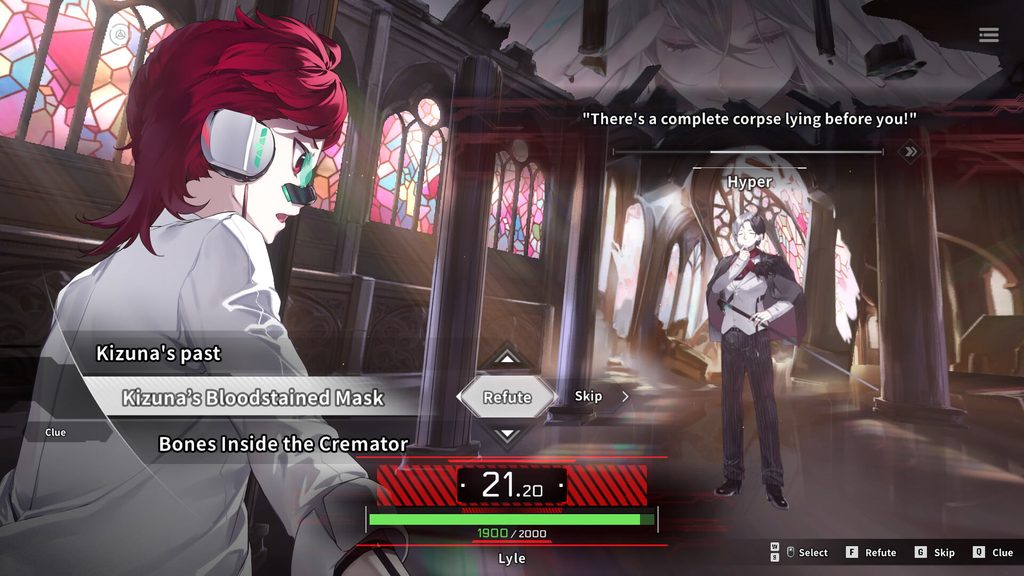
Debate Mode is where the game puts its cards on the table. Characters make statements. You listen, then either accept or refute with the correct piece of evidence under a timer. It is closer to Ace Attorney’s cross-examinations than Danganronpa’s nonstop debates, but the Pathosync rules add an extra layer of “which version of reality is this person currently operating under?” The difficulty is generally fair if you have been paying attention. The grading system at the end of each trial is harsher than the actual fail states; I never game-overed, but I also never got a grade I was proud of. There are a few short bad endings tied to voting decisions after the culprit is revealed, which is a nice touch that makes the moral weight of “execute or elevate” feel slightly less theoretical.
The cases themselves get properly convoluted. Some of the later murders require you to hold three or four overlapping perceptual distortions in your head at once. When the solution finally snaps into place it is satisfying in the specific way only a well-constructed locked-room mystery can be. A couple of solutions lean a little too hard on “because Pathosync,” but the game is usually good about seeding the necessary information earlier so it does not feel like pure authorial fiat.
Presentation: Pretty, Bloody, and Occasionally Uncanny
The art direction is strong. Live2D models for the thirteen main characters have a lot of personality, though a few of the mouth and eye movements still have that slightly rubbery quality Live2D sometimes cannot shake. The CGs are excellent—especially the more grotesque ones. There is a content warning and a censor toggle for the gore, which is appreciated because the game does not shy away from dismemberment, faceless corpses, and other perceptual horrors. The cathedral setting is used well; stained glass, shadows, and limited color palettes do a lot of the atmospheric lifting.
Music is solid. There are over fifty original tracks, and the ones that play during high-stakes debates and revelations hit the right mix of tension and melancholy. Japanese voice acting is present for key scenes and is generally high quality. Full English voice would have been nice, but the localization itself is clean and readable. The script is long—over 500,000 characters—and it shows. This is not a short visual novel. Expect roughly 20–25 hours for a careful playthrough, more if you dig into every conversation.

The Rough Edges
It is not perfect. The first chapter is the weakest, both in terms of character introduction and mechanical teaching. It takes a while for the game to stop explaining Pathosync rules and start trusting you to use them. A few side characters never get the depth the main ones receive. Some of the comedy, particularly the siscon material, will either land as endearing or feel like the writers are a little too pleased with themselves. The presentation, while handsome, never quite reaches the cinematic heights of the best entries in the genre; the camera work and scene composition are competent rather than inspired.
There is also the inevitable question of how tastefully the game treats real cognitive disorders when it turns them into superpowers. Psycho-Sleuth is more interested in the dramatic and puzzle potential than in clinical accuracy or deep psychological exploration. It is not cruel about it, and several characters’ backstories treat their conditions with genuine empathy, but if you are looking for a thoughtful examination of mental health you will come away unsatisfied. The disorders are primarily tools for murder and mystery, and the game is honest about that.
Final Thoughts
I keep coming back to one particular late-game moment. A character is describing a crime scene that, according to every other witness, simply did not look that way. The camera stays on Lyle’s face while the testimony plays, and for a few seconds you are not sure whether the speaker is lying, whether their Pathosync is rewriting the room, or whether Lyle’s own senses have quietly decided that this version of events is the real one. The game does not resolve the ambiguity immediately. It just lets you sit with the uncertainty.
That is the best version of Psycho-Sleuth. Not the flashy executions or the twisty locked-room solutions (though those are fun), but the stretches where it successfully makes you doubt the reliability of the information the game itself is feeding you. In a genre that often treats evidence as sacred and perception as neutral, that is a meaningful achievement.
If you like death games, complicated mystery writing, and protagonists who are allowed to be messy, Psycho-Sleuth is an easy recommendation. It is not the tightest or most polished entry in the genre, but it is one of the more interesting ones to come out in recent years. The Pathosync system gives the formula a genuine new angle, the cast mostly earns the time you spend with them, and the final stretch sticks the landing harder than I expected.

Just do yourself a favor and play it when you have a clear head. The game is already doing enough work scrambling your sense of what is real. You do not need sleep deprivation helping it along.
Score: 8.2 / 10
Strong concept, memorable characters, and murder mysteries that actually make you question the ground under your feet. Worth the price of admission if the premise sounds even remotely interesting to you.
