
Ghost of Yotei: Echoes of Sekigahara
I finished the base game of Ghost of Yotei last winter and put the controller down feeling satisfied, maybe even a little empty in that good way good stories leave you. Atsu’s revenge had run its course. The Yotei Six were handled. The snow on Mount Yōtei looked the same as it always did. I told myself I was done. Then October rolled around, the Complete Edition dropped, and I loaded back in because of course I did. Sucker Punch has a habit of giving you just enough new ground to make the old map feel different again. Echoes of Sekigahara is that kind of expansion. It is not a reinvention. It is a careful, sometimes quiet, sometimes brutal return to the same world with a few new scars and one particular face from the past.
You start it the way most things start in this series: by taking a bounty. After a bit of early-to-mid-game progress in the main story (you do not need to finish the whole campaign), a poster for “Nagato the Handsome” appears on the board. The name alone is enough to make Atsu pause. The man is not some random target. He is someone she knew three years earlier, back on the mainland, during the chaos that ended at Sekigahara. Accepting the bounty opens the Ashoro Foothills, a previously locked valley on the eastern side of the map. That is the new playground, and it is the best reason this DLC exists.
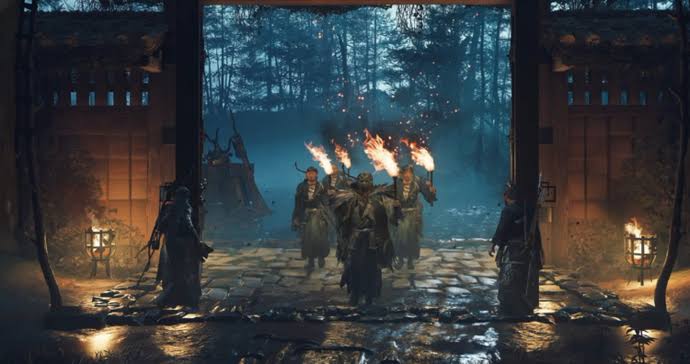
The Ashoro Foothills feel smaller than the main regions of Ezo, but they are denser. The land has been chewed up by the Vipers, the remnants of The Snake’s old crew who are now fighting among themselves for whatever scraps of power are left. There are still the usual open-world rhythms—fox dens, hot springs, shrines, the occasional wandering musician—but the tone is different. The woods feel more used up. Trees have been cut for fortifications. Animal trails lead to butcher sites. The Vipers are not just bandits; they are strip-mining the valley to feed Lord Saito’s larger war machine. That framing gives the side activities more weight than the usual “clear the camp, free the villagers” checklist. One longer side thread involving The Snake’s family business is especially good at showing the slow, ugly aftershocks of Atsu’s early actions. Revenge is never clean here, and the DLC is willing to sit with that for a while.
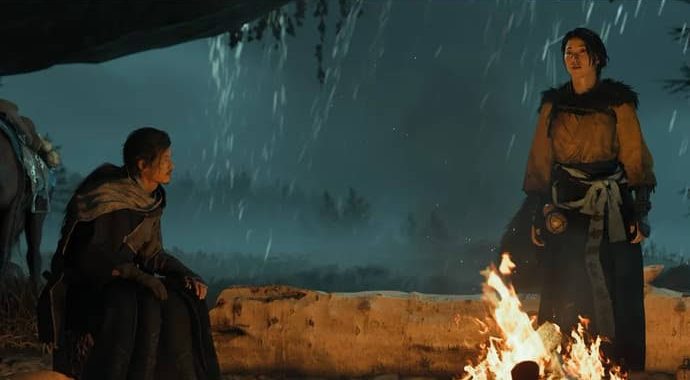
The main story is built around Atsu and Nagato traveling together through this mess. He is charming in the way that makes you distrust him on principle, and the game knows it. Their conversations are the real engine of the expansion. There is banter, old arguments, and the careful dance of two people who once trusted each other with their lives and no longer know how to stand in the same clearing. Short, playable flashbacks drop you into their time on the mainland before and during the Battle of Sekigahara. These sequences are not long, but they are effective. You see a younger, less hardened Atsu. You see the beginning of whatever they had, and you see how the machinery of war ground it down. The writing does not over-explain. It trusts the performances and the quiet moments between fights. I found myself caring more about the space between the two of them than about the next Viper lieutenant I had to put in the ground.
Combat is still the star of the show, and the expansion is smart about how it uses it. The core rock-paper-scissors weapon system is unchanged, which is fine because it was already excellent. What is new are the Massive Weapons—giant clubs, axes, and the like that heavier enemies drop or that you find on racks in camps. They are temporary, they break after a short flurry, and they feel fantastic. There is something deeply satisfying about turning an armored brute’s own weapon against him and just swinging until the armor gives. You also get bolas for temporary crowd control. Nagato himself is useful in a practical way: when you draw your bow, he will often target a second enemy, which leads to clean double kills from stealth or from cover. He is not a full companion AI who carries the fight for you, but he occupies space and creates openings. The frequent stealth sections in the DLC benefit from that partnership.
The new region is full of the same climbing and walking-and-talking sequences that Ghost of Yotei already did well. The Uncharted-style platforming still has weight to it. Reaching a high ridge with Nagato and looking out over the valley never got old. Sucker Punch’s environmental work remains some of the best in the business. The light through the remaining trees, the way fog sits in the low ground, the sudden appearance of a distant peak when the weather clears—these things still stop me mid-traversal. The Kurosawa-inspired presentation in cutscenes is still there, but the real beauty is in the living world between the scripted moments.
Most Wanted is the other half of the package, and it is a different beast entirely. It is a run-based combat challenge mode available from the main menu. You pick a bounty (each themed around one of the Yotei Six), survive waves of enemies and mini-bosses, and eventually face the target. Die and you start the run over. Between rounds you choose from a small selection of perks that can stack into genuinely strong builds. Permanent unlocks for techniques, charms, and weapons are purchased with currency earned across runs. The four playable characters—Atsu, Oyuki, Nagato, and, yes, Jin Sakai with his original stance system intact—feel meaningfully different. Jin in particular is a treat. His movement and the specific rhythm of his stances bring back a different flavor of the series’ combat without feeling like a simple nostalgia trip.
Most Wanted is pure systems play. No exploration, no story, just the combat loop under pressure. Waves get crowded fast, and the lack of a hard lock-on can still bite you when the camera or the targeting decides the wrong enemy is the priority. Those moments are frustrating, especially late in a long run. But the mode is also the clearest demonstration of how deep the combat already was. You start thinking harder about tools, positioning, and resource management. I lost more runs than I care to admit and still kept saying “one more.” That is the sign of a mode that works.
If I have complaints, they are familiar ones. The expansion does not reinvent the formula. Some side content still feels like checklist padding even when it is thematically tied to the larger idea of a wounded region trying to recover. The flashbacks could have been a little longer or more numerous; the most interesting version of Atsu is the one still becoming the woman we meet at the start of the base game, and I wanted more time with her. The ending of the main DLC storyline arrives a touch abruptly after the careful build-up. And Most Wanted, while fun, is not as carefully designed as the narrative half. It is good arcade-style combat with progression, not a revelation.
None of that stopped me from playing through the whole thing twice. The first time I treated it as a focused story campaign. The second time I wandered, finished every bounty and collectible in the foothills, and then sank hours into Most Wanted just to see how far I could push a Jin build. The expansion is roughly seven to eight hours if you stick mostly to the critical path and the better side content. Fully clearing the new region and chasing the extra trophies stretches it further. The $15 upgrade price for existing owners feels fair for what you get. New players can just buy the Complete Edition and have everything in one place.
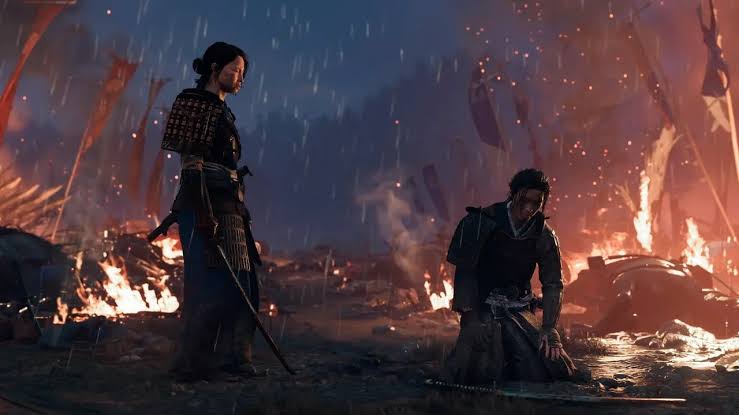
What Echoes of Sekigahara does best is make Atsu feel more complete. The base game gave us a driven, angry, highly competent killer. This expansion shows the cost of that path and the people she left behind or lost along the way. Nagato is a strong foil—charismatic, compromised, and useful both as a narrative partner and as a combat asset. Their relationship is the emotional spine, and Sucker Punch handles it with more restraint than I expected. The new valley is beautiful in the specific, slightly broken way that fits the themes. The combat remains a joy. Most Wanted gives the systems room to breathe without the open world diluting the pressure.
I am not going to pretend this is essential in the way some landmark expansions are. It is not rewriting the series or opening a radically new chapter. It is, however, a very good reason to return to Ezo if you already loved being there. It is more of the same, executed with care, and in a game this well-made, more of the same is still something special. The leaves still move in the wind the way they should. The steel still sings when the timing is perfect. And for a few more hours, Atsu is still out there, carrying every choice she has made, trying to decide whether any of it was worth the price.
If you still have the game installed, the upgrade is an easy yes. If you never played Ghost of Yotei, start with the base game and let this be the dessert. Either way, the foothills are waiting, and the ghosts of Sekigahara have one more story to tell.
