
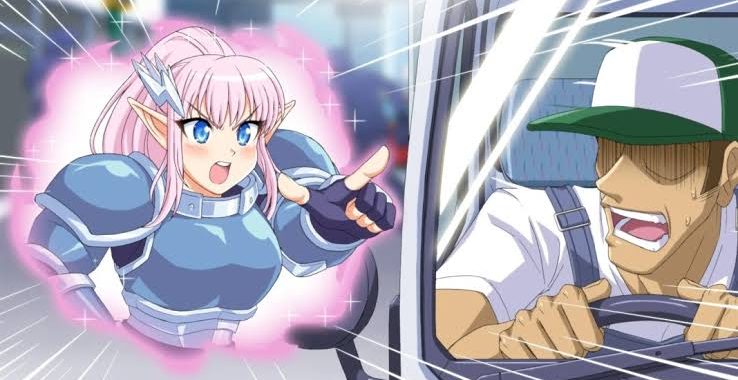
Truck-kun is Supporting Me From Another World?! is the purest expression of “what if the truck that starts every isekai was the real protagonist,” and somehow it mostly works.
Released July 29, 2026, from Strange Scaffold (the same studio that brought us I Am Your Beast and CLICKOLDING) and published by Frosty Pop, this absurdist anime driving game puts you behind the wheel of the infamous Truck-kun. You accidentally hit Carissa Ward, a newly promoted VP of marketing in the sunny coastal town of Wenvale, and send her consciousness into the fantasy world of Talinfold as a buff elf warrior. Now you’re psychically linked, and the only way she gets home is by defeating the Skeleton King and claiming his Scroll of Resurrection. Your job? Drive like a maniac, smash everything in sight, run over pedestrians (who then become monsters she can farm for XP and stars), make deliveries, dodge cops, and keep the chaos going until she can open the Galactic Gate.
It’s Crazy Taxi if it had a Katamari Damacy soul and a deep, unapologetic love for isekai tropes, light novels with titles longer than most novels, and the particular brand of American anime fandom that both mocks and genuinely adores the genre. The game is short—about three and a half to four hours to the credits for most people—and it’s built as an “OVA-sized” experience. That framing is smart. It knows exactly what it is and doesn’t pretend to be more.
The Premise That Sells Itself
The setup is perfect for the bit. Carissa was about to start her big corporate job. You hit her. She wakes up as a legendary hero in a medieval fantasy land. Instead of the usual “gather a party, grow as a person, learn the value of friendship” arc, she weaponizes every isekai trope she knows and immediately starts treating the whole situation like a speedrun. You, the Driver, feel terrible about what happened. She does not care. She needs stars. She needs power. She needs you to keep hitting things.
The writing leans hard into the absurdity without ever becoming mean-spirited. Characters constantly tell you (and themselves) not to think too hard about the moral implications of turning civilians into XP fodder. “It’s fine! Don’t worry! Stop thinking about it!!” is basically the game’s thesis statement. The dialogue between the guilt-ridden Driver and the increasingly powerful, increasingly deadpan Carissa is one of the best parts. She’s knowledgeable about anime and JRPGs in a way that feels specific and lived-in rather than just referential. The game never winks so hard it breaks its own neck, but it also never pretends the situation isn’t completely ridiculous.
There’s a surprising amount of heart under the chaos. The relationship between the two of them grows in a way that feels earned within the short runtime. It’s not deep character study, but it’s warmer and more sincere than a pure shitpost would be. Strange Scaffold has always been good at this—taking something that looks like pure meme energy and finding the human core underneath.
How It Actually Plays
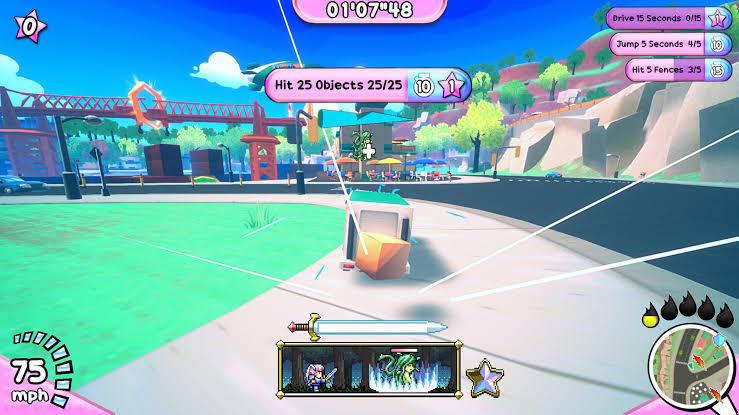
You drive a magic delivery truck around a single cartoonish open city map. Runs start with a timer (usually around 90 seconds, but it can stretch). Objectives appear on the side of the screen: smash X parked cars, get Y meters of airtime, hit Z pedestrians, destroy billboards, deliver packages, sideswipe cops, drift for a certain distance, honk the horn at the right moment, etc. Completing them adds time and generates stars. Stars power Carissa’s progress in the fantasy world, which you can see running in a little window at the bottom of the screen in charming 16-bit Final Fantasy-inspired pixel art.
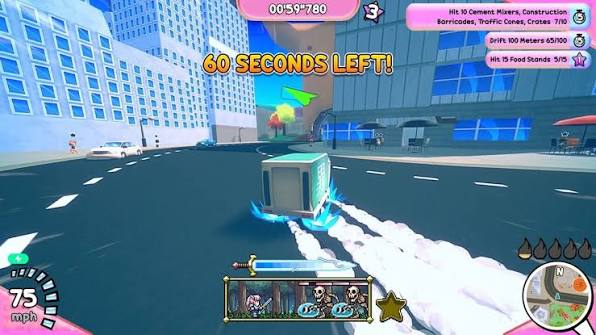
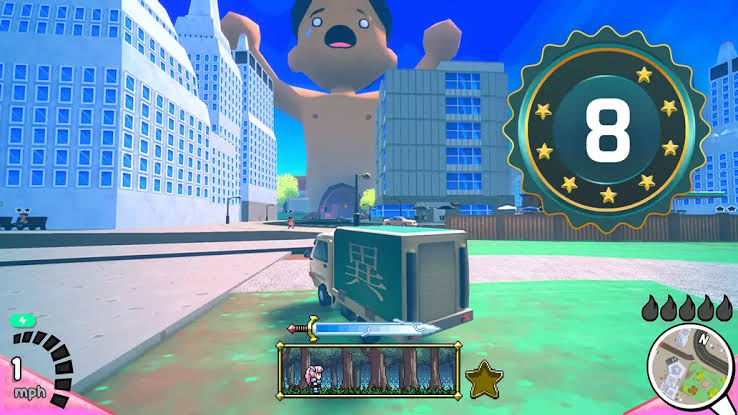
Hitting people sends them to Talinfold as monsters she can fight. Smashing objects and vehicles fills a gauge that lets you trigger her Super Burst by sounding the horn. Deliveries work a lot like classic Crazy Taxi—pick up packages, race to the destination, bank the stars. Police show up once your wanted level climbs. There are phoenix feathers and potion vials scattered around that give bonus time. A giant crying naked man serves as a tunnel for some reason. Don’t think about it.
The driving itself is arcade-loose. Drifting is easy and satisfying. Boost and side-slam abilities help with tougher targets. It feels good when you’re in the zone—whipping around corners, chaining objectives, watching the star count climb while Carissa carves through a stack of enemies below. The feedback loop of destruction-to-power is immediate and addictive in short bursts. The soundtrack, by David Mason (who worked on Dredge), is bombastic and perfectly tuned for high-speed cartoon mayhem. It sells the energy hard.
The map is colorful and packed with stuff to hit, though not always as densely packed with pedestrians as you might want when you’re trying to build a massive monster stack. You start each run in a different spot, which keeps orientation interesting for a while. Once you’ve internalized the layout, though, the same streets start to feel familiar very quickly.
The Limits of the Joke
Here’s the part where the game’s self-aware shortness becomes both a strength and a limitation. Because it’s only one map and the core loop is “drive around causing mayhem until the timer runs out or you hit the star threshold for the next story beat,” repetition sets in. After the first hour or so, you’ve seen most of what the systems have to offer. The remaining time is spent grinding higher star totals and repeating similar objective mixes to push the story forward. Some players will find that loop still fun in short sessions. Others will feel the padding.
There are no alternate maps. No significant progression systems beyond star milestones and story unlocks. The garage for truck cosmetics was promised as a post-launch addition rather than being ready at release. Button remapping was also still coming at launch. The handling can feel a little floaty or overly sensitive depending on your controller and preferences, and occasional input hiccups (especially with side-slam or boost) were reported by some players. None of these are catastrophic, but they add up when the novelty is already doing heavy lifting.
The dual-screen presentation (driving above, Carissa’s auto-battler-ish combat below) is clever and thematic, but the combat itself is mostly passive. You’re primarily generating resources for her rather than actively directing fights in a deep way. It works for the fantasy of supporting her from another world, but it doesn’t evolve much.
Who This Is For
If you love the idea of a Crazy Taxi-style score-attack sandbox fused with isekai parody, and you’re fine with a short, focused experience that doesn’t overstay its welcome, this is an easy recommendation—especially at its price point (it launched around $10–$20 depending on platform and sales). Anime fans who enjoy shows that lean into self-aware comedy (Konosuba energy is the closest comparison) will get a lot out of the writing and the visual gags. People who just want to smash things with a truck for a few evenings will also have a good time.
If you need mechanical depth, multiple environments, long-term progression, or a story that develops beyond its initial high concept, you’ll probably bounce off after the first couple of hours. The game is honest about its scope. It calls itself OVA-length for a reason. Treating it like a full-priced open-world action game would be a mistake. Treating it like a clever, heartfelt arcade riff on a very specific meme works much better.
The Strange Scaffold Touch
What elevates Truck-kun above pure meme cash-in is the studio’s consistent personality. Xalavier Nelson Jr. and the team have a knack for taking high-concept absurdity and grounding it in genuine feeling. The game is silly, but it isn’t empty. The Driver’s guilt, Carissa’s determination and knowledge of genre tropes, the way the two of them end up supporting each other across worlds—these things land because the writing treats them with a kind of affectionate seriousness underneath the jokes. It’s the same sensibility that made I Am Your Beast feel like more than just a power fantasy.
The presentation is clean and readable even when the screen is full of flying debris, pixel monsters, and objective pop-ups. The pixel art for Talinfold is charming. The truck itself has a satisfying sense of weight and momentum once you settle into the controls. The humor never feels like it’s punching down; it’s more like the whole game is in on the joke with you.
Final Thoughts
Truck-kun is Supporting Me From Another World?! is exactly as ridiculous as its title promises, and that is mostly a good thing. It understands the isekai truck meme better than almost anything else has, then builds a playable arcade experience around it that actually feels good in the moment. The short runtime is both a mercy and a limitation. The single map and repeating loop will wear on some players, and the technical roughness at launch is noticeable. But the core fantasy—being the truck that starts the adventure and then having to stick around to finish it—is executed with enough charm, humor, and mechanical satisfaction to make the ride worthwhile.
It’s not a masterpiece. It’s not trying to be. It’s a focused, funny, surprisingly warm little game about vehicular manslaughter, corporate burnout, anime tropes, and the weird bonds we form under absurd circumstances. In a year full of bigger, louder, longer experiences, there’s something refreshing about a title that knows when to hit the gas, when to drift, and when to just let the credits roll after a solid OVA’s worth of chaos.
If the idea of powering up a buff elf girl by running over cartoon pedestrians while making pizza deliveries and dodging the cops makes you smile, just buy it. Don’t think about it too hard. Truck-kun is not guilty. (Okay, maybe a little guilty. But he’s trying.)
Play it in short bursts. Laugh at the dialogue. Enjoy the soundtrack. Help Carissa get home. Then go outside and look both ways before crossing the street, just in case.
