
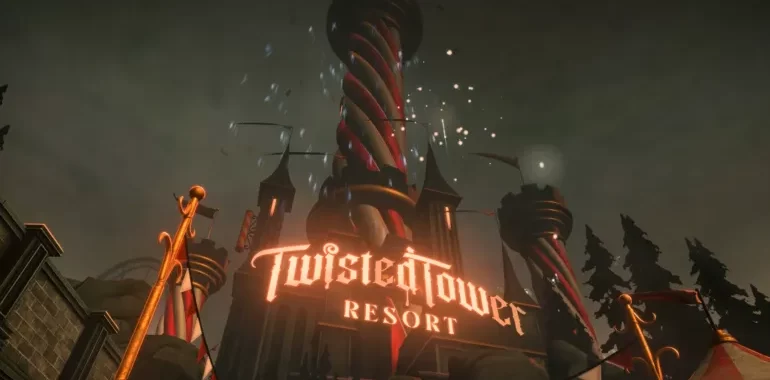
Twisted Tower Review: Climbing the Funhouse from Hell
There’s something about abandoned amusement parks that just hits different. The peeling paint, the silent rides, the sense that the laughter stopped decades ago and never quite left. Twisted Tower, the new first-person shooter from Thomas Brush and Atmos Games, leans all the way into that feeling and then twists the knife. Released on August 18, 2026, for PC via Steam, this is a short, sharp, bloody love letter to BioShock filtered through a 1950s carnival gone rotten. It’s equal parts nightmare and dark comedy, and for the most part, it works like a charm.
I went in expecting a solid indie homage. I came out having played through the whole thing in basically one sitting, then immediately starting a second run. That doesn’t happen often anymore.
The Setup: One Ticket to the Top
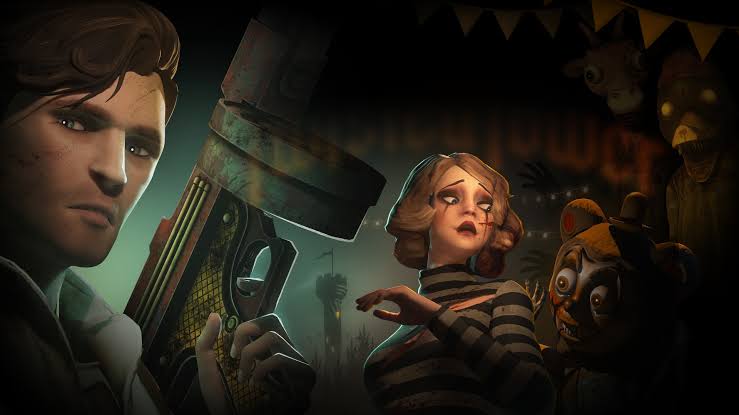
You play as Vincent (sometimes referred to as Tiny in older materials), a young man in the 1950s who’s just proposed to his girlfriend Charlotte at a drive-in. She loves movies. Her favorite is The Twisted Tower, the magnum opus of eccentric filmmaker and toymaker V.C. Twister (or Mr. Twister, depending on how theatrical he’s feeling that day). The next morning, Charlotte is gone. A note under the door makes it clear: Twister has taken her to his abandoned resort, and if you want her back, you’d better climb.
The premise is pure pulp. Damsel in distress, mad genius, deadly game show of a tower. But Brush sells it with enough sincerity and weirdness that it never feels completely cynical. The tower itself is the star—an ever-shifting, multi-floor nightmare that once sold itself as wholesome family entertainment and now serves as a personal playground for someone who never quite left the stage.
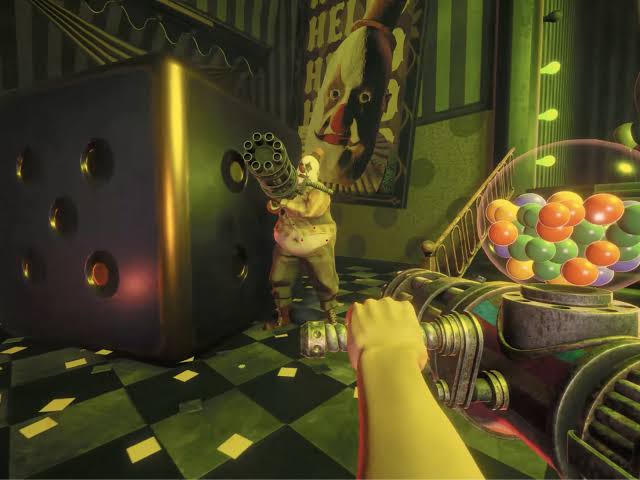
You start with almost nothing. A rubber-band pistol. A whack-a-mole mallet. The kind of toys you’d find in a prize booth if the prize booth had a body count. From there, the arsenal grows in the most delightful ways: a dart-throwing Tommy gun, a shotgun powered by flatulence (yes, really), a bubblegum chain gun, a slingshot that acts like a sniper rifle, a skull-popping ray gun, and more. Everything feels toyish and wrong at the same time. Upgrades come from ticket vending machines scattered through the levels. More damage, bigger clips, the occasional wild alternate fire mode. It’s simple, but it keeps the loop feeling fresh.
Five Floors of Rot and Wonder
The game is built around five distinct levels: the hotel, the waterpark, the clown casino, the carnival forest, and a 1950s-style space station. Each one has its own personality and its own flavor of wrong.
The hotel is pure BioShock art deco decay—grand staircases, dusty ballrooms, advertisements for attractions that never quite worked out. The waterpark is damp and echoing, with rides that look like they could collapse at any second. The clown casino is exactly as nightmarish as it sounds; if coulrophobia is a problem for you, this floor will test you. The carnival forest mixes trees and carnival lights into something that feels both magical and predatory. And the space station is pure kitsch sci-fi, the kind of attraction that would have been the pride of the park in 1958 and now feels like a tomb.
What makes the level design special is the sense that everything is plywood and smoke and mirrors. These aren’t photorealistic ruins. They’re deliberately stagey. You can almost see the seams. That theatrical quality is intentional, and it pays off. The environments feel like sets that have been left to rot after the audience went home for good.
There’s a room-flipping mechanic that deserves special mention. Hit a switch and entire sections of a level invert. Suddenly the ceiling is the floor, new paths open, enemies that were out of reach are now right in your face. It sounds gimmicky on paper. In practice, it makes exploration feel clever instead of just thorough. Secrets are plentiful—ammo, tickets, health, the occasional bit of lore—and the game rewards poking around without making it mandatory.
Combat is fast and punchy. Enemies come in waves of corrupted mascots: killer telephones, teddy bears with too many teeth, clowns that talk about wetting the bed while trying to murder you, and a whole menagerie of fairy-tale rejects that have long since stopped being cute. They attack in manageable numbers most of the time, though larger encounters can get chaotic. The camera can get a little squirrelly when things heat up, and there’s no real defensive tool beyond health pickups and positioning, so you stay mobile or you die. Jump scares exist, but they’re more theatrical than cheap.
Bosses appear at the end of each major area. They’re less “giant health sponge in a small room” and more tests of what you’ve learned so far—using the right tool, the right movement options, the right path. They’re satisfying without overstaying their welcome.
Story and Atmosphere: More Than Just a Rescue
The narrative is the part that sneaks up on you. On the surface it’s a straightforward rescue mission. Underneath, it’s about memory, failure, the stories we tell ourselves, and the gap between the person we want to be and the person we are. Audio diaries and environmental details slowly fill in Vincent’s past, his relationship with Charlotte, and the long shadow of Mr. Twister’s ego. The voice acting is surprisingly strong for an indie title this size. Mr. Twister in particular is a treat—grandiose, theatrical, occasionally pathetic, always dangerous. Charlotte’s presence is felt even when she’s not on screen. The writing walks a fine line between sincere emotion and dark absurdity, and it mostly sticks the landing.
There’s a New Game Plus mode that opens up additional paths and lets you keep your arsenal. The tower really does feel different the second time through. Some of the “secret” areas on the first run feel a bit too obvious, but the second playthrough rewards the people who want to dig deeper.
At four to six hours for a main playthrough, Twisted Tower is short by modern standards. That shortness is both a strength and a limitation. The game never overstays its welcome. Every level feels distinct. There’s no filler. But if you’re the type who wants a forty-hour epic with branching quests and endless side content, this isn’t it. It’s a complete thought, not a platform.
The Rough Edges
No game this ambitious from a small team is flawless. The combat music sometimes clashes with the jazz-club atmosphere of the quieter moments. Weapon upgrades are functional but not especially deep—some of the alternate fire modes feel more like novelties than necessities. A few animations are janky. The camera can misbehave in bigger fights. And while the story has solid twists, some players will want more psychological depth or more lore about how the park became what it is.
There’s also the matter of tone. The game leans hard into potty humor and cartoon violence at times—the fart shotgun is not subtle. Most of the time it works because the darker material is played straight. Occasionally the tonal swing is a little abrupt. One critic found the humor disrespectful in places; most players seem to take it in the spirit of a demented carnival.
Who It’s For
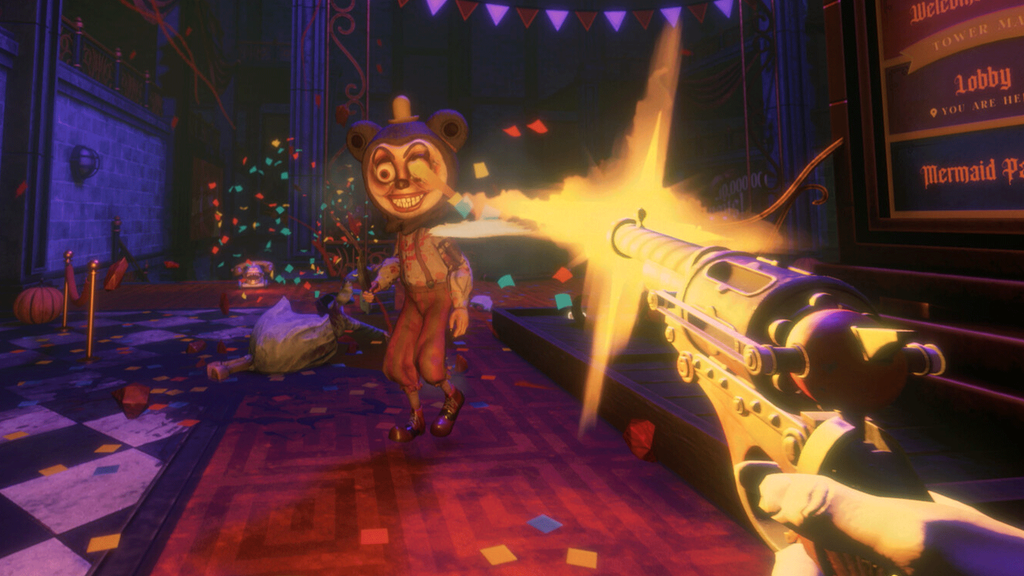
If you loved the original BioShock for its atmosphere and world-building more than its RPG systems, this is for you. If you like short, focused shooters that know exactly what they are, this is for you. If the idea of blasting murderous clowns with a bubblegum gun in a decaying 1950s theme park makes you smile, you’re the target audience.
If you need photorealistic graphics, endless progression systems, or a twenty-hour campaign, look elsewhere. If clowns genuinely freak you out, be warned: there are a lot of them, and they talk.
The Bigger Picture
Thomas Brush has been making games for years—Pinstripe and Neversong both carried his particular mix of melancholy and whimsy. Twisted Tower feels like the project where he got to swing for the fences with the tools and team he needed. The influence of BioShock is obvious and openly acknowledged, but the game never feels like a cheap knockoff. It feels like someone who genuinely loves that style of environmental storytelling and decided to build his own funhouse version of it.
The critical reception has been mostly warm. Metacritic landed around 79 from early reviews, with user scores on Steam sitting in the “Overwhelmingly Positive” range shortly after launch. Some writers called it their favorite game of the year so far. A couple found it derivative or unfinished. That’s the indie shooter experience in 2026: one person’s perfect fever dream is another person’s janky experiment.
At $14.99 (or $13.49 during the launch discount), the value proposition is strong. You get a complete experience with personality, solid combat, memorable environments, and enough secrets to justify a second run. Steam Deck verified is a nice bonus.
Final Thoughts
Twisted Tower doesn’t reinvent the first-person shooter. It doesn’t need to. What it does is take a handful of familiar ideas—decayed grandeur, moral ambiguity, punchy gunplay, environmental storytelling—and dress them up in carnival lights and blood. The result is something that feels both nostalgic and fresh, silly and sincere, short and complete.
I finished the game late at night with the lights low, and when the credits rolled I sat there for a minute just processing. Not because the ending was some world-shattering revelation, but because the whole experience had been so committed to its own strange vision. That’s rare. Most games this size play it safe. This one leans into the weirdness and trusts the player to come along for the ride.
Is it perfect? No. Is it memorable? Absolutely. Will I still be thinking about that clown casino months from now? Unfortunately, yes.
If you’ve been looking for something to scratch the BioShock itch without the bloat of modern AAA, or if you just want a few hours of high-quality carnival horror with toy guns and genuine atmosphere, step right up. The tower is open. The mascots are waiting. And the ticket price is more than fair.
Just don’t expect them to play fair once you’re inside.
