
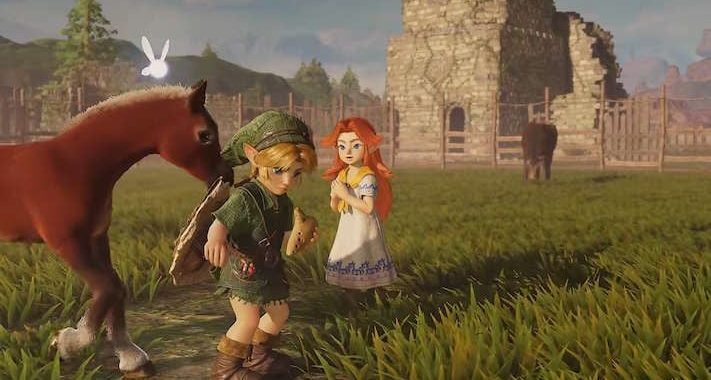
The Legend of Zelda: Ocarina of Time
I still remember the first time the title screen faded in. That soft, almost shy ocarina melody, the way the camera slowly pulled back over Hyrule Field at dusk. It has been nearly thirty years since the original dropped on the N64, and somehow this new version—whatever official designation Nintendo is using this time—still manages to feel like the first time someone handed you the keys to a living fairy tale and said, “Go on, get lost.”
I played the 1998 original as a kid who had never touched a 3D game that didn’t feel like a tech demo. I played the 3DS remaster on a train during a bad year. I watched friends discover it for the first time on emulators, on Switch Online, on whatever device they could find. And now, in late 2026, here we are again. Nintendo has given us another chance to fall into this world, and the world is still waiting with the same quiet patience it always had.
The Weight of Arrival
There is a particular kind of silence that settles over you when you first step out of Kokiri Forest. The trees thin, the music changes, and suddenly the horizon is bigger than anything the game has prepared you for. Hyrule Field stretches out under a sky that still looks painted by someone who loved clouds more than polygons. In this 2026 release the lighting has been gently modernized—sunsets linger longer, the grass moves with a little more personality—but the fundamental feeling remains unchanged. You are small. The world is large. And somewhere out there is a princess who needs you, even if she does not yet know your name.
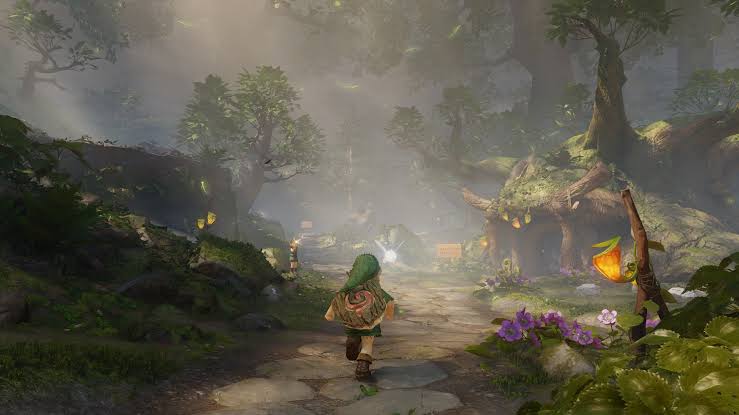
That sense of scale was revolutionary in 1998. It still works. Modern open-world games throw ten times the content at you and somehow feel smaller because they cannot stop explaining themselves. Ocarina of Time never explains more than it has to. It trusts you to wander, to get lost, to notice that the same melody you heard in the forest is now being hummed by a lonely farmer in a different part of the map. That trust is rare.
Link, and the Business of Growing Up
Link does not speak. He never has. In most games that would feel like a limitation. Here it becomes the point. You are not watching a character grow up; you are doing it yourself, one awkward conversation and one failed jump at a time. The child version of Link is pure curiosity with a wooden sword. The adult version carries the weight of seven years that happened off-screen while you were busy learning songs on an ocarina. The transition still hits harder than most games manage with entire cutscenes devoted to trauma.
I have always loved how the game refuses to rush that moment. You do not become the Hero of Time because the plot demands it. You become him because you walked into the Temple of Time, placed the three spiritual stones, and pulled the Master Sword. The world changed while you slept. When you wake up, the people you knew are older, some of them gone, some of them broken in ways a child could not have understood. The game does not lecture you about it. It simply lets you walk through the same streets and feel the difference in your bones.
Dungeons That Still Teach
People talk about the Water Temple like it is a war crime. They are half right and half wrong. The Water Temple is difficult in the specific way that a good puzzle is difficult: it asks you to understand the rules of the space and then use those rules against it. Once you stop treating the iron boots like a punishment and start treating them like a tool, the whole dungeon rearranges itself in your head. That click—the moment the geometry of a place becomes clear—is one of the purest pleasures in gaming, and Ocarina of Time still delivers it better than almost anything that came after.
The Forest Temple remains my favorite. The way it uses the poes and the twisted corridors and the sudden appearance of a phantom to make you feel like the building itself is dreaming. The Fire Temple’s rhythm of elevators and timed jumps. The Shadow Temple’s quiet horror. Even the Spirit Temple, with its dual-age structure, still feels elegant. These dungeons were designed when 3D space was still new territory. You can feel the designers discovering what was possible in real time. That sense of invention has never quite been replicated, even by later Zelda games that had far more technical power.
Combat is simple by modern standards. You lock on, you swing, you use the right item at the right time. Yet the lock-on system—Z-targeting—still feels more precise and more intimate than most modern equivalents. When you circle a Stalfos and wait for the opening, the camera stays close enough that you can almost feel the weight of the shield. Boss fights are theatrical without being exhausting. Ganon’s final form is still one of the best “final boss as pure spectacle” moments in the medium.
The Ocarina Itself
The instrument is the real protagonist. Learning songs is never just a checklist. Each melody rearranges the world in a small, permanent way. You play the Song of Storms and a windmill starts turning differently. You play the Sun’s Song and time itself skips forward. You play the Song of Time and a block that should not move does. The game treats music as a language the world already understands. You are simply learning to speak it.
In this 2026 version the ocarina inputs feel slightly more responsive, and the visual feedback when a song is recognized is cleaner, but the core magic is untouched. There is still nothing quite like standing in the middle of Hyrule Field at night, playing the Serenade of Water just because you can, and watching the notes hang in the air for a second longer than they need to.
A World That Remembers You
Side quests in Ocarina of Time are mostly small. Help a girl find her father. Deliver a letter. Race a man on a horse for a bigger wallet. None of them feel like content designed to pad a playtime metric. They feel like the natural consequence of living in a place where people have problems and you happen to be the only one with a fairy and a sword. The Mask quest in particular still stands as one of the most quietly ambitious pieces of design in the series. You collect masks, you wear them, you watch how the world reacts. Some reactions are funny. Some are heartbreaking. All of them make Hyrule feel more real.
Epona is still perfect. The first time you successfully jump a fence with her, the camera pulls back just enough to let you feel the speed. Later, when you are racing across the field with the sun going down and the music swelling, it is hard not to grin like an idiot. Some joys do not age.
What Has Changed, and What Has Not
This 2026 release is not a full remake in the style of the recent 3D Mario titles. It is closer to a careful restoration with modern comforts. Frame rate is locked and smooth. Load times are nearly nonexistent. The HUD can be toggled into a more minimal state. There is an optional modern control scheme that maps everything more intuitively for players who never held an N64 controller. None of these changes break the spell. The game still looks like a slightly improved memory of itself rather than a completely new object.
The most welcome addition is the ability to mark the map more freely and a gentle hint system that can be turned off entirely. The original game could be cryptic in ways that felt charming in 1998 and occasionally punishing in 2026. The new version respects both the players who want to be left alone and the ones who would rather not spend forty minutes staring at a stone block wondering which song they forgot.
Voice acting is still absent, which is the correct choice. The occasional grunts and the expressive animation of the characters have always been enough. Adding full dialogue would have risked turning a dream into a cutscene.
The Long Shadow
It is impossible to talk about Ocarina of Time without acknowledging what it did to everything that came after. It set the template for 3D adventure games so thoroughly that we still measure new releases against it, often unfairly. Open worlds, lock-on combat, context-sensitive actions, the idea that a single instrument could be both puzzle tool and emotional center—all of it starts here in a more concentrated form.
Yet the game’s greatest achievement is not technical. It is tonal. Ocarina of Time understands that a legend is not the same thing as a power fantasy. Link is powerful, yes, but he is also late. He arrives after the damage is done. His job is not to prevent the fall of Hyrule; it is to walk through the ruins and try to put something back together. That melancholy sits underneath even the most triumphant moments. When you finally stand in front of Ganondorf for the last time, the victory does not feel clean. It feels earned and exhausted at the same time.
Personal Inventory
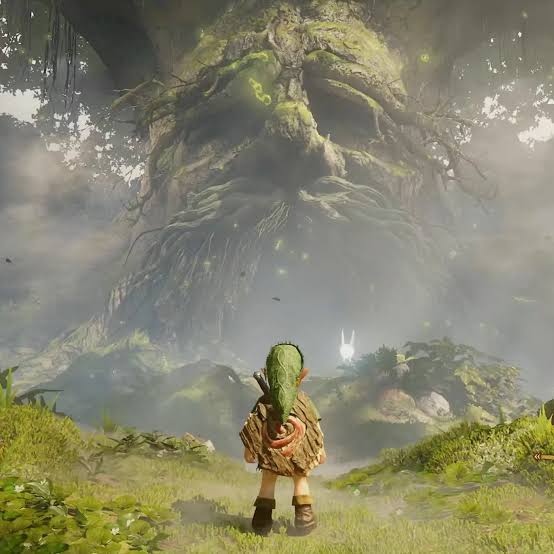
I have finished this game more times than I can count. Every playthrough I notice something new. A NPC who only appears at a certain time of day. A secret grotto I somehow missed for twenty years. The way the light hits the stained glass in the Temple of Time when you are a child and again when you are an adult. These are small things, but they accumulate into a feeling of genuine place.
There are flaws. The camera still fights you in tight spaces if you let it. Some of the item management feels archaic until you remember the N64 only had three C-buttons that mattered. The fishing minigame remains simultaneously relaxing and slightly broken in the way only a Zelda fishing minigame can be. None of these things matter much once the credits roll and the final image of Link and Navi fades.
Final Notes
Playing Ocarina of Time in 2026 is a strange, lovely experience. The game is old enough to be history and still immediate enough to feel like a secret being told for the first time. It does not try to compete with the density of modern open-world titles. It does not need to. It offers something quieter and, in the end, more lasting: the feeling of being a child handed a sword and an instrument and told that the world is bigger than you thought, and that you might be able to help it anyway.
If you have never played it, this is as good a time as any. The new version removes most of the friction without sanding away the soul. If you have played it before, the game will still find ways to surprise you. It always does.
Some legends improve with age. This one simply refuses to leave.
