
Midnight Moments Review
The kind of game that sneaks up on you. Not with some flashy trailer promise or a big marketing push, but with the quiet insistence that maybe you just need a place to sit for a while. Released on July 30, 2026 by Belgian studio Happy Volcano, this small cyberpunk diorama builder costs almost nothing—around three bucks with the launch discount—and asks almost nothing of you in return. No objectives. No timers. No fail states. Just vibes. And somehow, in a year full of loud, demanding games, that feels like a genuine gift.
I fired it up the evening it dropped, half-expecting something pretty but thin. What I got instead was a little rain-soaked corner of a neon city that I kept coming back to long after I meant to close the laptop. It’s the digital equivalent of staring out a window at night while the world outside keeps moving and you don’t have to.
The Premise Is Almost Embarrassingly Simple
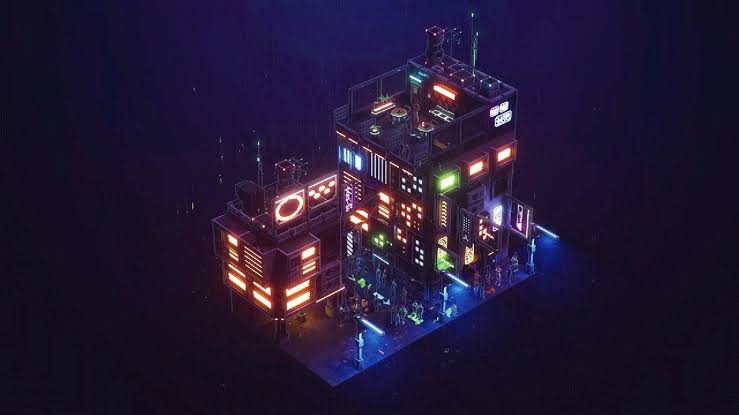
You build. That’s it. You stack modular buildings, thread narrow alleyways between them, hang neon signs that still drip with rain, plant rooftop gardens, stick antennas on the roofs, and then zoom in and start filling the spaces with people and props. A vending machine glowing under a streetlamp. A couple standing too close under an awning. Someone sitting alone on a fire escape with a cigarette. A bouncer outside a club door that never opens. You place them, you arrange them, and then you step back and just… look.
The game never tells you what the scene is about. It doesn’t need to. The stories form themselves in your head the same way they do when you’re walking home late and notice a lit window on the third floor. Who lives there? Why is that person still awake? That quiet narrative space is the whole point.
Happy Volcano has described the feeling they’re chasing as looking out from a warm apartment into the rainy city below—part of it, but also safely apart. That lands. The rain is constant. The neon is soft rather than aggressive. The color palette lives in deep blues, wet asphalt grays, and the occasional warm spill of yellow light from a shop window or apartment. It feels like the visual language of late-night lofi playlists given physical form.
Building Without the Usual Pressure
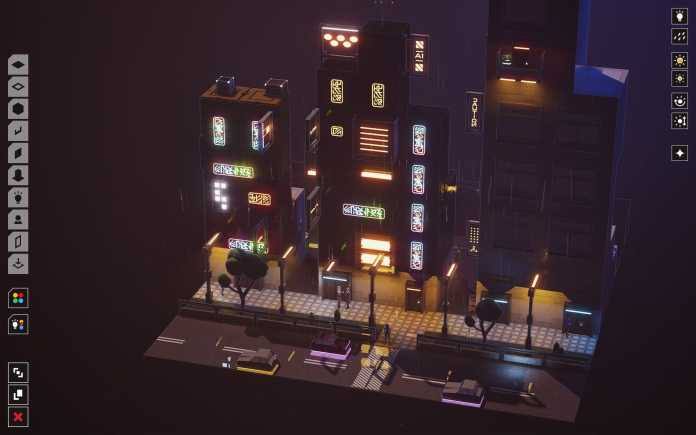
If you’ve played Townscaper, you’ll feel immediately at home with the stacking logic. Buildings rise in modular chunks. You can focus on a single storefront or expand into a whole neighborhood corner. Alleys form naturally when you leave gaps. Rooftops become little stages of their own—antenna farms, laundry lines, tiny green spaces that feel like secrets. The controls are simple enough that you stop thinking about them after ten minutes. Mouse and keyboard, no complicated menus, just place and rotate and delete if something feels wrong.
What surprised me is how quickly the scenes start to feel lived-in. The citizens aren’t animated in any elaborate way, but their stillness works. A figure leaning against a wall at 2 a.m. doesn’t need to pace. The rain does the moving for them. Light pools under lamps. Reflections shimmer on wet pavement. You can spend a long time just orbiting a finished block, adjusting the camera angle, watching the weather do its quiet work.
I built three different scenes in my first proper session. One was a tight residential alley with laundry strung between buildings and a single convenience store glowing at the end. Another was a wider street corner with a nightclub entrance, a food stall, and a few people waiting under umbrellas that never quite keep the rain off. The third was pure rooftop territory—gardens, satellite dishes, a couple of chairs facing the city. None of them were “complete.” That’s not how this game works. You stop when the mood feels right, and then you come back later and change something.
Atmosphere Is the Real Feature
The sound design and music do a lot of the heavy lifting. Soft rain. Distant traffic that never gets loud. A low ambient bed that sits somewhere between electronic and ambient without tipping into pure chill-out territory. It pairs ridiculously well with whatever you’re already listening to—podcasts, playlists, silence. I’ve left the game running in the background more than once while answering emails or just sitting with a cup of something warm. That feels intentional. The developers have said they designed it as a companion game for winding down, and it succeeds at that better than most games that market themselves as “cozy.”
Cyberpunk usually means danger, corporate dystopia, chrome and rain as threat. Midnight Moments flips the script without rejecting the aesthetic. The neon still glows. The rain still falls. The alleys are still narrow. But the feeling is shelter rather than threat. A lit window is comfort. A small group of people standing together under an awning is company. The game never lectures you about this tonal shift. It just commits to it completely.
Limitations Are Real, and That’s Mostly Fine
For all its strengths, Midnight Moments is a small game made by a small team (a micro-team inside Happy Volcano, itself not a huge studio). The asset library is generous for the price but finite. After a few hours you’ll start recognizing the same props and citizen poses. The buildings have a modular vocabulary that works, but it doesn’t expand into wild architectural freedom. You won’t build sprawling megastructures or fully simulated cities. This is diorama scale by design.
There’s no day-night cycle beyond the permanent midnight. No weather variation beyond the rain. No way to save multiple scenes and jump between them with a quick load (at least not in any polished way that I found early on). Citizens don’t walk or interact. Props stay where you put them. If you’re looking for systems depth or emergent storytelling through simulation, this isn’t that game.
Some people will bounce off that immediately. Fair enough. The same things that make it relaxing can make it feel limited if you’re in the mood for something denser. The early Steam reviews (still trickling in as of this writing) seem split between people who get exactly what it’s offering and people who wanted more mechanics. That tracks. A 73 Metacritic score from the first wave of coverage feels about right—competent, diverting, and genuinely peaceful without pretending to be more than it is.
I also noticed the occasional small visual hiccup or placement awkwardness that reminded me this is a day-one indie title from a tiny team. Nothing game-breaking. Just the kind of rough edges that larger productions usually sand down. At this price point they feel almost charming rather than frustrating.
Who This Is Actually For
If the phrase “no goals, just vibes” makes you roll your eyes, skip it. If you’ve ever wanted a digital model railroad or a virtual snow globe you can rearrange, this is for you. If Townscaper scratched an itch but you wished it had more mood and neon, this is the spiritual cousin. If you need a game that doesn’t demand anything from you after a long day, that lets you create something small and then simply look at it, Midnight Moments understands that need better than most.
It’s also a strong reminder that not every game has to be an experience you finish. Some games are places you visit. I’ve already got a screenshot of my favorite alley set as a desktop background. That feels like the success metric the developers talked about in their early logs, and it landed.
The Quiet Value of Small Games
Happy Volcano has a track record of swinging for something different each time—You Suck at Parking, The Almost Gone, Modulus. Midnight Moments feels like a passion side project that got the care it needed without being forced into a bigger mold. The fact that it shipped for pocket change, with a demo that was already winning people over during Next Fest, says something good about where parts of the indie scene still sit. Not everything needs to be a hundred-hour epic or a live-service treadmill.
There’s a particular pleasure in a game that knows exactly what it wants to be and refuses to apologize for the boundaries. Midnight Moments wants to be the rainy window you stare out of when the rest of the world is too loud. On that measure, it works. I’ve spent more time than I expected just orbiting the same few blocks, adjusting a sign, moving a person two steps to the left, and then sitting with the result.
It’s not a perfect game. It’s not trying to be. It’s a small, carefully lit corner of a larger imaginary city, and for a few hours at a time that’s enough. The rain keeps falling. The neon keeps glowing. And for once, nobody is asking you to optimize anything.
If you’ve got three dollars and a quiet evening, it’s worth stepping into. Just don’t be surprised if you stay longer than planned.
