
Rapid Vienna 2–2 Heart of Midlothian: Match Preview, Analysis, Top Highlights and Full Match Report
European football has a special way of producing nights that supporters remember for years. Sometimes, a match is decided by a moment of individual brilliance. On other occasions, it comes down to a goalkeeper making an extraordinary save, a substitute changing the direction of the game, or a team refusing to surrender when everything appears to be going against it.
The UEFA Conference League qualifying play-off between Rapid Vienna and Heart of Midlothian delivered all of those elements.
Played at the Allianz Stadion in Vienna on 26 August 2026, the second leg finished 2–2 after extra time. Rapid Vienna appeared to have the upper hand for long periods, particularly during the first half, when the Austrian side controlled the tempo and created dangerous attacking opportunities. Their reward came through Ercan Kara, whose goal gave the home team an important advantage.
Hearts, however, refused to accept defeat.
The Scottish visitors gradually found their rhythm, fought their way back into the contest and produced two outstanding attacking moments through substitutes Landry Kabore and Calvin Miller. Even after Tomas Magnusson was sent off, leaving Hearts with ten players, they continued to defend with determination and threaten Rapid on the counterattack.
Rapid eventually found a late equaliser through Nenad Cvetkovic, sending the tie to a penalty shootout after the two sides finished level at 4–4 on aggregate.
That was when goalkeeper Beau Reus became the central figure of the evening.
With the pressure at its highest, Reus produced two crucial penalty saves to help Hearts win the shootout 4–3 and secure their place in the Conference League league phase.
For Rapid Vienna, it was a painful conclusion to a tie in which they had enjoyed substantial periods of control. For Hearts, it was a remarkable European achievement built on resilience, tactical adjustments and the ability to keep believing when the odds were against them.
The final score may have read 2–2, but the story behind it was considerably more dramatic.
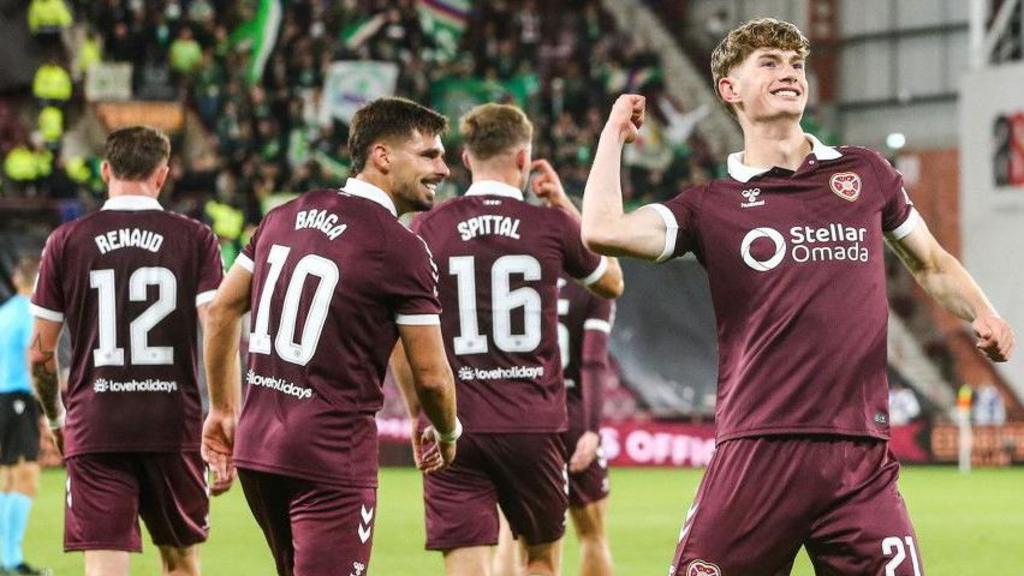
Match Preview: Two Teams, One European Dream
The second leg began with everything still to play for.
The first meeting between Hearts and Rapid Vienna had finished 2–2 at Tynecastle Park on 20 August. Both teams had demonstrated their attacking strengths, and neither had managed to establish a decisive advantage before travelling to Austria for the return fixture.
That result created a fascinating situation for the second leg. The teams knew each other well enough to understand the principal threats, but the tie remained open. One good spell of attacking football could change everything.
Rapid Vienna entered the home fixture with the advantage of playing in front of their own supporters. The Allianz Stadion provided a familiar environment, and the Austrian side had every reason to approach the contest positively.
Their challenge was to turn possession and attacking pressure into goals without allowing Hearts to exploit the spaces left behind.
Rapid possessed the technical ability to move the ball quickly through midfield, use the width of the pitch and create opportunities around the penalty area. Players such as Yusuf Demir and Matthias Seidl could help connect the midfield with the forward line, while Kara offered a physical presence and a reliable target inside the box.
The home side also needed to remain patient. Hearts had already shown in the first leg that they could survive difficult spells and punish defensive mistakes.
For the Scottish visitors, the objective was slightly different.
Hearts needed to remain organised, compete physically and prevent Rapid from establishing complete control. They also needed to make their attacking moments count.
The Scottish side had several players capable of creating problems when the opposition defence was unsettled. Blair Spittal offered creativity and delivery from set pieces, while Claudio Braga and James Wilson provided attacking options capable of stretching the Austrian defence.
The availability of substitutes would also prove important. In a European tie of this magnitude, the quality of the starting eleven matters, but so does the ability to introduce fresh legs and change the game’s rhythm during the second half.
Both teams understood that qualification could depend on small details.
A missed opportunity, a poorly defended corner or a moment of hesitation could prove decisive. Neither side could afford to lose concentration, especially if the match progressed into extra time.
The first leg had suggested that the teams were closely matched. The return fixture would ultimately confirm just how difficult it was to separate them.
First Half: Rapid Vienna Take Control
Rapid Vienna started the second leg with the greater urgency, immediately putting Hearts under pressure.
The Austrian side looked dangerous from the opening minutes, moving the ball forward quickly and testing the visiting defence with direct attacking movements.
Hearts goalkeeper Beau Reus was called into action early. Yusuf Demir threatened with a long-range free kick, forcing Reus to get down and push the ball away. Soon afterwards, Tonni Adamsen created another problem for the visitors, but Reus again produced an important intervention.
These early saves were significant because they prevented Rapid from gaining an immediate advantage and gave Hearts time to settle.
However, the visitors were unable to establish complete control of the midfield. Rapid continued to find spaces between the lines, and their attacking players looked increasingly confident as the half progressed.
Hearts also suffered an unfortunate setback when Tom Renaud was forced off with an injury in the opening quarter of the match. His departure disrupted the visitors’ original plans and required a substitution earlier than they would have wanted.
Tomas Magnusson entered the game, but the change meant Hearts had to adjust their midfield structure while Rapid continued to push forward.
The home side’s persistence eventually paid off.
In the 34th minute, Rapid created the breakthrough through a move involving Demir and the attacking players around the Hearts penalty area. After an effort was blocked, the ball fell favourably for Kara, who found himself in a dangerous position.
The striker kept his composure and finished into the net.
Rapid Vienna led 1–0.
The goal was an important reward for the home side’s first-half work. They had started brightly, forced the goalkeeper into action and continued to put pressure on the visiting defence until an opening appeared.
For Hearts, the goal represented a difficult moment. They had spent much of the half trying to contain Rapid and now faced the prospect of needing to score to keep their European hopes alive.
Nevertheless, the visitors did not completely disappear from the contest.
Claudio Braga threatened after taking advantage of a loose ball, but Rapid goalkeeper Niklas Hedl was able to make the save. Hearts also continued to search for opportunities before the interval.
The final stages of the half offered further evidence that the contest remained open. Rapid had the lead, but Hearts were still capable of creating chances when they moved the ball forward with purpose.
At half-time, Rapid had the advantage on the scoreboard.
Their supporters had reason to be optimistic, while Hearts faced an important tactical challenge. The visitors needed to find a way to create more attacking pressure without allowing Rapid additional space to exploit.
The match was far from over, but the next goal would be crucial.
Second Half: Hearts Find Their Courage
Hearts returned for the second half with a noticeably greater attacking intent.
The visitors understood that simply defending their position would not be enough. They needed to take more risks, move the ball forward more quickly and force Rapid to defend rather than dictate the match.
Blair Spittal provided one of the early warning signs.
He struck a first-time volley from distance, sending the ball narrowly wide of the target. Although the attempt did not produce an equaliser, it demonstrated that Hearts were prepared to attack with greater confidence.
The visitors began to find more promising positions around the Rapid penalty area.
Their attacking movements became more purposeful, and Rapid were forced to spend more time defending. Hearts also looked increasingly dangerous from set pieces, an area that would eventually become decisive.
A dangerous delivery into the box created another opportunity, with Magnusson helping direct the ball towards Braga. Rapid’s Kara intervened to clear the danger near the goal line.
It was a crucial defensive contribution from the home side, but it also showed that Hearts were beginning to threaten in ways they had struggled to manage during the first half.
Rapid remained dangerous themselves.
Demir continued to find opportunities to release teammates into attacking positions, while the home side looked for openings that would allow them to extend their advantage.
However, Hearts were growing into the game.
As the clock moved towards the final quarter, the visitors increased their pressure. Their persistence eventually produced the breakthrough they needed.

Landry Kabore Changes the Game
With approximately ten minutes remaining, Hearts found their equaliser through substitute Landry Kabore.
The goal came from a corner, an attacking situation that had become increasingly important as the visitors searched for a way back into the contest.
Kabore attacked the delivery and diverted the ball into the net with his chest.
The Hearts players immediately celebrated a goal that changed the atmosphere of the match.
The score was now 1–1.
More importantly, the goal demonstrated the value of persistence. Hearts had continued to compete despite conceding first, losing a midfielder through injury and struggling to control the opening half.
Kabore’s contribution also highlighted the importance of substitutions in European football. Fresh players can offer a different physical presence, attack spaces that have become difficult to reach and provide an additional threat during the closing stages.
Rapid were suddenly facing a much more complicated situation.
Their first-half advantage had disappeared, and the tie was moving towards extra time. They now needed to regain their attacking momentum while avoiding another mistake at the back.
The closing minutes became increasingly tense.
Rapid pushed forward in search of a winner, while Hearts attempted to exploit opportunities whenever the home side committed players into attack.
Another major moment arrived when substitute Christian Borchgrevink produced an important defensive intervention, turning a close-range effort from Serge-Philippe Raux-Yao onto the post and away from goal.
That save helped keep Hearts level as the match approached extra time.
Neither side could find the decisive goal during the remaining regulation minutes.
After 90 minutes, the second leg stood at 1–1, leaving the aggregate score level at 3–3.
The contest would require another 30 minutes.
Extra Time: The Drama Reaches Another Level
Extra time brought a different kind of pressure.
The players had already completed 90 demanding minutes, and fatigue was becoming a factor. Every sprint required additional effort, every defensive recovery mattered and the possibility of a penalty shootout was becoming increasingly real.
Rapid Vienna looked to use their numerical advantage after Hearts midfielder Tomas Magnusson received a second yellow card in the 76th minute and was sent off.
Playing with ten men placed a significant burden on Hearts.
The remaining midfielders and defenders needed to cover more ground, maintain their shape and ensure that Rapid could not use the extra player to create clear openings.
The Austrian side attempted to take advantage of the situation, pushing forward and looking for the goal that would restore their advantage in the tie.
Hearts, however, remained dangerous when opportunities to counterattack appeared.
Their determination was rewarded early in extra time.
Calvin Miller Produces a Brilliant Finish
In the 100th minute, Hearts produced a devastating counterattack.
Substitute Rogers Mato carried the ball forward down the left and delivered an excellent cross towards the far post. Calvin Miller arrived in the right position and connected with a superb volley, directing the ball into the opposite corner.
It was a moment of outstanding execution.
Miller had timed his run well, adjusted his body to the delivery and produced a finish that gave the goalkeeper little opportunity to respond.
Hearts led 2–1 on the night.
The aggregate score moved to 4–3 in the Scottish side’s favour.
Considering that Hearts were playing with ten men, the goal was particularly impressive. They had been forced to defend for long periods, yet they had found a way to punish Rapid when the opportunity presented itself.
The finish also demonstrated why counterattacking football can be so effective in European competition.
Rapid were attempting to make their numerical advantage count by committing players forward. That approach created spaces, and Hearts exploited one of them with precision.
For a short period, the visitors were on the verge of a remarkable victory.
They still had time to negotiate, however, and Rapid had no intention of giving up.
The home side increased the pressure, sending the ball into dangerous areas and attempting to force a mistake.
Hearts defended with determination, but the constant pressure eventually produced another breakthrough for Rapid.
Nenad Cvetkovic Delivers a Late Equaliser
With approximately one minute remaining in extra time, Rapid Vienna found their second goal.
Defender Nenad Cvetkovic finished from close range after a late attacking delivery created an opportunity inside the Hearts penalty area.
The goal made it 2–2.
Rapid had rescued the match at the very last moment.
The aggregate score was now 4–4, and the tie would be decided by penalties.
The equaliser was a major moment for the home supporters, who had watched their team come close to elimination before finding a way back into the contest.
For Hearts, it was a heartbreaking setback.
They had defended for long periods with ten men, produced a brilliant counterattacking goal and come within moments of qualifying without a shootout.
Yet they had conceded at the most difficult possible time.
There was no opportunity to recover the lead before the final whistle.
After 120 minutes, both teams had scored twice in Vienna, and neither could be separated across the two legs.
The tie had reached its final stage.
Penalty Shootout: Beau Reus Becomes the Hero
Penalty shootouts are among the most unforgiving situations in football.
A team can perform well for two hours and still leave the competition because of one missed kick. A goalkeeper can spend an entire match making routine saves before being asked to produce the defining moment of the evening.
For Rapid Vienna and Hearts, the shootout represented the final test of composure.
The players had to overcome fatigue, manage the pressure of the occasion and execute their penalties against goalkeepers who understood the importance of every movement.
The shootout began with Calvin Miller converting for Hearts.
Rapid responded through Ercan Kara, keeping the score level.
Jordi Altena then scored for the Scottish side, before Louis Schaub converted for Rapid.
The pressure continued to build as both teams found the net.
Rogers Mato successfully converted another penalty for Hearts, but Rapid’s Moulaye Haidara was unable to score after Beau Reus made an important save.
Hearts then moved closer to victory when Sabah Kerjota converted his attempt.
Yusuf Demir scored for Rapid to keep the Austrian side alive, and Niklas Hedl subsequently saved a penalty from Oisin McEntee.
The tension was enormous.
Rapid still had a chance to extend the shootout, but the next attempt would prove decisive.
Marco Tilio stepped forward for the Austrian side.
Reus produced another save.
The goalkeeper had now denied two Rapid penalties, and his second intervention secured a 4–3 shootout victory for Hearts.
The celebrations among the Scottish players reflected the significance of the achievement.
They had survived a difficult opening, overcome a numerical disadvantage, scored twice in the second leg and recovered from the disappointment of conceding a late equaliser.
Reus’s performance was the defining factor in the shootout.
His saves were not merely impressive individual moments; they were the difference between elimination and qualification.
For Rapid Vienna, the conclusion was painful. They had fought back from behind in extra time and forced the tie to penalties, only to fall short when the decisive kicks arrived.
For Hearts, the result represented a major European success.
They had earned their place in the Conference League league phase through a performance that required patience, courage and an extraordinary level of determination.
Tactical Analysis: Why the Match Was So Closely Contested
The 2–2 draw was the product of two teams approaching the match with different strengths and priorities.
Rapid Vienna generally enjoyed greater control of possession and spent long periods attempting to move Hearts away from their defensive positions.
Hearts, meanwhile, demonstrated their ability to remain competitive without controlling the ball for extended periods.
The tactical contest changed considerably as the match progressed.
1. Rapid Vienna’s Possession and Attacking Pressure
Rapid’s principal strength was their ability to circulate possession and move the ball into dangerous areas.
Their midfielders attempted to create passing angles, while their attackers looked to receive the ball between the lines and exploit spaces around the penalty area.
Demir’s technical quality was particularly useful in this regard. His ability to deliver dangerous balls and attempt shots from distance forced Hearts to remain alert.
Rapid also benefited from Kara’s presence in the attacking third.
The striker provided a focal point, giving his teammates an option when they wanted to play directly and helping them maintain pressure around the box.
The opening goal reflected the benefits of this approach. Rapid continued to attack, created a dangerous situation and took advantage when the ball fell favourably for Kara.
However, possession alone was not enough to secure qualification.
Rapid struggled to turn their attacking pressure into a decisive advantage. Hearts continued to block passing lanes, compete for second balls and make important defensive interventions.
The Austrian side also faced difficulties when Hearts moved quickly into attack.
The goal scored by Miller in extra time illustrated the danger of committing players forward without maintaining sufficient defensive protection.
Rapid’s approach created opportunities, but it also left them vulnerable to counterattacks.
2. Hearts’ Defensive Organisation
Hearts’ performance was built on their willingness to defend collectively.
The Scottish side did not always manage to control the midfield, particularly during the first half, but they continued to compete for possession and attempt to limit the quality of Rapid’s chances.
The defenders were required to deal with crosses, direct passes and movement from the Austrian forwards.
Reus also played an important role by making early saves that prevented Rapid from extending their lead.
As the match progressed, Hearts became more confident.
Their defensive structure allowed them to remain in the contest long enough for their attacking players to create opportunities.
Even after Magnusson’s dismissal, Hearts continued to protect dangerous areas and force Rapid to work for openings.
The late equaliser was disappointing, but the visitors’ ability to reach penalties with ten men demonstrated the resilience of the defensive unit.
3. The Importance of Substitutions
Substitutions were among the most influential elements of the match.
Landry Kabore scored the equaliser that brought Hearts back into the game during the second half.
Rogers Mato then played a decisive role in the extra-time goal, delivering the cross that allowed Calvin Miller to finish brilliantly.
These contributions showed how fresh players can change the direction of a match even when they have limited time on the pitch.
Kabore offered an additional attacking presence, while Mato provided the pace and delivery needed to exploit space behind Rapid’s defensive line.
Miller’s finish completed the move and briefly put Hearts in control of the tie.
Rapid also benefited from their attacking pressure and late substitutions, eventually finding the goal that forced the shootout.
However, the contrasting impact of the substitutes illustrated the importance of timing, execution and decision-making during the closing stages.
4. Set Pieces Made the Difference
Set pieces were another important factor.
Kabore’s equaliser came from a corner, demonstrating the value of well-delivered dead-ball situations when open-play opportunities are limited.
Rapid’s pressure also produced dangerous situations around the Hearts penalty area, requiring the visitors to remain organised when defending crosses and second balls.
In closely contested European ties, set pieces often become decisive because they allow teams to create opportunities without having to break down a complete defensive structure through passing alone.
Hearts made one of those opportunities count.
Rapid’s late equaliser also showed the value of continuing to attack until the final whistle.
5. Goalkeeping Decided the Outcome
Both goalkeepers played important roles, but Reus’s contribution extended beyond normal match situations.
His early saves helped prevent Rapid from building an even greater advantage.
Later, his team needed him to remain composed under pressure as the shootout approached.
The two penalty saves ultimately decided the tie.
Hedl also produced important interventions, including a save during the shootout, but Rapid could not find the additional conversion required to progress.
Reus’s performance under pressure will be remembered as one of the defining features of the match.

Top Highlights of Rapid Vienna vs Hearts
Highlight 1: Beau Reus Keeps Hearts in the Game
Rapid started strongly, and Reus was required to make important saves during the opening minutes.
His interventions prevented the home side from taking an early lead and gave Hearts the opportunity to settle into the match.
Those saves proved especially valuable in a tie that eventually required a penalty shootout.
Highlight 2: Ercan Kara Gives Rapid the Lead
Kara’s goal in the 34th minute rewarded Rapid’s attacking pressure.
The striker reacted quickly to the developing situation inside the Hearts penalty area and finished confidently.
For the home side, it was an important step towards qualification.
Highlight 3: Hearts Respond After Half-Time
The Scottish visitors increased their attacking intent after the interval.
Spittal threatened from distance, and Hearts began creating more dangerous situations around the Rapid penalty area.
Their improved performance laid the foundation for the equaliser.
Highlight 4: Landry Kabore Scores the Equaliser
Kabore’s goal in the closing stages of normal time brought Hearts level.
The substitute connected with a corner and diverted the ball into the net with his chest.
It was a crucial moment that prevented Rapid from securing the tie during the 90 minutes.
Highlight 5: Tomas Magnusson Receives a Red Card
Magnusson’s second yellow card in the 76th minute left Hearts with ten players.
The dismissal made the remaining stages considerably more difficult for the Scottish side and forced them to defend with even greater discipline.
Despite the disadvantage, Hearts continued to create attacking opportunities.
Highlight 6: Calvin Miller’s Outstanding Volley
Miller produced one of the finest moments of the evening when he finished Mato’s cross in the 100th minute.
The strike put Hearts ahead and demonstrated their ability to punish Rapid on the counterattack.
It was a goal of considerable technical quality and one that briefly appeared to have secured qualification.
Highlight 7: Nenad Cvetkovic Rescues Rapid
Cvetkovic scored in the 119th minute, giving Rapid a dramatic equaliser.
The late goal forced a penalty shootout and extended the uncertainty until the final kicks.
For Rapid supporters, it was a moment of renewed hope.
Highlight 8: Beau Reus Saves Two Penalties
The decisive highlight arrived during the shootout.
Reus saved penalties from Haidara and Tilio, helping Hearts secure a 4–3 victory.
His performance transformed an exhausting and dramatic contest into a memorable European night for the Scottish club.
Match Summary: Rapid Vienna 2–2 Hearts
The match can be summarised as a contest in which Rapid enjoyed substantial periods of control, but Hearts proved capable of surviving pressure and producing decisive attacking moments.
Rapid took the lead through Kara in the first half and looked well placed to progress.
Hearts responded through Kabore in the second half before Miller’s extra-time volley put the visitors ahead.
Cvetkovic equalised late in extra time, leaving the aggregate score at 4–4.
The penalty shootout then provided the final twist, with Reus making two saves to help Hearts win 4–3.
The result highlighted the importance of resilience in European football. Hearts did not dominate every phase of the game, but they continued to compete when the circumstances became difficult.
Rapid, meanwhile, were left to reflect on a match in which they created opportunities and showed considerable determination but ultimately failed to convert their advantage into qualification.
What the Result Meant for Rapid Vienna
For Rapid Vienna, the result was a painful disappointment.
Playing at home, they had the opportunity to secure qualification in front of their supporters. Their first-half performance suggested that they could achieve that objective.
Kara’s goal gave them the advantage, and their attacking play created further opportunities.
However, Hearts’ response changed the direction of the match.
Rapid were unable to prevent the equaliser in normal time, and Miller’s goal in extra time placed them under enormous pressure.
Cvetkovic’s late intervention gave them another opportunity, but the penalty shootout ultimately went against them.
The defeat did not erase the positive elements of their performance. Rapid showed attacking intent, moved the ball effectively and continued to push forward even when the tie appeared to be slipping away.
Nevertheless, the match also highlighted the importance of defensive organisation and clinical finishing.
When a team creates pressure but cannot establish a decisive lead, it leaves itself vulnerable to late setbacks.
Rapid’s experience in Vienna provided a clear example of that problem.
What the Result Meant for Heart of Midlothian
For Hearts, qualification represented a significant achievement.
The team had travelled to Austria knowing that the tie was evenly balanced after the first leg. They then found themselves trailing, lost a midfielder to a red card and conceded a late equaliser in extra time.
At several points, the situation looked unfavourable.
Yet Hearts continued to fight.
Kabore’s equaliser demonstrated their determination, while Miller’s volley showed their attacking quality. Their ability to defend with ten men and reach the shootout reflected the collective effort of the team.
Reus then provided the decisive contribution.
The goalkeeper’s two saves gave Hearts the victory and secured their place in the Conference League league phase.
For the players and supporters, the result offered a memorable example of what can happen when a team refuses to surrender.
The victory was not simply about scoring two goals. It was about maintaining belief through difficult periods and taking advantage of the opportunities that eventually appeared.

Final Verdict: A European Thriller That Had Everything
Rapid Vienna and Heart of Midlothian produced a memorable European contest that demonstrated why knockout football can be so unpredictable.
The match featured an early attacking advantage for Rapid, a determined Hearts comeback, a red card, a brilliant extra-time finish, a last-minute equaliser and a penalty shootout decided by outstanding goalkeeping.
Rapid had periods of control and looked capable of securing qualification, but Hearts demonstrated remarkable resilience.
Kabore’s equaliser kept the Scottish side alive. Miller’s volley appeared to put them through. Cvetkovic’s late goal then forced the contest into penalties, where Reus delivered the defining performance.
The final score of 2–2 did not tell the entire story. Over two legs, the aggregate score was 4–4, and Hearts ultimately won 4–3 on penalties.
For Rapid Vienna, it was a difficult elimination after a determined performance.
For Hearts, it was a night of celebration and a reward for refusing to give up.
The match offered several lessons. Possession must be converted into goals, defensive concentration must last until the final whistle, and substitutions can change the outcome of even the most difficult contests.
Above all, it demonstrated the importance of composure under pressure.
In the end, the difference between the two sides was not the number of chances created or the length of time spent attacking. It was the ability to deliver when the decisive moment arrived.
Beau Reus did exactly that.
His two penalty saves secured Hearts’ progression and gave the Scottish club a European victory to remember.
Final score: Rapid Vienna 2–2 Heart of Midlothian after extra time. Hearts won 4–3 on penalties and advanced to the UEFA Conference League league phase.
