
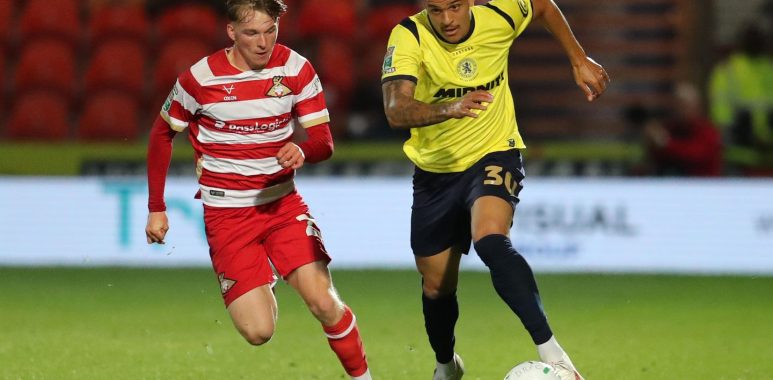
Doncaster Rovers 1-3 Middlesbrough: Boro’s Quality Tells as Joseph, Lankshear and Sarmiento Fire Them Through
There are nights in the cup when the gap between the Championship and League One feels theoretical. Then there are nights like this one, when Middlesbrough turned up in South Yorkshire, took a while to settle, and eventually showed exactly why they sit a division higher. A controlled, professional 3-1 win sent Boro into the third round and left Doncaster with another early exit, despite a late consolation that gave the home crowd something to cheer on the way out.
Preview: History, form and the weight of recent meetings
Coming into this one, the recent history between these sides carried a sting for Middlesbrough. Twelve months earlier, almost to the day, Doncaster had gone to the Riverside and hammered Boro 4-0 in the first round of the same competition. That result still lingered in Teesside. Kim Hellberg’s side arrived at the Eco-Power Stadium looking for a measure of revenge, even if nobody in the Boro camp was framing it that way publicly.
Doncaster, managed by Grant McCann, were sitting in the lower half of League One and had rotated heavily. Josh Clarke made his competitive debut in goal. Five changes from the side that had drawn 0-0 with Barnsley the previous weekend told you everything about their priorities. League survival and the push for a play-off place matter more than a deep cup run when you’re a League One club with limited resources. Still, the home support turned up hoping for another giant-killing.
Middlesbrough, by contrast, were in the Championship mix and treating the cup with a degree of seriousness. They had quality on the bench and options across the pitch. Will Lankshear was already looking like one of the signings of the summer. Jeremy Sarmiento had shown flashes. Kyle Joseph was still searching for his first goal in Boro colours. The visitors expected to dominate the ball and create chances. The question was whether Doncaster’s organisation and the compact Eco-Power pitch could frustrate them long enough to force a mistake or a shootout.
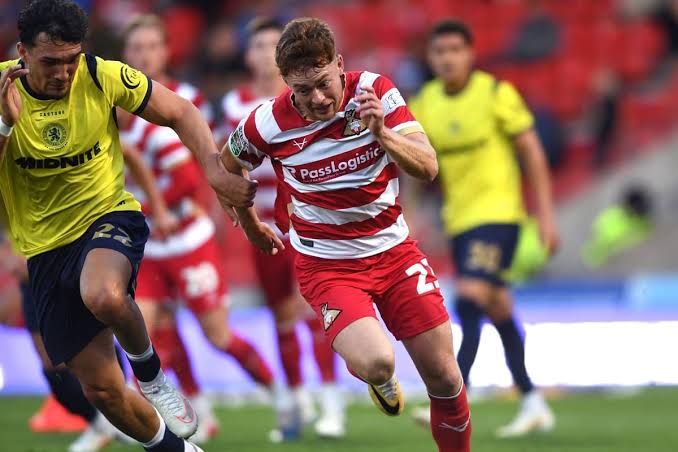
The form lines were mixed. Doncaster had been hard to beat at home in patches but lacked a consistent cutting edge. Boro had been solid without being spectacular in the early weeks of the Championship season. The bookmakers made Middlesbrough clear favourites, and the pre-match models leaned the same way. Yet cup football has a habit of ignoring the models when the underdog is organised and the favourite is a touch complacent.
Attendance was modest — just under 7,000 — but the atmosphere was typical of a midweek cup night in this part of the world: noisy in the home end, expectant from the travelling support, and edged with the knowledge that one mistake could decide it.
Analysis: Control, quality and the League One ceiling
What unfolded was a classic illustration of the difference in levels when the better side finally clicks into gear. Middlesbrough finished with 66% possession, 24 shots to Doncaster’s 12, and an expected goals tally that sat comfortably in their favour. They completed 525 of 589 passes at 89% accuracy. Doncaster managed 234 accurate passes from 295 at 79%. Those numbers do not lie.
Early on, though, the game was tighter than the final score suggests. Doncaster pressed with purpose. They forced Boro into a few hurried clearances and had moments where the Championship side looked a fraction off the pace. Morgan Whittaker was a constant threat on the right for the visitors, but Josh Clarke made a couple of smart early saves that kept the score level and the home crowd believing.
The breakthrough came in the 34th minute and it was pure quality. Kyle Joseph produced an acrobatic finish — his first goal in Middlesbrough colours — after good work involving Sarmiento. It was the kind of strike that separates the divisions. Suddenly the tension left Boro’s play. They began to recycle the ball more calmly, stretched the pitch, and forced Doncaster deeper.
The second half followed a familiar pattern for these fixtures. Doncaster made changes and tried to inject energy. Leon Ayinde came on and caused a few problems with his pace. Alfie May and others worked hard. But the structural gap was obvious. Middlesbrough’s midfield, with players like Sebastian Berhalter and Myles Peart-Harris, controlled the tempo. When the home side did win the ball, the transition was usually hurried and the final ball was lacking.
Will Lankshear’s introduction changed the game again. The young striker, already in fine form, needed only a few minutes to find the net. In the 78th minute, after Whittaker’s stumbling run into the box created chaos, the ball fell kindly and Lankshear finished from close range. 0-2. Game over, for all practical purposes.
Jeremy Sarmiento then produced the moment of the night. In the 87th minute, substitute Ashley Phillips — making his first appearance after a significant summer move — floated a lovely ball over the top. Sarmiento ran onto it, looked up, and delivered a sublime chip from outside the box that left Clarke stranded. It was the kind of finish that makes you stop and rewatch. 0-3.
Doncaster’s response was pure character. In the second minute of stoppage time, Jack Senior launched a long, accurate ball forward. Isaac Hutchinson timed his run, controlled it, and slotted home for his first goal in red and white. 1-3. It was no more than a consolation, but it was deserved on the night for a side that had never stopped running.
The stats underlined the gulf. Boro had seven corners to Doncaster’s one. They created the clearer chances. Their defensive structure, even when stretched early, recovered well. Doncaster’s two yellow cards (Robbie Gotts and George Broadbent) told a story of a side forced into fouls to break up play. Boro collected two of their own but never looked in serious trouble after the first goal.
Hellberg’s side showed the benefit of squad depth. The changes worked. Lankshear scored. Phillips assisted. Sarmiento finished. For McCann, the night confirmed what he already knew: his side can compete for periods against higher-level opposition, but sustaining it over 90 minutes against a well-organised Championship team with better technical quality is another matter entirely.
Top Highlights
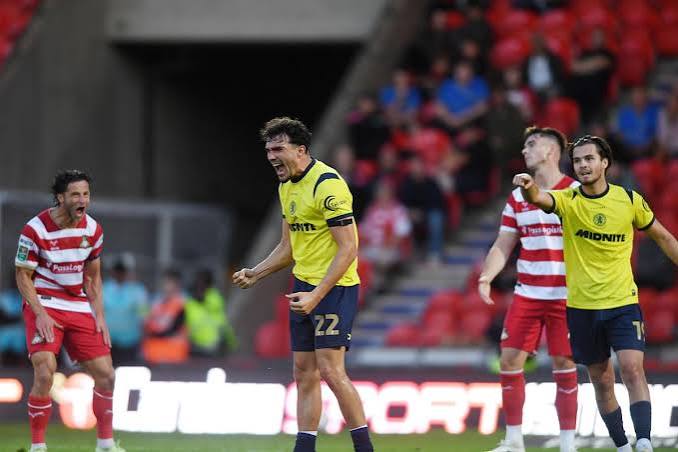
34th minute – Kyle Joseph’s acrobatic opener
The game’s first real moment of quality. Sarmiento’s involvement created the chance and Joseph produced a finish that required athleticism and composure. It settled Boro and changed the entire complexion of the evening.
78th minute – Will Lankshear doubles the lead
A substitute’s goal that killed the contest. Whittaker’s persistence in the box, a deflection, and Lankshear was in the right place. Clinical, simple, and exactly what you want from a young striker finding his feet at a new club.
87th minute – Jeremy Sarmiento’s chip
The pick of the bunch. Phillips’ weighted pass over the top, Sarmiento’s first touch and vision, and a delicate chip that looped perfectly into the net. Pure technique under no real pressure. The kind of goal that travels on social media for days.
90+2 – Isaac Hutchinson’s late reply
A moment of quality from Doncaster. Senior’s long ball was inch-perfect. Hutchinson’s finish was calm. It gave the home supporters a reason to stay until the end and prevented a complete shut-out.
Honourable mentions go to Josh Clarke’s early saves that kept the score level longer than it might have been, and the overall control shown by Middlesbrough’s midfield once they found their rhythm. The substitutions from the visitors also stood out — every change seemed to improve them.
Summary
Middlesbrough did what they were supposed to do, eventually. They absorbed an early period of pressure, took the lead through a moment of individual brilliance, and then used their superior quality and depth to pull clear. Kyle Joseph’s first goal for the club, Will Lankshear’s clinical finish, and Jeremy Sarmiento’s exquisite chip were the decisive moments. Isaac Hutchinson’s late strike was a reminder that Doncaster never stopped competing, but it changed nothing about the result.
For Boro, the win keeps their Carabao Cup campaign alive and offers useful minutes to players who needed them. The squad depth looks healthy. The attacking options are starting to click. Hellberg will take the result and move on to the Championship fixtures that matter more in the long run.
For Doncaster, it was another night that highlighted both the promise and the limitations of their current group. They can organise, they can work, and they can produce the occasional moment of quality. Against a full-strength Championship side that decides to take the game seriously, those qualities are rarely enough over ninety minutes. McCann will focus on the league again, knowing that cup exits like this are part of the territory at this level.
The final scoreline was fair. Middlesbrough were the better side by a clear margin once the first goal went in. Doncaster can hold their heads high for the effort and for the late goal, but the gap in quality was never in serious doubt after the half-hour mark. Boro go through. Rovers go back to the grind of League One. That is how these nights usually end when the higher-division side remembers what it is supposed to do.
