
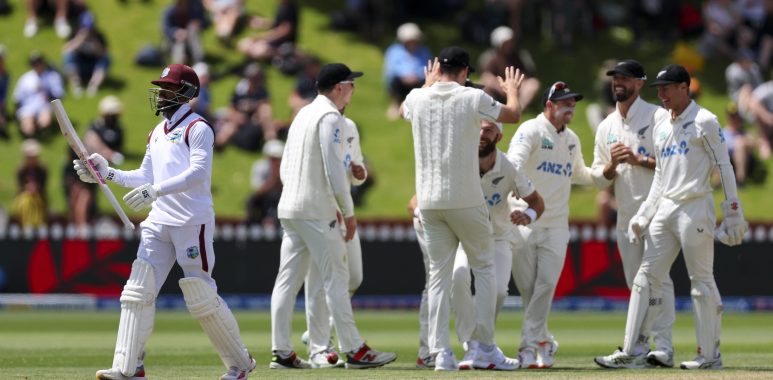
New Zealand Dominate West Indies in Wellington to Seal Series with Emphatic Nine-Wicket Victory
New Zealand sealed a commanding victory in the second Test against West Indies at the Basin Reserve in Wellington, wrapping up the match inside three days with a nine-wicket triumph. The home side demonstrated superior skill, discipline, and adaptability to the conditions, exposing the visitors’ vulnerabilities in seaming conditions that favored the black caps throughout. This result not only leveled the series but also highlighted New Zealand’s growing dominance in home Test conditions while raising fresh questions about West Indies’ ability to compete away from their Caribbean strongholds.
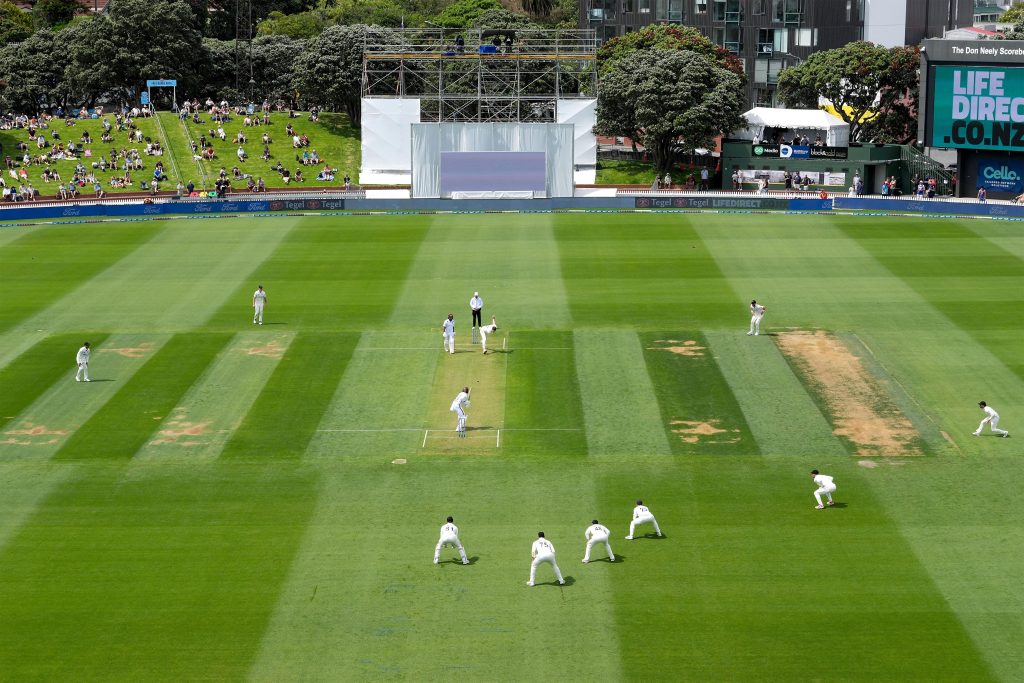
The Basin Reserve, with its characteristic breeze and green-tinged pitch, lived up to its reputation as a bowler-friendly venue. West Indies arrived in New Zealand after a mixed warm-up period, carrying the momentum from a competitive first Test but lacking the depth to handle New Zealand’s varied bowling attack. Captain Kraigg Brathwaite won the toss and, perhaps surprisingly, chose to bat first on a surface that offered early movement. It proved a decision he would regret as New Zealand’s seamers made the most of the conditions from the outset.
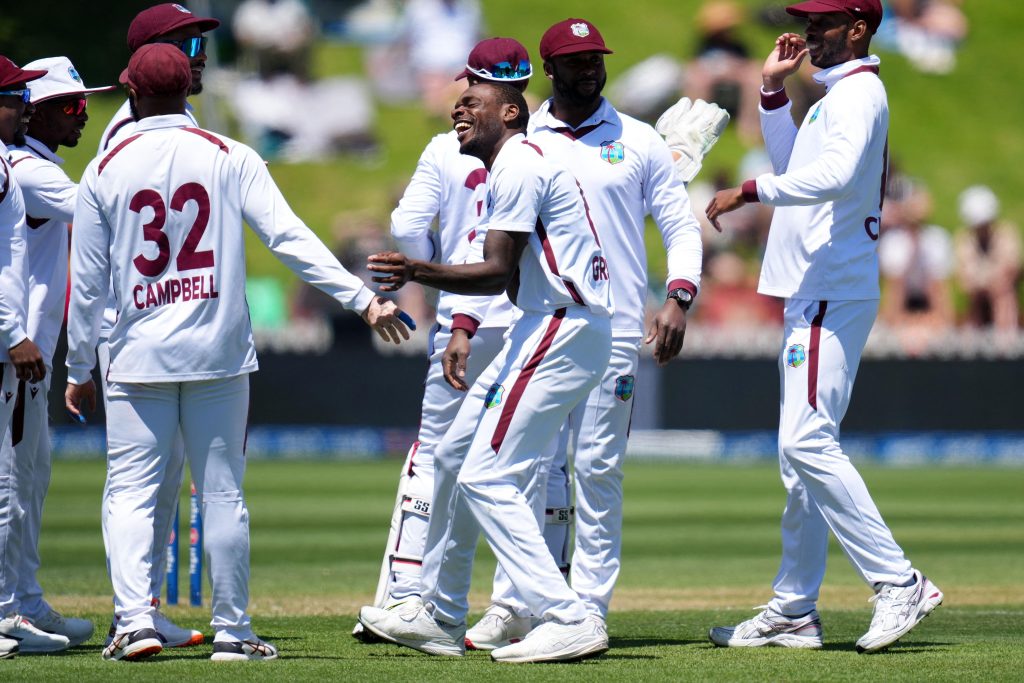
Day one began under overcast skies, perfect for swing bowling. Tim Southee, leading the New Zealand attack with his trademark accuracy, struck early. He dismissed John Campbell with a delivery that nipped away just enough to find the edge, caught comfortably in the slips by Tom Latham. From there, the West Indies innings unfolded like a slow-motion struggle. Brathwaite tried to anchor the innings, but he found himself under constant pressure from the moving ball. Kyle Jamieson, towering at his full height, extracted bounce that troubled the middle order. Shai Hope looked solid for a time, compiling 42 patient runs before falling to a sharp delivery from Matt Henry that seamed back sharply.
The West Indies middle order crumbled under the pressure. Nicholas Pooran, usually a dynamic presence, was undone by a brilliant piece of seam bowling from Southee, who claimed three wickets in a spell that shifted the momentum decisively. By lunch, West Indies were reeling at 85 for five. The lower order showed some fight, with Alzarri Joseph and Gudakesh Motie adding valuable runs through gritty resistance, but the total of 237 all out felt well below par on what many expected to be a decent batting surface once the early moisture dried out.
New Zealand’s openers, Devon Conway and Tom Latham, approached their reply with measured aggression. Conway, in fine form throughout the summer, played some exquisite drives through the covers, punishing anything loose from the West Indies pacers. Latham provided the perfect foil, leaving balls judiciously and rotating the strike. By the close of play on day one, New Zealand had reached 142 without loss, already in a position of strength and eyeing a substantial first innings lead.
The second day dawned brighter, but the pitch retained enough life to keep the bowlers interested. West Indies needed early wickets to claw back into the contest, and Kemar Roach, their most experienced seamer, responded with a probing spell. He removed Conway for 78, caught behind after a delivery that held its line beautifully. It was a vital breakthrough, but New Zealand’s batting depth proved too much. Kane Williamson, returning to form after a lean patch, played one of his trademark innings, blending defense with elegant stroke play. He reached his half-century just before lunch, and together with Latham, took the score past 250.
Williamson fell shortly after the interval for 87, trapped lbw by a Motie delivery that turned just enough, but the damage was done. Henry Nicholls joined Latham, and the pair added 112 for the third wicket in a display of classical Test batting. Latham eventually brought up his century to warm applause from the Wellington crowd, his patient 134 laying the foundation for New Zealand’s dominance. The declaration came at 456 for six late on day two, giving New Zealand a commanding lead of 219 runs. West Indies’ bowlers looked weary, with Roach and Jayden Seales carrying the bulk of the workload but receiving little support from the rest of the attack.
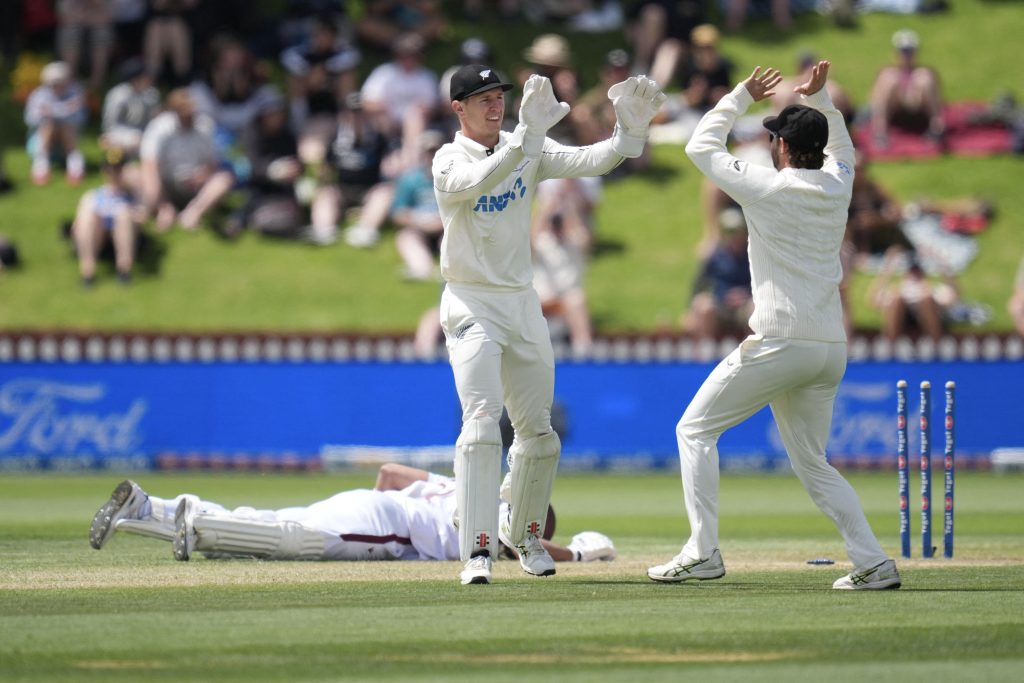
As the sun dipped lower, West Indies began their second innings with a mountain to climb. The evening session saw Brathwaite and Campbell battle hard against the new ball, but Southee and Jamieson were relentless. Campbell edged behind for 19, and shortly after stumps, Brathwaite was dismissed in controversial fashion, given out caught at short leg off Jamieson after the ball appeared to flick the pad. West Indies closed at 48 for two, still trailing by 171 runs with eight wickets in hand but facing an uphill battle.
Day three proved to be the final act in a match that showcased New Zealand’s efficiency. The home side’s bowlers operated like a well-oiled machine. Matt Henry, often the unsung hero in this attack, claimed four wickets in a devastating spell after lunch. Hope and Pooran tried to counterattack, but the variable bounce and seam movement proved too much. Pooran, in particular, fell to a brilliant catch by Daryl Mitchell in the gully, diving full length to his right. The West Indies lower order offered fleeting resistance, with Jason Holder top-scoring with 38, but the innings folded for just 156. New Zealand had bowled them out for the second time in the match, setting up a target of just 138 runs to win.
The chase was never in doubt. Conway and Latham knocked off the runs with clinical precision. Conway fell for 29, caught at midwicket attempting a pull shot off Joseph, but Williamson and Nicholls saw the side home comfortably. Nicholls hit the winning runs with a crisp cover drive, sealing the nine-wicket victory shortly after tea on the third day. The Basin Reserve erupted in celebration as New Zealand’s players embraced on the field, their white uniforms stained with the sweat of hard-earned dominance.
This win was built on several standout performances. Tim Southee finished with match figures of eight for 92, a masterclass in swing and seam bowling that earned him the player of the match award. His ability to set fields and outthink the batsmen was crucial. Matt Henry and Kyle Jamieson provided excellent support, sharing 12 wickets between them across both innings. With the bat, Tom Latham’s century and Kane Williamson’s fluent knock provided the backbone of New Zealand’s first innings total.
For West Indies, the defeat highlighted ongoing structural issues. Their batting lineup struggled to cope with quality seam bowling, a recurring theme in tours to New Zealand and England. Brathwaite’s captaincy came under scrutiny, particularly his decision at the toss and the defensive fields set during New Zealand’s innings. Shai Hope and Nicholas Pooran showed glimpses of their talent, but consistency remains a challenge. The bowling attack, led ably by Roach and supported by the emerging Seales, lacked the penetration needed to break partnerships on responsive pitches.
Looking back at the broader context, this second Test came after a hard-fought draw in the series opener in Hamilton, where West Indies had pushed New Zealand close. The visitors had spoken optimistically about challenging for their first series win in New Zealand since 1999, but the reality at the Basin Reserve was stark. New Zealand’s home record remains formidable, with this victory extending their unbeaten streak at the venue.
The conditions played a significant role. The Basin Reserve pitch offered assistance to seamers throughout, but New Zealand adapted better, using the breeze to their advantage and maintaining tighter lines. West Indies appeared tentative at times, their footwork against the moving ball lacking the necessary commitment. Fielding was another differentiator. New Zealand held onto their chances, including several sharp slip catches, while West Indies dropped a couple of crucial opportunities that could have altered the momentum.
Beyond the individual battles, this match underscored the evolution of Test cricket in the modern era. With packed schedules and T20 leagues pulling players in different directions, maintaining focus over five days remains a test of character. New Zealand’s squad depth allowed them to rotate players effectively, while West Indies missed the experience of several key figures unavailable due to injury or commitments elsewhere.
Post-match reactions captured the mood. New Zealand captain Tom Latham praised his team’s bowling effort, saying the seamers executed their plans perfectly on a helpful surface. Southee, reflecting on his performance, noted the satisfaction of contributing to another win at his home ground. For Brathwaite, the disappointment was evident as he acknowledged his side’s shortcomings in the second innings. He vowed to regroup ahead of the deciding Test, emphasizing the need for better application with the bat.
This result sets up an intriguing finale to the series. New Zealand hold the psychological edge, but West Indies have shown in patches that they possess the talent to compete. The third Test in Christchurch will likely feature similar conditions, testing both teams’ resolve as the southern summer draws to a close.
Delving deeper into the technical aspects, New Zealand’s bowling strategy revolved around patience. Southee and Henry varied their lengths expertly, using the short ball sparingly but effectively to unsettle the West Indies top order. Jamieson’s height created awkward angles, forcing batsmen to play at deliveries they might otherwise have left alone. The coordination between the seamers and the close catchers was exemplary, with Mitchell and Nicholls forming a reliable cordon.
On the batting side, Latham’s innings was a study in concentration. Facing 278 balls, he left deliveries outside off stump with precision, only attacking when the bowlers erred. His partnerships with Conway and Nicholls were built on clear communication and complementary styles. Williamson’s return to runs was timely, his footwork against spin particularly impressive as he danced down the track to Motie on several occasions.
West Indies’ struggles were multifaceted. Their openers failed to provide solid starts in either innings, putting undue pressure on the middle order. The spin department, reliant on Motie, was underutilized as the pitch favored pace. Roach bowled with heart, but at 37 years old, the workload in back-to-back Tests is telling. Younger talents like Seales showed promise, generating good pace, but they need more support to trouble established Test sides consistently.
The crowd at the Basin Reserve added to the atmosphere, with a healthy turnout despite the match concluding early. Local supporters appreciated the high-quality cricket, cheering every wicket and boundary. The match also featured several notable moments off the field, including a touching tribute to former New Zealand greats before play on day two, reminding everyone of the rich history at this venue.
As the players reflect on this encounter, it serves as a reminder of Test cricket’s enduring appeal. The ebb and flow, the individual duels within the team contest, and the strategic depth all combine to create drama unmatched in shorter formats. For New Zealand, this victory reinforces their status as a top-tier Test nation capable of clinical performances. For West Indies, it provides valuable lessons as they continue their rebuilding phase under Brathwaite’s leadership.
In the dressing room celebrations, there was a sense of quiet satisfaction rather than euphoria. New Zealand know there is still work to do in the series, but this win by nine wickets, achieved with time to spare, sends a strong message to opponents worldwide. The black caps have set a high standard, and the cricket world will be watching to see if West Indies can respond in kind in the final Test.
Expanding on the individual contributions, one cannot overlook the role of the all-rounders. Daryl Mitchell’s handy 45 not out in the first innings and his sharp fielding added balance to the New Zealand side. For West Indies, Holder’s fighting 38 in the second innings and his economical bowling spells kept the margin from being even greater. These supporting acts often determine the outcome in closely contested series.
Weather played its part too. The overcast conditions on day one and three assisted the ball’s movement, while day two’s clearer skies allowed the batsmen more freedom. Groundsmen at the Basin Reserve prepared a pitch that rewarded good cricket without becoming unplayable, striking an ideal balance for Test match cricket.
Statistically, New Zealand’s first innings total of 456 was their highest against West Indies at this venue in recent memory. The lead of 219 runs after the first innings set a platform that few teams could recover from. West Indies’ combined total of 393 across both innings was their lowest in a Test loss in New Zealand for over a decade. These numbers tell a story of one-sided dominance despite the visitors’ best efforts.
As the series heads to its conclusion, fans can anticipate more exciting cricket. New Zealand will look to sweep the series, while West Indies will aim for a morale-boosting win to salvage pride. Regardless of the outcome, this second Test will be remembered as a showcase of New Zealand’s mastery in home conditions and a learning curve for a West Indies side still finding its feet on the international stage.
The victory also has implications for the World Test Championship standings. New Zealand’s strong performance boosts their points percentage, keeping them in contention for a final spot. West Indies, meanwhile, continue to battle at the lower end of the table, needing consistent results to climb the rankings.
In summary, New Zealand’s nine-wicket win in Wellington was comprehensive and deserved. It was a triumph of teamwork, tactical acumen, and execution under pressure. As the players depart the Basin Reserve, the black caps can hold their heads high, while West Indies must regroup and analyze where improvements can be made before the next encounter. Test cricket at its finest, played in front of passionate fans in a historic venue, delivered a memorable contest that will linger in the memory long after the series ends.
