
ONE PIECE: Grand Gourmet Review – A Floating Feast That Hits the Spot (Mostly)
I sat down with ONE PIECE: Grand Gourmet a couple of days after its October 23, 2026 launch expecting something light and disposable. What I got instead was a solid week of “just one more day” sessions that somehow stretched past midnight more than once. Developed by Kairosoft and published by Bandai Namco, this is a restaurant management sim dressed up in the bright, chaotic colors of Eiichiro Oda’s long-running pirate epic. You run a second Baratie—Baratie Number Two—sailing the seas, cooking with Sanji, recruiting familiar faces, and trying to turn a modest floating kitchen into the most talked-about eatery on the Grand Line.
It is not a deep strategy game. It is not trying to be. What it does extremely well is bottle the cheerful, slightly ridiculous energy of One Piece and pour it into the familiar Kairosoft loop of building, serving, and slowly expanding. If you’ve ever lost an afternoon to Game Dev Story, Hot Springs Story, or any of their other pixel-art management titles, you already know the basic rhythm. Here that rhythm gets a full pirate makeover, and the result is more charming than it has any right to be.
Setting Sail with a Second-Rate Baratie
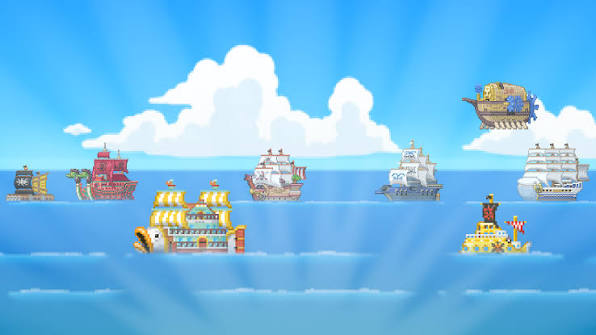
The premise is simple and effective. A fake Baratie has been sullying the name of the real one, so the Straw Hats—plus you, a customizable original character—set out to restore its reputation by opening their own floating restaurant. You start small. A handful of tables, a basic kitchen, Sanji already in the back doing what he does best, and Luffy ready to charge off on exploration runs because of course he is. From there the game opens up in classic Kairosoft fashion: customers arrive, you take their orders (or rather, the staff does while you manage the bigger picture), money comes in, and you reinvest it into better furniture, new recipes, more floor space, and better staff.
The restaurant itself is the star. You decorate with more than two hundred furniture and decoration pieces themed around different islands and arcs—Whole Cake Island sweets, Egghead tech, Wano aesthetics, the works. Layout actually matters a little. Happy customers stick around longer, tip better, and sometimes become regulars who bring friends or drop useful tips. Unhappy ones leave faster and hurt your reputation. It’s never punishing, but it gives you a reason to care about whether the tables are spaced properly or whether that ridiculous giant meat statue is blocking the flow.
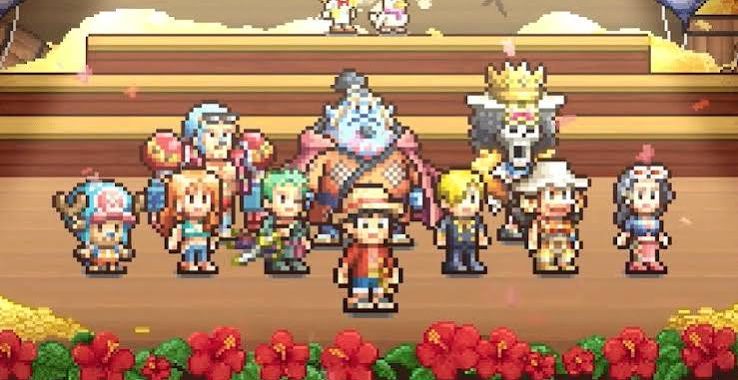
What keeps the loop from feeling like pure busywork is the constant trickle of One Piece characters. There are over four hundred of them. Some show up as customers, some as potential staff, some just to cause a little chaos and then leave you with a new recipe idea or a gift. Seeing Buggy argue with a waiter or watching a Marine admiral quietly enjoy a dessert is the kind of fan-service that works because it never feels forced. The game treats these appearances as natural parts of the world rather than checklist collectibles, even if collecting them is clearly part of the fun.
Cooking, Collecting, and Crew Jobs
Sanji handles the actual cooking. You don’t stand at a stove and time button presses. Instead you gather ingredients by sending crew members out on expeditions, then combine those ingredients into dishes inspired by the series—Water-Water Meat BBQ, Sea King Penne Gorgonzola, Devil Fruit-powered experiments, and plenty of original creations. Dishes get sorted into set menus (main, side, dessert, drink), and the better the combination and the higher the “tastiness,” the more money and satisfaction you earn.
The system is simple on the surface but has enough moving parts to stay interesting for a good while. Different customers have preferences. Some characters unlock unique recipes or reactions. Leveling up dishes and adding plate decorations further boosts their appeal. It never becomes a spreadsheet, but it does reward attention. I found myself rearranging menus more often than I expected just to chase higher satisfaction scores from specific regulars.
The crew system is where the game really leans into the One Piece fantasy. As you reunite the Straw Hats (and eventually bring in others), each one gets a job that fits their personality. Franky expands the ship and builds furniture. Nami handles finances and can score you a daily discount on big purchases. Usopp crafts decorations and utensils. Zoro trains the staff so they level up past normal caps. Luffy explores and finds rare ingredients and rumors. These roles aren’t just flavor text—they meaningfully change how you play. Having Nami around turns expensive upgrades into daily strategic decisions. Having Franky means you can keep growing the restaurant without hitting a hard wall as quickly.
Exploration is the other major pillar. You send characters to locations across the East Blue and beyond—Syrup Village, Loguetown, later Alabasta and further. They come back with ingredients, gifts, rumors about missing crew members, and the occasional story beat. It’s a hands-off system (you don’t control the expeditions in real time), but the returns feel good and the locations are full of little visual nods that fans will appreciate.
The Kairosoft Feel, for Better and Worse
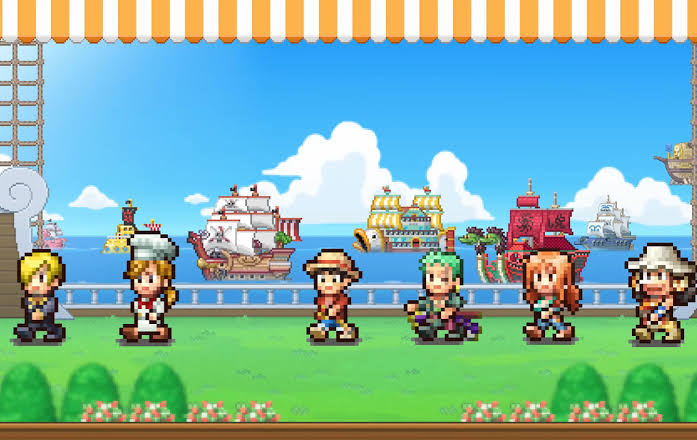
Anyone familiar with Kairosoft’s catalog will feel at home immediately. The pixel art is bright, expressive, and packed with personality. Characters bounce around with exaggerated animations. The restaurant fills up with colorful little sprites that somehow never get too hard to read even when it’s packed. The music is the usual upbeat, looping Kairosoft fare—cheerful and inoffensive, though it does start to wear thin after long sessions. Sound effects are punchy and satisfying when a big tip comes in or a new recipe is unlocked.
The interface is classic Kairosoft: a bit cluttered, a bit text-heavy, and occasionally more opaque than it needs to be. Tutorials are long and hand-holdy at the start, which some players will find comforting and others will find slow. Dialogue boxes sometimes disappear faster than you’d like if you’re trying to read every line. On Switch 2 there are occasional performance dips once the restaurant gets large and crowded—nothing game-breaking, but noticeable enough that I started noticing the frame rate more than I wanted to. PC and mobile versions seem cleaner in that regard from what I’ve seen and heard.
The game is also quite passive compared to something like Cook, Serve, Delicious! or even older Diner Dash-style titles. You are managing systems more than actively serving tables. Some people will love the chill pace. Others will bounce off because it can feel like you’re watching the restaurant more than running it at times. I fell into the first camp, especially once the crew was fully assembled and the systems were humming. There is always something to tweak—a new set menu to test, a decoration to place, an expedition to send out, a character affinity to raise with gifts. The “just one more day” feeling is strong.
Fan Service Done Right (and a Few Caveats)
The biggest strength of Grand Gourmet is how thoroughly it understands its source material without requiring you to be a lifelong fan. You can enjoy the management loop without knowing who half the customers are. At the same time, if you do know the series, the game is constantly rewarding you. Character interactions feel true to their personalities. Locations and recipe names land with a little extra weight. Seeing nearly the entire roster of the series wandering around your ship in pixel form is genuinely delightful.
There are mild spoiler risks for people who are still catching up with the manga or anime, since characters and locations from later arcs appear. The game doesn’t dwell on major plot points, but names and designs alone can give things away. Fair warning if you’re carefully avoiding spoilers.
Content-wise, the game has legs. The main story arc wraps up after a solid twenty or so hours for most players, but the systems keep going. New Game+ style resets, continued expansion, and the pure completionist drive to see every character and unlock every decoration give it real staying power for the right audience. At its roughly $20 price point (a bit higher than some pure Kairosoft titles, probably due to licensing), it feels fair for what you get.
The Not-So-Perfect Bits
It’s not all perfect. The management depth is limited. Once you understand the core loops, there aren’t many hard decisions left—mostly optimization and preference chasing. Finances never feel truly threatening. Failure is soft. Some players will find the lack of real pressure boring after a while. The UI can feel dated and overcrowded. The soundtrack loops a little too aggressively. On console, the occasional lag when the restaurant is packed is annoying. And the early hours are paced slowly while the game teaches you everything.
None of these are deal-breakers for me, but they keep Grand Gourmet from being a true standout management sim in its own right. It is a very good One Piece management sim, and a perfectly solid Kairosoft game that happens to have an excellent license attached.
Who This Is For
If you love One Piece and enjoy cozy, low-stakes management games, this is an easy recommendation. The combination of familiar faces, satisfying expansion, and that specific Kairosoft “one more day” addiction is hard to resist. If you’re a management sim fan who has never watched a single episode, there’s still a fun game here—just know that a big part of the charm comes from recognizing the cast.
If you want deep strategy, tight active gameplay, or a serious challenge, look elsewhere. This is comfort food gaming. It’s bright, cheerful, a little chaotic, and designed to make you smile more than sweat.
I finished my first major playthrough with a restaurant that felt like a proper home for the Straw Hats—tables full of laughing pirates and Marines alike, the menu full of ridiculous and delicious-sounding dishes, the ship expanded far beyond its humble beginnings. It felt like the kind of silly side adventure the series itself might have featured in a filler episode, only here I got to live inside it for dozens of hours.
ONE PIECE: Grand Gourmet doesn’t reinvent the restaurant sim or the Kairosoft formula. It doesn’t need to. It takes a proven, comfortable structure, fills it with one of the most colorful casts in anime, and lets you build something joyful in the middle of the Grand Line. For fans, it’s a treat. For everyone else, it’s a pleasant, low-pressure way to spend a few evenings. Either way, I’m glad this particular ship set sail.
Final score: 7.5 / 10
A warm, generous helping of pirate hospitality that may not be gourmet fine dining, but hits the spot when you’re in the mood for something fun, familiar, and easy to keep coming back to.
