
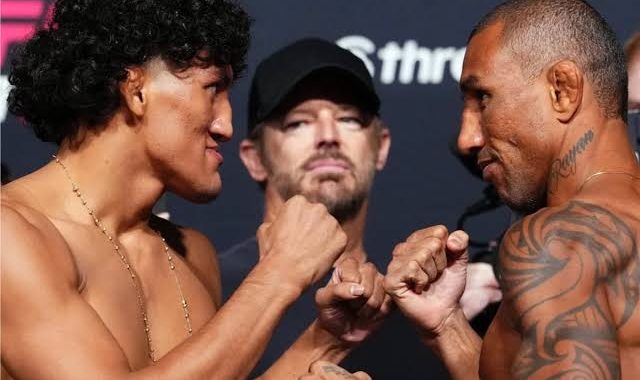
Raul Rosas Jr. steals a war from Raoni Barcelos in a fifth-round thriller that left the Octagon holding its breath
There’s something about a Meta APEX main event that still feels like the purest version of the UFC. No big arena spectacle, just the cage, the lights, the fighters, and whatever they bring into that blue mat. On a late September Saturday in Las Vegas, Raul Rosas Jr. and Raoni Barcelos delivered one of those nights that people will still talk about years from now—not just because of the result, but because of how it ended and everything that led up to it.
The card was billed as UFC Fight Night: Rosas Jr. vs. Barcelos (UFC Vegas 121), and the main event lived up to every ounce of the hype and then some. A 21-year-old prospect with the world in front of him against a 39-year-old Brazilian veteran who had been rewriting his own story on a five-fight win streak. The largest age gap in UFC main event history at 17 years. Both men undefeated in their last five. Both stepping into their first five-round main event. What followed was a bloody, back-and-forth war that swung on heart, timing, and one sudden, terrifying moment in the fifth round.
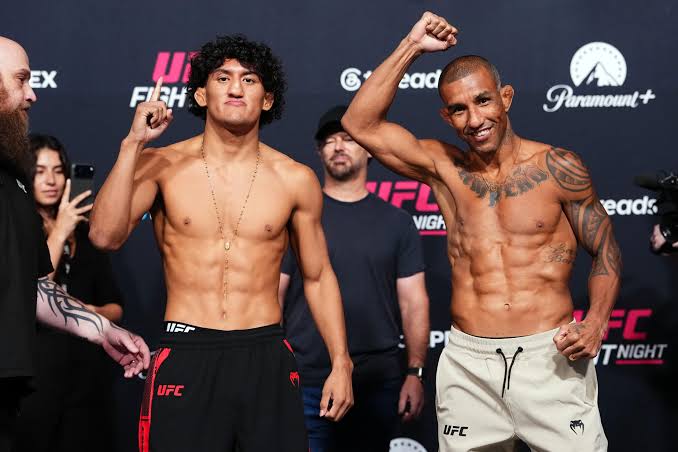
The Setup: Youth vs. Experience, and a Whole Lot of Stakes
Going into the fight, the storylines were clean and compelling. Raul Rosas Jr.—“El Niño Problema”—had already lived a career’s worth of moments before most fighters even get their first UFC contract. He earned that contract at 17 on Contender Series, the youngest ever. By 21 he was ranked, riding a five-fight win streak that included a solid decision over Rob Font, and carrying the kind of expectation that can crush a young fighter. His striking had sharpened. His confidence was obvious. The question everyone kept asking was whether the five-round distance and a crafty, durable veteran would expose the gaps that still exist in a prospect’s game.
Raoni Barcelos arrived as the perfect test. The Brazilian had been around the block, absorbed losses, reinvented himself, and put together a run that included wins over solid names and the kind of veteran savvy that doesn’t show up in highlight reels. At 39 he was still moving well, still dangerous on the feet, and still capable of making younger fighters uncomfortable in the clinch and on the mat. This was his first main event too. He had the experience, the toughness, and the quiet confidence of a man who knows how to make a fight ugly when he needs to.
The matchup promised pace, volume, and grit. Rosas’s athleticism and improving boxing against Barcelos’s pressure, body work, and late-fight experience. Odds leaned toward the younger man, but anyone who had watched Barcelos over the previous couple of years knew this wasn’t going to be simple. It rarely is when a veteran with nothing left to prove meets a kid who believes the sky is the limit.
The Fight: Five Rounds of Carnage
From the opening bell the pace was high. Both men came out ready to work. Rosas switched stances, probed with calf kicks, and showed the sharper early combinations. Barcelos planted his feet, looked for the uppercut and right hand, and answered body shots with his own. The first round was competitive and messy in the best way—exchanges in the pocket, a takedown attempt that didn’t stick long, blood already starting to show. Rosas’s volume and willingness to engage edged it for many observers, but Barcelos was never out of the conversation.
Round two belonged more to the veteran. Barcelos found his rhythm with the jab and body work. Rosas’s output dipped just enough for the older man to take over the center and land cleaner shots. A couple of takedowns mixed in, and by the end of the round both faces were marked up. The swelling on Barcelos’s face was already noticeable. Rosas was bleeding. The fight had the feel of a war that was only getting started.
The third was another back-and-forth scramble. Barcelos got Rosas down and threatened from the back. Rosas scrambled, got to better positions, and kept throwing. By the time the round ended both men were bloodied, both still moving, and the crowd inside the Apex was locked in. Official scorecards would later show Barcelos winning the middle rounds, including a 10-8 from one judge in the fourth. That fourth round was the veteran’s best stretch—control time, a deep rear-naked choke attempt that had Rosas fighting for survival, ground-and-pound, and the kind of grinding pressure that can break a younger fighter’s spirit. Rosas’s nose was a mess. Barcelos’s left eye was closing. Yet neither man slowed down completely.
Heading into the fifth, Barcelos was ahead on the cards. Rosas needed a finish or a clear round. He came out with urgency. Barcelos met him. There was another scramble near the fence. Rosas secured a trip takedown. What happened next is still hard to describe cleanly even with the replays. Barcelos went limp almost immediately on the way down or upon impact. Some saw a possible head collision or the fence playing a role. Others simply saw a man who had given everything suddenly stop defending. Rosas recognized it instantly, stepped off, and didn’t throw unnecessary strikes. Referee Herb Dean waved it off at 1:38 of the fifth. The official result: Raul Rosas Jr. via KO (slam).
Barcelos remained motionless long enough for the medical team to take over. He was stretchered out of the Apex and transported to a Level 1 trauma center. The arena went from roar to quiet concern in seconds. Rosas, still bloodied and breathing hard, immediately asked for prayers for his opponent. Class in a moment when celebration could have felt hollow.
Aftermath and Recovery
The good news came relatively quickly. Barcelos was conscious, alert, and responsive with full movement. UFC confirmed he was stable. His coach and corner provided updates. He spent time in the hospital under observation, underwent scans, and was discharged a few days later. In the weeks that followed he described the moment as a sudden faint or illness, saying his body went numb and he remembered little after that. There was talk of possible traumatic brain injury or swelling as a protective response, but full official diagnosis details remained limited publicly. Barcelos insisted he felt better with time, continued testing and therapy, and left the door open on his future while acknowledging retirement had not been ruled out. The sport exhaled when the updates stayed positive.
Rosas himself was also evaluated afterward—precautionary scans after a war like that are standard. Both men earned Fight of the Night bonuses, a well-deserved $100,000 each for one of the year’s best fights.
Analysis: What the Fight Told Us
This was a genuine Fight of the Year candidate that got overshadowed by the ending. For four-plus rounds it was a clinic in toughness and adaptation. Rosas showed improved striking, real heart when the fight got ugly, and the ability to dig deep when trailing. The finish, however unconventional, still required him to stay present and capitalize when the opportunity appeared. At 21, main-event experience is gold. He now has it, along with a sixth straight win and a statement that he belongs in the upper half of the division conversation.
Barcelos proved once again why veterans like him remain dangerous. He controlled large stretches, mixed striking and grappling effectively, and put Rosas in real trouble late. The age gap was real, but the experience gap was even more apparent in the middle rounds. The sudden end doesn’t erase the quality of the performance. It does, however, force a hard conversation about recovery and long-term health for a 39-year-old who has given the sport everything.
Style-wise, Rosas’s willingness to engage in the pocket and his athleticism created openings. Barcelos’s pressure, body attack, and late-round grinding nearly stole the show. The scorecards reflected a close, competitive fight that could have gone either way if it reached the final bell. One moment changed the narrative.
Top Highlights
- The nonstop pace across five rounds with both men still throwing late.
- Barcelos’s fourth-round dominance, including the near-submission that had the Apex on edge.
- Rosas’s visible second wind in the fifth and the trip that ended it.
- The pure sportsmanship after the stoppage—Rosas prioritizing concern for Barcelos over celebration.
- The visual of two bloodied warriors who left everything in the cage.
The Bigger Picture
Rosas Jr. moves forward with momentum and a growing resume. The bantamweight division is deep and unforgiving, but a young fighter who can win a five-round war while trailing has the kind of intangible that managers and matchmakers notice. Calls for ranked opposition make sense. For Barcelos, the priority remains health. The updates have been encouraging, and his willingness to keep fighting the good fight off the mat is consistent with the toughness he showed inside it.
Nights like this are why people fall in love with MMA. Two fighters with different timelines, different paths, and the same willingness to test themselves against the best available. One walks away with the win and the bonus. The other walks away with the respect of the entire room and the hope that the body recovers fully. The Meta APEX saw a main event that will be remembered for the action, the finish, and the humanity that followed.
Raul Rosas Jr. is still ascending. Raoni Barcelos reminded everyone why the veteran’s road is paved with grit. And for one night in late September, the cage belonged to both of them.