
Final Fantasy Resonance Review: A Pixel-Perfect Love Letter That Actually Hits
There are certain feelings only Final Fantasy can deliver. That first time you board an airship and the map opens up. The moment a battle theme shifts into something bigger and more desperate. The quiet satisfaction of watching your carefully built party finally click against a boss that felt impossible an hour earlier. For a long time, those feelings felt locked in the past. Then Final Fantasy Resonance showed up.
This is the first HD-2D game to carry the Final Fantasy name, and it is also something rarer: a full, single-player, turn-based console RPG built from the bones of a mobile game that most people either never played or quietly dropped years ago. Square Enix and Lancarse took the first story arc of Final Fantasy Brave Exvius (the Lapis portion), stripped out every last gacha mechanic, rebuilt the systems from the ground up, and presented it in the richest version of HD-2D the company has ever shipped. The result is a 40-ish hour adventure that feels like a lost classic that somehow understands exactly what a lot of longtime fans have been missing.
The World of Lapis and the Knights Who Protect It
The story begins in the Kingdom of Grandshelt. Rain is the earnest, blonde commander of the airship squadron. Lasswell is his childhood friend and second-in-command—stoic, capable, and quietly carrying more weight than he lets on. When the Earth Crystal is destroyed by a mysterious armored figure, the two of them are sent to investigate. They quickly cross paths with Fina, a young woman who emerges from a crystal with no memory of who she is. From there the game expands outward across continents as the Sworn Six (sometimes called the Sword Six) systematically target the remaining crystals, threatening the balance of the world.
It is classic Final Fantasy material. Crystals, airships, chocobos, moogles, espers, and a band of heroes bound by fate. The tone stays mostly earnest with regular injections of humor, especially once the party starts growing. Lid, the airship mechanic, brings practical energy and some of the best banter. Later additions like Nichol and Sakura add different flavors—tactician and ageless mage respectively—though not every supporting character gets the same level of development. The core trio of Rain, Lasswell, and Fina carries the emotional weight, and their relationships are the strongest part of the writing. The brotherly bond between Rain and Lasswell in particular feels lived-in. You can sense the history even when the dialogue is straightforward.
That said, the story is not going to rewrite the series’ narrative high-water marks. Large stretches play like solid, well-produced JRPG fare rather than something transcendent. Dialogue can feel a little padded, and some of the regional side plots about environmental damage or political oppression are fine on their own but do not always weave together as tightly as they could. The Sworn Six start strong as imposing antagonists and get more interesting as their motivations surface, but the final stretch takes some sharp turns that not every player will love. If you go in expecting Final Fantasy VI or IX-level emotional precision, you may feel the gap. If you go in wanting a sincere, well-paced crystal-saving adventure with genuine heart between its leads, it delivers.
Combat That Remembers Why Turn-Based Felt Good
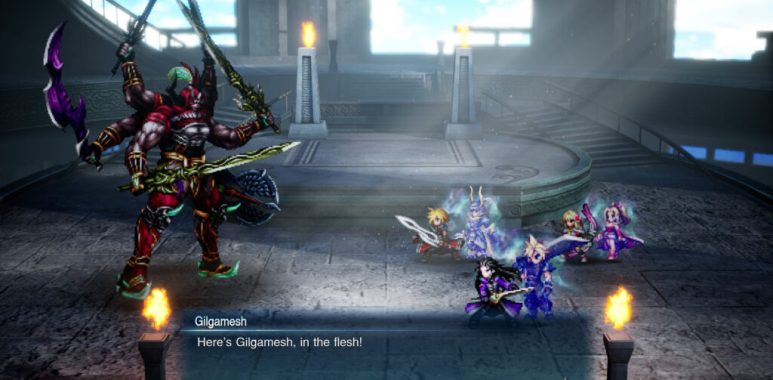
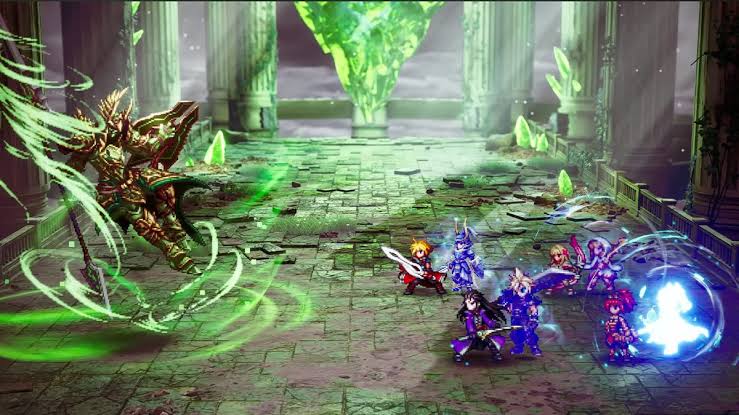
The combat is pure turn-based. No ATB bars. A clear timeline shows whose turn is coming, and you plan accordingly. Every enemy has a stagger meter. Hitting weaknesses and landing strong attacks fills it. Stagger an enemy and you get bonus actions. Stagger the entire group and the party enters a Resonance phase that ends with a big cinematic attack from one of your equipped Visions.
Visions are the mechanical heart of the game. These are crystallized echoes of iconic Final Fantasy characters—Cloud, Tidus, Cecil, Terra, Lightning, Clive, and many more. You find them at Sanctums of Light scattered across the world. Equip one to a party member and that character gains the Vision’s abilities, elemental affinities, and eventually passive bonuses. Level the Vision and you unlock more skills that can be assigned even after you swap it out. It sits somewhere between Final Fantasy V’s job system and VI’s esper system, and it works beautifully. Building a pure lightning-focused team to dismantle a water boss feels great. Mixing physical powerhouses with support Visions creates real flexibility. The system rewards experimentation without demanding spreadsheets.
Early game combat is relatively easy if you keep your elemental coverage solid. Things tighten up in the mid-to-late game when enemies hit harder, status effects become more dangerous, and bosses demand actual planning. The satisfaction of setting up a perfect stagger and watching the whole party unload is real. Animations land with weight, and the camera work during big moments makes the pixel art feel dynamic in a way earlier HD-2D games only gestured toward.
Side content keeps the systems interesting longer. There is a colosseum, the Chamber of Arms with tough optional fights, Gilgamesh appearances, and a proper Ultima Weapon encounter. Exploration on the overworld and by airship turns up shrines, hidden bosses, and treasure. Dungeons themselves are often on the short side—more focused set pieces than sprawling labyrinths—which some players will appreciate and others will miss.
The Best HD-2D Yet
Visually, Resonance is a showcase. Character sprites are more expressive and detailed than anything in the Octopath or Dragon Quest HD-2D games. Facial animations and body language sell emotion during cutscenes in a way pure pixel art rarely manages. Towns and environments look gorgeous, though the fixed camera angles in some settlements can make navigation slightly fiddly when you are hunting chests. The mix of detailed pixel characters against richer 3D environments and dynamic lighting is the strongest argument yet that HD-2D still has room to grow.
The soundtrack, handled by Noriyasu Agematsu with a large selection of returning Brave Exvius tracks plus new material, is frequently excellent. Town themes capture the personality of each region. Battle tracks range from energetic to full orchestral-metal hybrids that somehow work. Certain Vision recruitment sequences that lean on classic series motifs hit hard if you have history with those games. The music carries a lot of the emotional heavy lifting when the writing is more functional than inspired.
Who This Is For
If you have been waiting for Final Fantasy to remember how good pure turn-based combat can feel, this is the game. If the idea of collecting and customizing around classic series icons appeals to you, the Vision system will keep you occupied for a long time. If you love the look of HD-2D and want to see it applied to Final Fantasy aesthetics with airships, crystals, and chocobos, Resonance is the best version of that aesthetic the company has made.
It is not perfect. The story has soft spots and a few late swings that do not land for everyone. Some party members feel less essential once the roster grows. Random encounters can occasionally interrupt the flow when you just want to move. And because it is built on the foundation of a mobile story arc, there are moments where the structure still feels a little episodic.
None of those issues erase what works. The combat is deep and satisfying. The presentation is frequently stunning. The core relationships have genuine warmth. And the whole package feels like Square Enix looked at what made the classic era special, kept the soul of it, and built modern systems and production values around it instead of simply chasing nostalgia.
At $49.99 it is also priced like a substantial mid-tier RPG rather than a full-price blockbuster, which makes the 40–50 hour runtime (depending on how thoroughly you explore) feel generous.
Final Fantasy Resonance is not trying to reinvent the series. It is trying to prove that the classic formula still has power when it is treated with care and given modern polish. For a lot of players who grew up on 16-bit and early PlayStation Final Fantasy, that is more than enough. It is the first time in years that a new Final Fantasy has made me want to immediately start a second playthrough just to try different Vision combinations and dig into the post-game content.
Hope resonates within the crystals, the game’s marketing says. In this case, the hope is pretty well placed. This one is worth your time.
