

England’s Resilient Triumph: Clinching a Thrilling 4-Wicket Victory Over New Zealand in Super Eights Thriller at the 2026 T20 World Cup
In a match that encapsulated the raw drama and unpredictability of T20 cricket, England secured a hard-fought 4-wicket win over New Zealand in the 49th match of the ICC Men’s T20 World Cup 2026. Played under the lights at the R. Premadasa International Cricket Stadium in Colombo on February 27, 2026, this Super Eights Group 2 clash saw New Zealand post a competitive 159/7 after opting to bat first. England, already qualified for the semi-finals, chased it down in 19.3 overs, finishing at 161/6 with three balls to spare. The victory not only completed England’s perfect run through the Super Eights but also kept the door ajar for other teams’ qualification hopes, while leaving New Zealand to anxiously await results elsewhere.

The 2026 edition, co-hosted by India and Sri Lanka, featured an expanded 20-team format with intense group stages leading into the Super Eights. Group 2 had been fiercely contested, with England emerging as the dominant force. Under captain Harry Brook’s leadership, the side boasted a blend of explosive batting firepower and versatile bowling options. Their earlier wins—a commanding 51-run victory over Sri Lanka and a tense two-wicket thriller against Pakistan—had already sealed their top spot. New Zealand, led by Mitchell Santner in the absence of regular skipper Kane Williamson (rested for this phase), had a mixed bag: a dominant 61-run win over Sri Lanka, a no-result against Pakistan, and now this crucial encounter. The Black Caps needed a strong performance to bolster their net run rate and semi-final prospects.
Colombo’s R. Premadasa Stadium, with its spin-friendly track and dew factor in evening games, often favors teams batting second. New Zealand won the toss and elected to bat, aiming to set a defendable total on a surface that gripped early but eased later. England made a bold tactical call, opting for spin-heavy bowling—deploying 16 overs of spin, a first in their T20I history—to exploit the conditions.
New Zealand’s innings got off to a cautious start. Openers Finn Allen and Devon Conway faced disciplined bowling from Adil Rashid and debutant spinner Rehan Ahmed. Allen fell early for 12, miscuing a lofted shot off Will Jacks to long-on. Conway (18) followed, stumped off Rashid attempting a sweep. At 38/2 after the powerplay, New Zealand needed momentum. Glenn Phillips, in fine form, provided it with a brisk 39 off 28 balls, including three sixes—one a massive pull over midwicket off Liam Livingstone. Rachin Ravindra chipped in with 22, but wickets fell regularly.
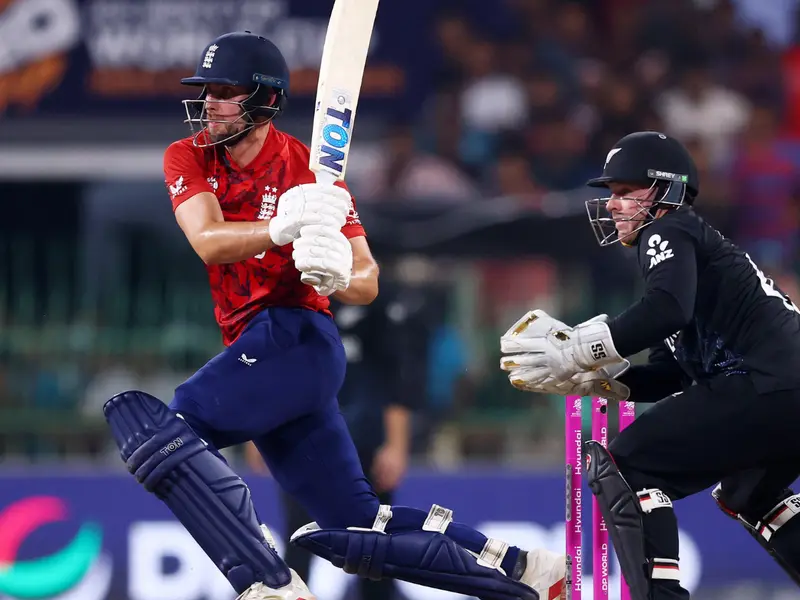
Jacks, bowling his off-spin, was exceptional, claiming 2/23 in four overs, including the key scalps of Phillips (caught at deep midwicket) and Daryl Mitchell (lbw to a slider). Rehan Ahmed, the young leg-spinner, added two wickets—dismissing Santner (15) and James Neesham (8)—with clever variations. Rashid picked up one, while pace options Mark Wood and Jofra Archer (returning from injury) bowled tight in the death. New Zealand managed 159/7, with lower-order contributions from Tim Southee (12*) and Matt Henry (9*). The total felt par on this pitch, but England’s chase would test their depth.
England’s pursuit began explosively. Philip Salt smashed the first ball from Trent Boult for four, but fell for 2 in the next over, caught behind off Henry. Jos Buttler (2) departed cheaply, edging Ravindra to slip. Tom Banton, promoted to open, steadied with 33 off 22, including a pulled six off Santner. However, Brook (14) and Jacob Bethell (10) fell in quick succession to Ravindra, leaving England 58/4 in the ninth over. At that point, needing 102 from 66 balls, the game tilted toward New Zealand.
Enter Will Jacks and the lower order. Jacks, batting at No. 6, played with composure, mixing powerful drives with calculated sixes. Rehan Ahmed, sent up the order as a pinch-hitter, provided fireworks. The pair needed 43 off the last three overs when they came together. Santner’s 18th over went for 16, including two sixes from Jacks. In the 19th, bowled by Henry, Jacks smashed a six over long-on and a boundary, reducing the equation to manageable.
The final over, bowled by Matt Henry, was edge-of-the-seat stuff. Needing 5 off 6, Jacks took a single, then Ahmed launched a six over midwicket off a full toss. A bye and a leg-bye followed, before Jacks sealed it with a four off a short ball that deflected off his helmet/glove to the boundary. Their unbeaten 44-run stand off just 16 balls turned the game dramatically. Jacks finished unbeaten on 32 off 18 (two fours, three sixes), earning Player of the Match, while Ahmed blazed 19* off 7.
Post-match, Jacks reflected: “We knew the dew would help, but credit to the bowlers for keeping it tight. Rehan’s cameo was massive—pure confidence.” Brook praised the spin strategy: “16 overs of spin worked wonders on this track. We’re peaking at the right time.” Santner rued the collapse: “We needed 180-plus. Credit to England—they fought back brilliantly.”
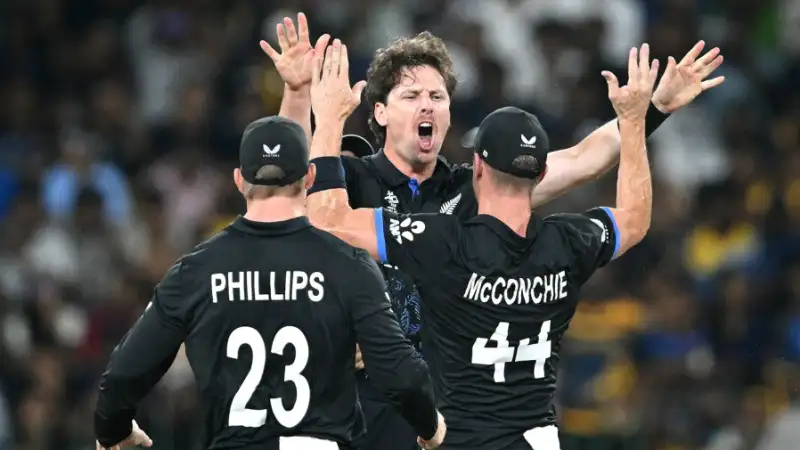
Key stats highlighted the match’s intensity: England’s spin dominance restricted New Zealand’s scoring rate in the middle overs. Jacks became the first England player to score 30+ and take 2 wickets in a World Cup match since 2022. The chase featured the highest successful run-rate in the death overs for England in T20Is this tournament.
This result saw England finish Super Eights Group 2 unbeaten with 6 points and a strong NRR (+1.096), topping the group. New Zealand, with 3 points from three matches (one win, one loss, one NR), relied on net run rate and the outcome of Pakistan vs Sri Lanka the next day to confirm their semi-final spot. Ultimately, they advanced to face South Africa in Kolkata, while England prepared for a blockbuster against India in Mumbai.
The match underscored T20’s fine margins—early wickets nearly derailed England, but resilience and individual brilliance prevailed. As the tournament headed to the knockouts—South Africa vs New Zealand (Semi 1), England vs India (Semi 2)—this Colombo thriller will be remembered as the one where England refused to yield, turning potential defeat into a statement victory.
In the broader context, England’s unbeaten Super Eights run positions them as strong contenders for a third T20 World Cup title, building on their 2010 and 2022 triumphs. New Zealand’s fightback efforts, despite the loss, showcased their never-say-die spirit, setting up an intriguing semi-final. Cricket fans worldwide were treated to yet another classic in a tournament full of them.

