
MOTORSLICE Review — Chainsaws, Concrete, and the Loneliness of Megastructures
There’s a specific kind of feeling that only certain games can create. It’s the feeling of standing inside a place so impossibly huge and abandoned that it almost stops feeling man-made. You look up at miles of concrete walls, rusted machinery hanging from ceilings, pipes stretching into darkness, and suddenly you feel tiny. Not scared exactly — just insignificant.
MOTORSLICE understands that feeling better than almost any game released this year.
Released on May 5, 2026, by Regular Studio and published by Top Hat Studios, MOTORSLICE is an action-adventure platformer built around parkour, giant industrial boss fights, and a chainsaw that feels less like a weapon and more like an extension of the protagonist herself. On paper, it sounds chaotic — maybe even ridiculous. “Anime girl fights giant construction equipment with a chainsaw” doesn’t exactly scream emotional depth or artistic subtlety.
And yet somehow, MOTORSLICE becomes something strangely beautiful.
It’s part high-speed platformer, part atmospheric exploration game, part boss-rush spectacle, and part melancholic slice-of-life story about routine, isolation, and identity. It borrows ideas from classics like Mirror’s Edge, Shadow of the Colossus, and Prince of Persia, but it never feels like a cheap imitation of any of them. Instead, it transforms those inspirations into something that feels deeply personal.
It’s messy in places. Sometimes frustrating. Occasionally janky. But it’s also one of the most memorable indie games of 2026.
A Story About Work, Machines, and Existing in Empty Spaces
The premise of MOTORSLICE is deceptively simple.
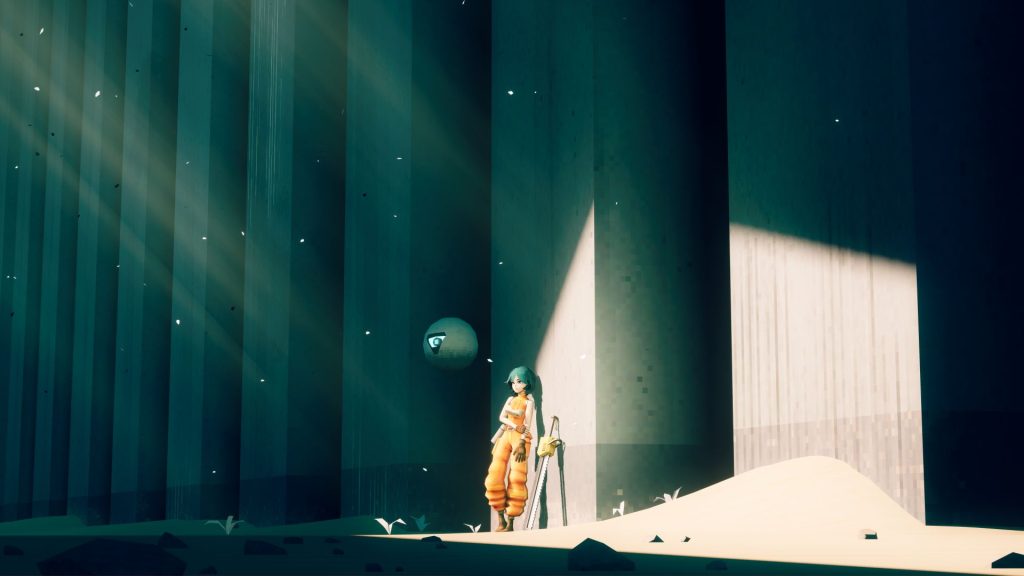
You play as P, a young woman known as a “Slicer,” sent into a massive abandoned industrial megastructure with one objective: destroy every machine inside. That’s the job. Get in, eliminate the machines, get out.
Simple.
Except almost immediately, things feel wrong.
The megastructure is far larger than expected. Stranger than expected. The machines don’t behave normally. The silence becomes oppressive. And the deeper P travels into the concrete labyrinth, the more the game begins to feel like a dream that’s slowly unraveling.
What surprised me most about MOTORSLICE is how restrained the storytelling is. Modern games often explain too much. Characters constantly talk, lore logs flood your inventory, and exposition arrives every few minutes to make sure nobody feels confused. MOTORSLICE takes the opposite approach.
Large stretches of the game are quiet.
You spend long periods simply moving through empty industrial ruins while ambient jungle and drum-and-bass tracks echo through the environment. Sometimes the only sounds are footsteps, distant machinery, and the roar of P’s chainsaw.
The game trusts atmosphere to do the storytelling.
And honestly, that trust pays off.
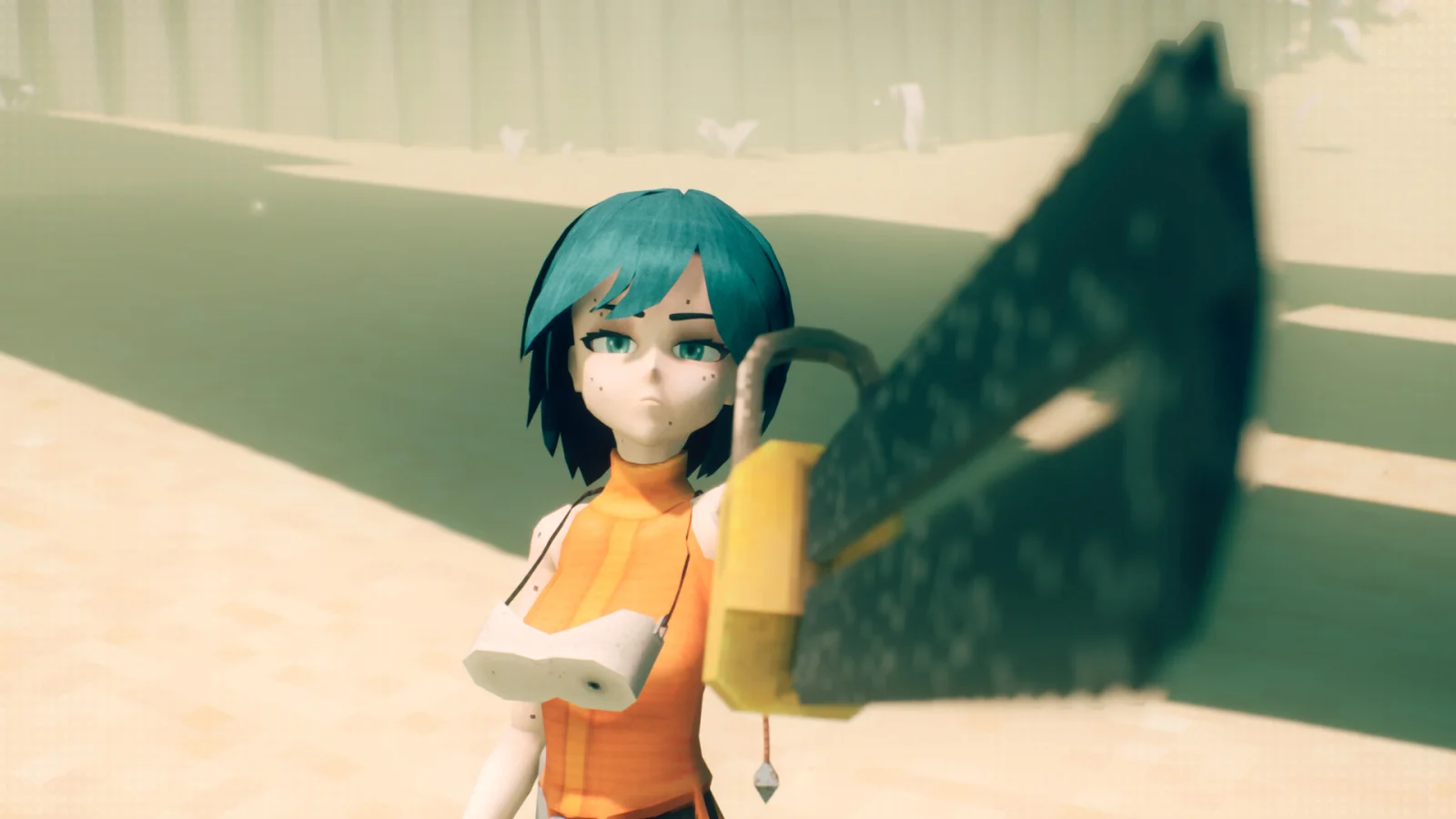
P herself is immediately likable. Voiced by Kira Buckland, she’s awkward, exhausted, sarcastic, and oddly relatable. She doesn’t feel like a traditional action hero. She feels like someone trying to survive another terrible workday in the worst possible workplace imaginable.
The quieter “slice-of-life” moments scattered between combat sections are some of the game’s strongest scenes. P reflects on her job, complains about routine tasks, takes goofy selfies, or simply sits in silence staring at the endless architecture surrounding her. These moments give MOTORSLICE a strange humanity that most action games completely lack.
It’s easy to laugh at the game’s premise initially, but after a few hours, you stop seeing “anime chainsaw girl” and start seeing a genuinely well-written protagonist trapped inside an oppressive mechanical world.
Movement Is the Real Star
Before playing MOTORSLICE, I expected the chainsaw combat to be the main attraction.
It isn’t.
Movement is.
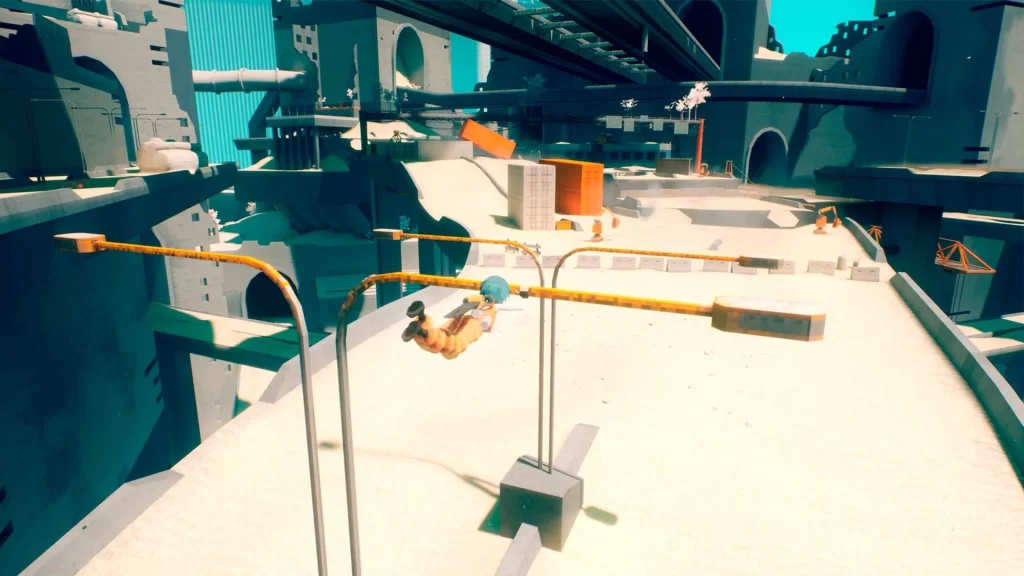
From the first few minutes, the game establishes that traversal is the core experience. Running, wall-jumping, sliding, climbing, vaulting, and chaining parkour moves together feels incredible when everything clicks. P moves with a fluidity that makes many AAA platformers look stiff by comparison.
The influence of Mirror’s Edge is obvious, but MOTORSLICE feels more aggressive and improvisational. Movement isn’t just about reaching objectives — it’s survival. Enemy encounters often become frantic momentum-based puzzles where standing still for even a second can get you killed.
And yes, you die quickly.
Very quickly.
MOTORSLICE follows the “you die easily, but enemies die easily too” philosophy. Combat encounters become tense bursts of movement and violence where positioning matters more than brute force. The chainsaw is devastating, but only if you’re fast enough to use it effectively.
There’s a wonderful rhythm to the gameplay loop:
Sprint across collapsing platforms.
Leap between suspended beams.
Slide under mechanical arms.
Launch yourself toward weak points on giant machines.
Carve into metal plating with the chainsaw.
Escape before the entire structure collapses around you.
At its best, MOTORSLICE feels almost musical.
The game’s level design deserves enormous praise here. The megastructure itself becomes the true main character. Every environment feels carefully built to encourage experimentation and momentum. Massive concrete towers, abandoned transit systems, industrial elevators, broken cranes, and impossible vertical spaces constantly reshape how you approach traversal.
There’s always another hidden route. Another shortcut. Another dangerous jump that feels barely possible until you somehow pull it off.
Few games this year have captured verticality this effectively.
The Boss Fights Are Spectacular
If traversal is the heart of MOTORSLICE, the boss fights are its soul.
This is where the Shadow of the Colossus inspiration becomes impossible to ignore — and thankfully, MOTORSLICE uses that inspiration brilliantly instead of lazily copying it.
Most bosses are gigantic industrial machines: excavators, cranes, drilling rigs, transport systems, and horrifying construction monstrosities that look like they escaped from a nightmare fueled by concrete and hydraulic fluid.
But these aren’t traditional boss fights.
You don’t simply dodge attacks and hit weak points.
Instead, each encounter becomes a traversal puzzle. You climb onto moving machinery while avoiding attacks, searching for ways to expose vulnerable areas before tearing them apart with the chainsaw. The environment itself constantly becomes part of the battle.
One boss encounter involving a colossal mining machine genuinely left me speechless. The scale was absurd. Entire sections of the arena shifted as the machine moved. Pipes exploded overhead while platforms collapsed beneath my feet. Meanwhile, P desperately sprinted across rotating machinery trying to reach a weak point before being crushed.
It felt cinematic without relying on scripted cutscenes.
That’s a difficult balance to achieve.
The bosses also avoid feeling repetitive because each one introduces new traversal mechanics or environmental hazards. Some emphasize speed. Others require careful climbing. A few become endurance tests where maintaining momentum is more important than dealing direct damage.
Not every fight lands perfectly. A couple encounters suffer from camera issues and occasionally unclear objectives. Still, even the weaker bosses remain visually unforgettable.
And visually unforgettable is the perfect way to describe MOTORSLICE overall.
A Beautifully Ugly World
Most post-apocalyptic games rely on familiar aesthetics: overgrown cities, deserts, ruined suburbs, military bunkers.
MOTORSLICE goes somewhere weirder.
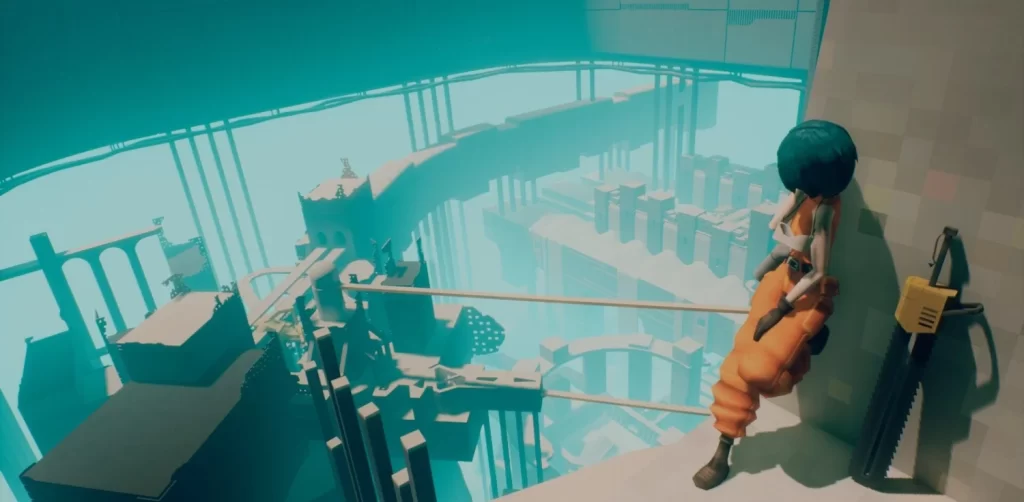
The game’s environments are heavily inspired by brutalist architecture — gigantic concrete structures that feel cold, oppressive, and strangely timeless. Endless gray hallways stretch into darkness. Industrial elevators disappear into impossible depths. Giant mechanical skeletons loom over abandoned platforms.
It’s ugly in a very deliberate way.
And somehow beautiful because of it.
The game uses a low-poly visual style combined with pixelated textures and modern lighting techniques. Normally that combination could feel inconsistent, but here it creates a surreal dreamlike atmosphere. Everything feels slightly unreal, like you’re exploring a memory instead of a physical place.
Lighting plays a massive role in this atmosphere. MOTORSLICE constantly contrasts darkness with harsh industrial lighting, glowing machinery, distant neon, and soft environmental haze. Entire scenes feel like interactive concept art.
There were moments where I stopped moving entirely just to absorb the environment.
One particular sequence had P standing atop an enormous abandoned transport system while orange light from a dying sunset reflected across endless concrete structures. No enemies. No dialogue. Just ambient music and impossible architecture stretching toward the horizon.
It’s one of the most visually striking moments I’ve experienced this year.
And somehow, a tiny indie game made it happen.
The Soundtrack Is Incredible
The soundtrack by Pizza Hotline deserves special recognition because it completely transforms the game’s atmosphere.
MOTORSLICE’s music constantly shifts between atmospheric jungle, drum-and-bass, ambient electronic tracks, and melancholic synth-heavy pieces. The soundtrack understands exactly when to intensify gameplay and when to step back into eerie silence.
During parkour sections, tracks pulse with nervous energy that perfectly matches the movement system. During quieter moments, the music becomes reflective and lonely.
It’s one of those rare game soundtracks that feels inseparable from the world itself.
The audio design overall is excellent too. The chainsaw sounds brutal without becoming obnoxious. Machinery groans and echoes realistically through massive spaces. Environmental ambience constantly reinforces the scale of the megastructure.
Even simple sounds — footsteps, sliding across concrete, metal collapsing in the distance — contribute to the game’s oppressive atmosphere.
Play this game with headphones if possible.
Seriously.
The Rough Edges Are Real
As much as I admire MOTORSLICE, it absolutely has problems.
The biggest issue is inconsistency.
Sometimes the movement feels flawless. Other times, the physics become unpredictable. There were moments where P grabbed ledges perfectly and others where identical jumps failed for unclear reasons.
The camera can also struggle during intense boss encounters, especially when multiple moving parts fill the screen simultaneously. A few deaths felt genuinely unfair because visibility became messy.
Checkpoint placement occasionally becomes frustrating too. Some difficult platforming sections require repeating longer sequences than necessary after failure. Since the game demands precision movement, repetition can become exhausting.
There are technical issues as well.
Several players reported launch bugs involving save corruption and checkpoint problems, though the developer responded quickly with patches after release. Even during my experience, I encountered minor glitches, awkward collision moments, and occasional animation hiccups.
But honestly?
None of these issues ruined the experience for me.
That’s the strange thing about MOTORSLICE. It’s rough around the edges, yet its ambition and atmosphere carry it through those flaws. You can feel the passion behind every part of the game. It doesn’t feel manufactured. It feels handcrafted by people obsessed with a specific artistic vision.
That matters.
Especially in an industry increasingly dominated by safe, overly polished design.
The Indie Spirit Is Alive Here
One of the most fascinating things about MOTORSLICE is how clearly it reflects independent development.
You can see where corners had to be cut. You can spot technical limitations. But you can also feel the freedom that comes from not being trapped inside corporate design philosophy.
A larger studio probably would have added unnecessary tutorials, excessive dialogue, bloated skill trees, crafting systems, and endless collectibles.
MOTORSLICE avoids almost all of that.
It remains focused on movement, atmosphere, and emotional tone.
That focus makes the game stand out immediately.
Even its stranger ideas — like optional selfie mechanics or awkward slice-of-life interactions — help establish personality. Modern action games often feel terrified of sincerity. MOTORSLICE embraces it completely.
The game can be goofy. Melancholic. Stylish. Introspective. Chaotic.
Sometimes all within the same hour.
And somehow it works.
Community Reception Feels Earned
The positive reception surrounding MOTORSLICE feels completely deserved.
Within days of launch, the game earned “Very Positive” user reviews on Steam, with players praising its atmosphere, traversal mechanics, and boss fights. Many comparisons to Shadow of the Colossus appeared online almost immediately, though the game’s identity extends beyond that inspiration.
Reddit discussions have already started speculating about a potential sequel, especially after the game’s ending hints at larger mysteries beyond the megastructure.
What’s especially impressive is that MOTORSLICE reportedly recouped development costs almost immediately after release. For a relatively small indie project, that’s an enormous success story.
And honestly, it deserves the attention.
Games like this are increasingly rare — projects driven by strong artistic identity rather than market trends.
Final Verdict
MOTORSLICE is not perfect.
It’s occasionally frustrating. The camera struggles sometimes. Movement can feel inconsistent. Technical issues still exist. Certain sections clearly needed more polish.
But perfection was never the point.
What makes MOTORSLICE special is its atmosphere, confidence, and originality. It understands exactly what it wants to be and commits fully to that vision. Few games capture loneliness, scale, and movement this effectively. Even fewer combine them with such memorable art direction and emotional subtlety.
This is a game about climbing impossible structures while trying not to lose yourself inside them.
It’s about routine work becoming existential horror.
It’s about momentum — physically and emotionally.
Most importantly, it’s a reminder that indie games can still surprise us.
In a year crowded with sequels, remakes, live-service experiments, and bloated open worlds, MOTORSLICE feels refreshingly personal. It may not have the budget of a AAA blockbuster, but it has something many bigger games lack entirely:
A soul.
And honestly, that matters more.
