
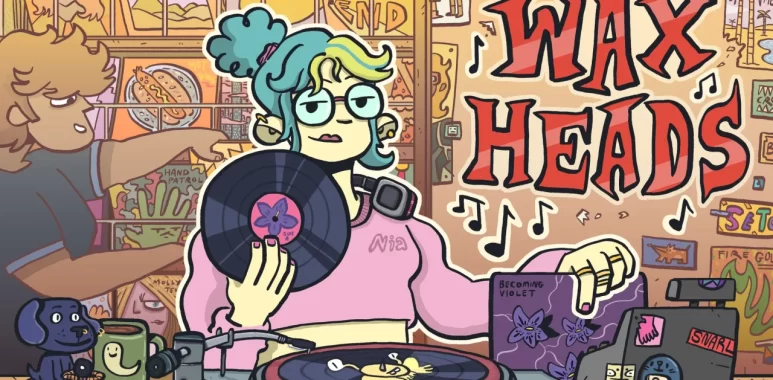
Wax Heads Review — A Love Letter to Music, Misfits, and the Magic of Record Stores
There are games that try to simulate jobs, and then there are games that try to simulate feelings. Wax Heads belongs firmly in the second category. On paper, it sounds almost aggressively niche: a narrative puzzle game about working in a struggling independent record store. You spend your days talking to eccentric customers, digging through vinyl crates, solving music-based recommendation puzzles, and getting wrapped up in the lives of coworkers who are all carrying their own emotional baggage. That premise alone probably determines whether you’re already interested or whether you checked out halfway through this paragraph.
But here’s the thing: Wax Heads is not really about records.
It’s about identity. About community. About the weirdly intimate relationship people have with music. About the way songs become timestamps in our lives. About the dying art of spaces where people gather simply because they love something.
Released on May 5, 2026, by developer Patattie Games and publisher Curve Games, Wax Heads arrived quietly amid a packed indie release calendar. Yet within days, it had become one of the year’s most passionately discussed indie titles among narrative game fans and cozy-game communities.
And after spending around ten hours inside the cluttered little world of Repeater Records, it’s easy to understand why.
This game has soul.
Welcome to Repeater Records
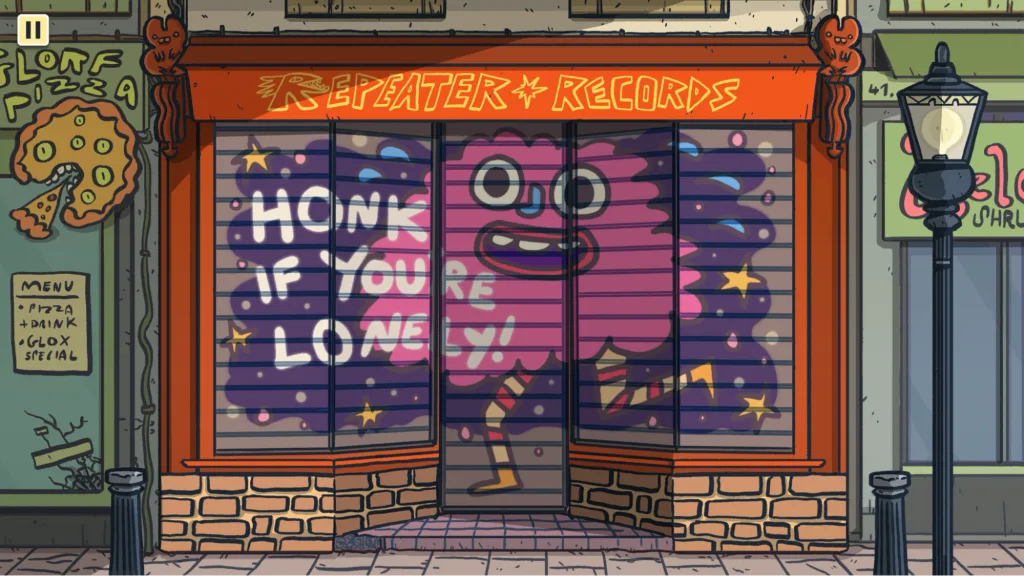
The setup is deceptively simple. You play as the newest employee at Repeater Records, an independent vinyl shop that’s barely surviving in a rapidly changing world. Streaming dominates music culture, rent prices are rising, and the store feels like it’s one bad month away from disappearing entirely.
Your job is straightforward: help customers find the perfect album.
Except customers in Wax Heads rarely ask for music directly.
Instead, they describe emotions, memories, aesthetics, or cryptic vibes. One person might want something “like heartbreak after a rooftop party.” Another might ask for music that sounds “humid and dangerous.” Someone else insists they need a record for “driving alone at 2 AM while questioning capitalism.”
The brilliance of Wax Heads lies in how it transforms these conversations into detective work. You browse fictional albums, study cover art, read reviews, inspect band histories, check in-universe social media posts, and gradually piece together what each customer is actually searching for.
At first, it feels like a quirky gimmick.
Then it becomes strangely addictive.
The Joy of Musical Deduction
Most puzzle games reward logic. Wax Heads rewards intuition.
That distinction matters.
You aren’t solving mathematical equations or manipulating objects in physical space. You’re interpreting human beings. You’re learning how personality, fashion, language, nostalgia, and emotion connect to taste.
A teenager wearing patched denim and combat boots might secretly love dreamy synth-pop. An older customer talking about “real music” may unexpectedly gravitate toward experimental noise records. The game constantly nudges you away from stereotypes and toward empathy.
That’s what makes the recommendation system so satisfying.
Every successful match feels personal.
And because the game creates an entire fictional music ecosystem—with dozens of fake bands, genres, rivalries, scandals, fanbases, and lore—the world begins to feel uncannily real. There are over 80 handcrafted albums in the game, each with its own visual identity and backstory.
You start remembering bands the way people remember actual artists.
You develop favorites.
You become emotionally invested in musicians who technically don’t exist.
That’s an extraordinary achievement.
The Writing Is the Real Star
Games centered around dialogue live or die by their writing. If the conversations feel artificial, the illusion collapses instantly.
Thankfully, Wax Heads has some of the sharpest indie writing in recent memory.
The dialogue feels messy, funny, awkward, and deeply human. Characters interrupt themselves. They overshare. They ramble about obscure bands nobody else cares about. They argue about authenticity in music with the kind of intensity normally reserved for political debates.
It never sounds like game dialogue.
It sounds like people.
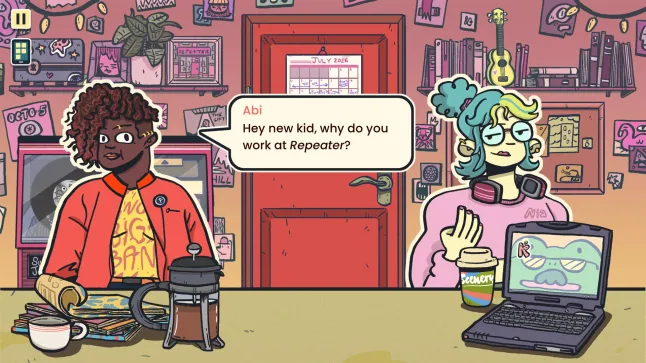
That authenticity extends to the main cast working at Repeater Records. Your coworkers aren’t just NPCs waiting to deliver exposition. They feel like fully realized individuals with complicated histories and conflicting personalities.
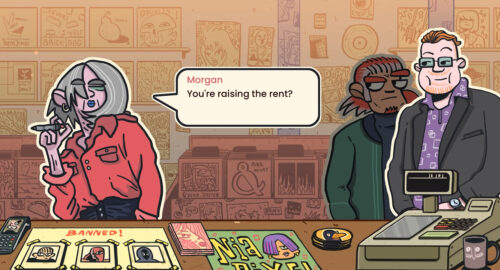
Morgan, the emotionally guarded owner of the shop, slowly emerges as the emotional center of the story. Matteo’s chaotic energy masks vulnerability. Willow carries a quiet sadness beneath her warmth. Hank feels like the kind of person every local music scene somehow produces: deeply cynical yet incapable of abandoning the thing he loves.
The game gives these characters room to breathe.
Some conversations go nowhere important. Some scenes exist purely to build atmosphere. Some moments are hilariously mundane. But together, they create the sensation of actually belonging somewhere.
Few games understand community this well.
Cozy-Punk Is the Perfect Description
The developers describe Wax Heads as “cozy-punk,” and surprisingly, that term fits perfectly.
It has the warmth and low-pressure structure of cozy games, but beneath that comfort is genuine anger about commercialization, artistic exploitation, and the erosion of independent spaces.
This isn’t the sanitized coziness of perfectly curated farm sims where nothing truly bad happens. Wax Heads exists in a world shaped by burnout, financial anxiety, loneliness, and cultural homogenization.
But instead of becoming cynical, the game chooses hope.
That emotional balance is incredibly difficult to pull off. Too much darkness and the cozy atmosphere collapses. Too much positivity and the themes lose weight.
Wax Heads walks that line beautifully.
The result feels emotionally honest in a way many narrative games don’t.
The Art Style Is Stunning
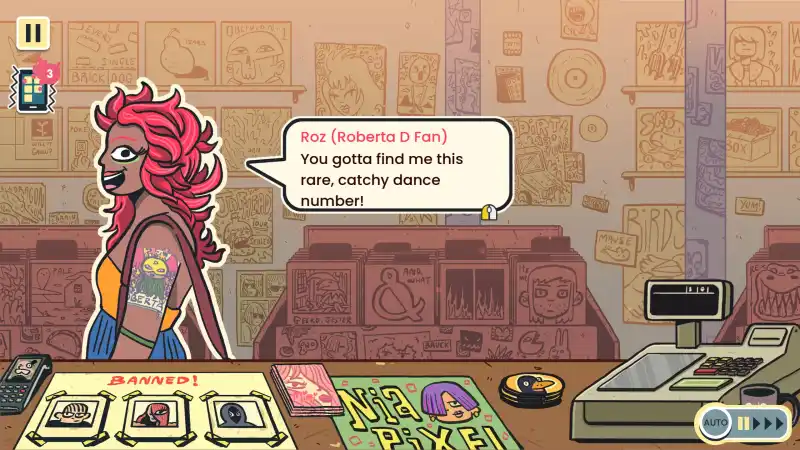
Visually, Wax Heads looks like a punk zine came to life.
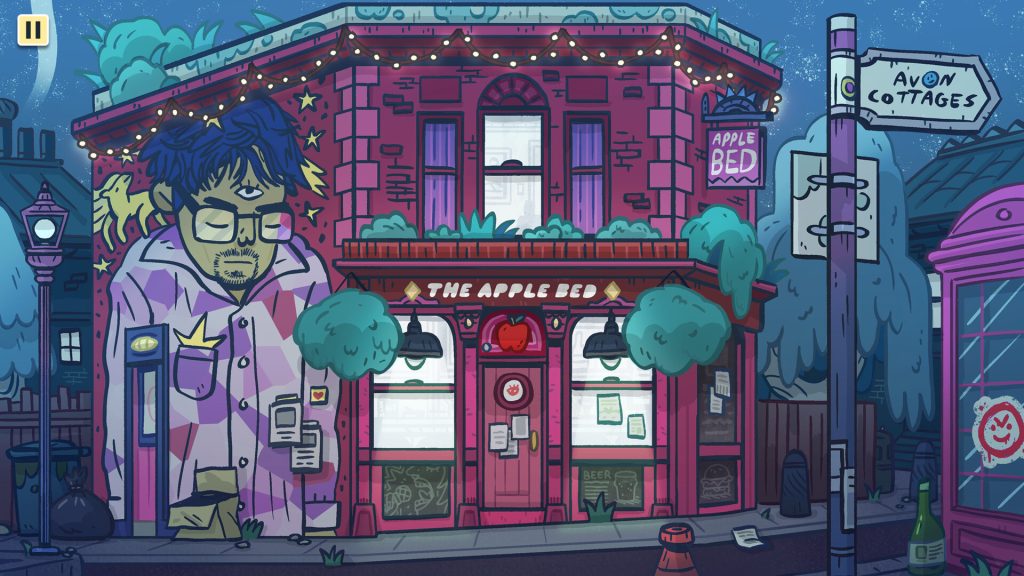
Everything is hand-drawn with thick lines, bold colors, exaggerated expressions, and a slightly messy aesthetic that perfectly matches the world. Posters crowd the walls. Record sleeves stack everywhere. Flyers overlap on corkboards. The store feels cluttered in the best possible way.
There’s an intentional roughness to the art direction that gives the game personality. It never feels over-polished or corporate. You can practically feel the fingerprints on it.
Character designs are especially memorable. Nearly everyone looks distinct enough that you could recognize them instantly from silhouette alone. Fashion choices communicate personality before a single line of dialogue appears.
And perhaps most importantly, the world feels lived-in.
Too many narrative games create environments that exist solely as backdrops for plot progression. Repeater Records feels like a place people actually spend time in.
You want to hang out there.
The Soundtrack Had an Impossible Job
A game centered around music lives or dies by its soundtrack.
Fortunately, Wax Heads absolutely delivers.
The game features dozens of original tracks spanning multiple genres, all designed to sound like believable underground bands from different eras and scenes.
That alone is wildly ambitious.
What’s impressive is how consistently convincing the music feels. None of it sounds like generic “fake indie music” made to fill space. Every track feels intentionally crafted to reflect the fictional artist behind it.
Some songs are grimy garage punk tracks recorded like they were captured in somebody’s basement. Others drift into dreamy shoegaze territory. There’s synth-pop, post-punk, emo, folk-inspired indie rock, noisy experimental material, and more.
The soundtrack does more than establish mood. It builds world credibility.
By the halfway point, you start associating songs with characters, memories, and story beats the same way you would in real life.
That’s rare.
One of the Best Representations of Music Culture in Games
Most games that feature music focus on performance. Rhythm games. Band simulators. Guitar mechanics.
Wax Heads focuses on listening culture instead.
That distinction makes it feel genuinely fresh.
The game understands how people use music as identity construction. How taste becomes social currency. How fans attach emotional meaning to albums. How discovering a new band can feel life-changing during certain moments in your life.
It also captures the absurdity of music fandom perfectly.
People in Wax Heads have hilariously pretentious opinions. They obsess over genre labels. They romanticize obscure artists. They gatekeep. They overanalyze. They project themselves onto bands constantly.
And yet the game never mocks them for caring deeply.
That sincerity gives the writing its emotional weight.
The Pacing Won’t Work for Everyone
For all its strengths, Wax Heads is undeniably slow.
This is a dialogue-heavy game where much of the experience involves reading album descriptions, scrolling through fictional social media, and talking to customers at length. If you’re looking for constant gameplay escalation or mechanically intense systems, you’ll probably lose patience quickly.
The recommendation puzzles can also become repetitive over time.
By the later chapters, you understand the core gameplay loop thoroughly, and while the writing remains engaging, the actual process of solving customer requests becomes somewhat predictable. Several reviewers noted this issue as well.
That said, repetition feels partially intentional.
Working retail is repetitive.
Running a small community space means hearing the same debates, helping similar personalities, and maintaining routines. The game leans into that atmosphere rather than fighting it.
Whether that works for you depends entirely on your tolerance for slower narrative experiences.
Accessibility and Player Freedom
One thing Wax Heads handles surprisingly well is player pressure—or rather, the lack of it.
There are no brutal fail states. No punishing timers. No systems aggressively demanding optimization. Even when you recommend the wrong record, the consequences are generally minor.
That creates a relaxed rhythm that suits the game perfectly.
You’re encouraged to explore, experiment, and simply spend time existing inside the world. You can wander the shop reading album lore for absurdly long periods if you want. You can chat with coworkers instead of rushing objectives. You can absorb the atmosphere at your own pace.
In an era where many games are terrified of letting players slow down, Wax Heads feels refreshingly confident.
Community Response Has Been Passionate
One of the most interesting things about Wax Heads has been the emotional intensity of player reactions.
Within days of release, cozy gaming communities were filled with players talking about how unexpectedly attached they became to the characters and world. Many praised the game’s inclusivity, emotional sincerity, and unique identity.
Others connected strongly with its anti-corporate themes and celebration of human-made art. Some players even described immediately starting second playthroughs after finishing the game.
That kind of response usually only happens when a game resonates on a personal level.
People don’t just like Wax Heads.
They feel seen by it.
Technical Issues Hold It Back Slightly
The launch hasn’t been completely flawless.
Players across platforms reported several bugs during the first week, particularly involving specific minigames and progression issues on Switch and Xbox versions.
Fortunately, the developers appear highly responsive, actively communicating with players and acknowledging problems quickly.
Given the game’s relatively small scope and indie team size, the technical shortcomings are understandable, though they occasionally interrupt immersion.
Still, none of the issues feel severe enough to overshadow the experience itself.
The Emotional Core Sneaks Up on You
What surprised me most about Wax Heads is how emotionally affecting it becomes.
At first, the game feels charming and quirky. Then somewhere along the way, without announcing it directly, it starts digging into loneliness, aging, artistic compromise, grief, identity, and the fear of becoming irrelevant.
There are scenes here that genuinely linger afterward.
Not because they’re melodramatic, but because they feel real.
The game understands that communities are fragile things. That independent spaces disappear quietly. That people drift apart. That nostalgia can be comforting and dangerous at the same time.
Yet despite all of that, Wax Heads ultimately believes in connection.
It believes people can still find each other through art.
That sincerity gives the entire experience extraordinary warmth.
Final Verdict
Wax Heads is one of 2026’s most distinctive indie games.
It’s not flashy. It’s not mechanically revolutionary. It probably won’t dominate mainstream Game of the Year conversations. But for the people it connects with, it’s going to become deeply personal.
This is a game made with obvious love—for music, for local scenes, for awkward people, for messy creativity, and for communities that survive purely because people refuse to let them disappear.
Its recommendation puzzles occasionally grow repetitive, and its slow pacing will absolutely divide players. But those flaws feel small compared to the emotional authenticity the game delivers.
Very few games feel this handmade.
Very few games trust quiet moments this much.
And very few games understand the emotional power of music culture as deeply as Wax Heads does.
If you’ve ever spent hours digging through record bins, argued passionately about albums with friends, fallen in love with obscure bands, or found comfort in community spaces that felt slightly outside the mainstream, Wax Heads will probably hit you harder than expected.
It’s cozy without being shallow.
Punk without being performative.
And heartfelt without ever feeling manipulative.
That combination is rare.
Score: 9/10 — A beautifully written, emotionally rich indie gem that turns record-store culture into one of gaming’s most human experiences
