
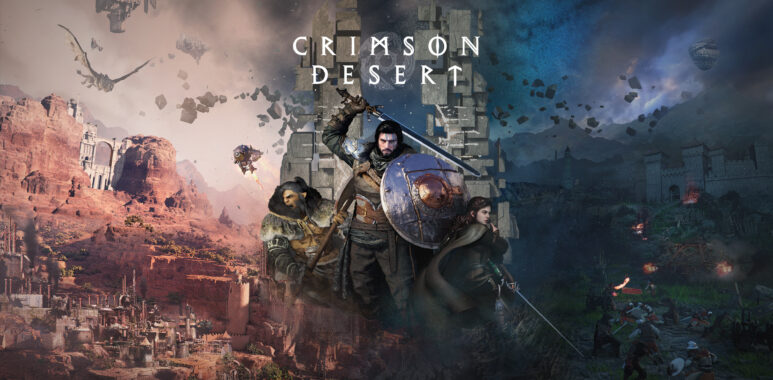
Crimson Desert: A Sprawling, Ambitious Epic That Soars and Stumbles in Equal Measure
Released on March 19, 2026, by Pearl Abyss, *Crimson Desert* arrives as one of the most hotly anticipated open-world action-adventure titles in recent memory. After multiple delays, shifting scopes, and years of stunning trailers that promised a breathtaking blend of cinematic storytelling, visceral combat, and a living medieval fantasy continent called Pywel, the game finally launched across PlayStation 5, Xbox Series X/S, PC (including Steam, Epic, and even Mac), and quickly amassed over 2 million sales in its first day. The hype was real—and for good reason. This is Pearl Abyss stepping away from the MMO grind of *Black Desert Online* to deliver a single-player experience that feels like a love letter to epic fantasy, drawing inspiration from everything from *The Witcher 3* to *Dragon’s Dogma*, *Elden Ring*, and even *Breath of the Wild*.
But does it live up to the promise? In short: yes and no. *Crimson Desert* is a technically dazzling, mechanically dense, and visually jaw-dropping achievement that frequently feels like one of the biggest games ever made. Its world is mind-bogglingly vast, its combat exhilarating when it clicks, and its ambition borderline overwhelming. Yet it is also hampered by clunky controls (especially on keyboard/mouse at launch), an overdesigned UI, a confusing progression system, repetitive narrative beats, and a main character whose personality often grates. The result is a game that scores around 79 on aggregate sites like OpenCritic and Metacritic—solid, but not the GOTY contender many hoped for. Still, for players who crave depth and spectacle, it’s a must-play that rewards patience.
At its heart, *Crimson Desert* is an open-world action RPG set on the war-torn continent of Pywel, a land scarred by endless conflict, ancient mysteries, and supernatural threats from “the Abyss.” You primarily play as Kliff (sometimes referred to as Macduff or Kliff the Greymane in community discussions), the grizzled leader of the Greymane mercenaries—a band of hard-bitten warriors-for-hire trying to survive in a world where loyalty is fleeting and power is everything.
 The scale is staggering. Pywel feels genuinely enormous, with towering mountains, sprawling forests, ruined cities, frozen tundras, volcanic badlands, and coastal strongholds all seamlessly connected. Dynamic weather, day-night cycles, and emergent events (bandit ambushes, merchant caravans under attack, massive boss-like creatures roaming) keep exploration fresh. You can climb almost anything with a contextual parkour system, ride horses (and later dragons in certain sequences), sail small boats, and even engage in large-scale battles where hundreds of NPCs clash.
Visually, the game is a triumph. Powered by Pearl Abyss’s proprietary BlackSpace Engine (an evolution of the tech behind *Black Desert*), it delivers some of the most impressive lighting, particle effects, and texture work seen in 2026. Sunsets over crimson-hued deserts, mist-shrouded forests at dawn, and rain-slicked castle sieges look cinematic. Character models, especially during cutscenes, are detailed and expressive, though some facial animations veer into uncanny territory.
The world isn’t just pretty—it’s alive. NPCs have schedules, factions react to your actions (helping one mercenary group might anger another), and side activities like hunting, mining, trading, fishing, and even tavern brawls feel meaningful. There’s a surprising amount of simulation: cook meals for buffs, upgrade camp facilities for your mercenaries, recruit companions, and manage relationships that influence story branches.
Combat is where *Crimson Desert* shines brightest—and where many players hit the biggest frustrations. It’s not a soulslike; it’s closer to a high-fantasy action game with heavy emphasis on combos, weapon-switching, and environmental interaction.
 Kliff starts with a massive greatsword but quickly unlocks a dozen weapon types: dual blades, polearms, bows, gauntlets, even elemental-infused staffs. Each has unique movesets, and you can chain them fluidly—dodge into a spinning polearm attack, then swap to a bow for a quick shot, then finish with a ground-pound from the greatsword. Skills are unlocked via a “Watch and Learn” system where you observe enemies or allies and steal their techniques, adding RPG depth.
Boss fights are highlights: massive dragons that require climbing and targeting weak points, multi-phase demon lords, and siege commanders surrounded by armies. Horseback combat adds variety, letting you charge into lines or fire arrows while galloping.
But the controls drew widespread criticism at launch. Lock-on is finicky (especially in crowds), inputs feel delayed or unresponsive on some setups, and keyboard/mouse support was described as “awful” by many. Pearl Abyss quickly acknowledged this, promising patches (and delivering day-one and follow-up updates with control tweaks, new tutorials, and boss balancing). On controller, especially PS5 DualSense, it feels much better—haptic feedback enhances sword clashes and environmental interactions.
Once you adapt (and after patches), combat becomes exhilarating. The spectacle—slow-motion finishers, blood sprays, crumbling environments—makes every fight feel epic.
 The narrative follows Kliff’s quest to rebuild the Greymanes after a devastating betrayal, uncover ancient secrets tied to the Abyss, and navigate shifting alliances in Pywel’s endless wars. It’s a tale of loyalty, revenge, survival, and destiny, told through cinematic cutscenes, in-engine sequences, and environmental storytelling.
The writing aims for gritty realism—mercenaries curse, betray, and die brutally—but Kliff himself is polarizing. Many players call him one of the weakest AAA protagonists in years: brooding, sarcastic, and often unlikeable, with dialogue that swings between cool anti-hero and try-hard edgelord. Supporting cast (your mercenary companions, rival faction leaders, mysterious Abyss entities) fare better, with some genuinely compelling arcs.
The story uses repetitive flashback mechanics and vague, fetch-heavy quests early on, which can drag. Mid-to-late game opens up with more impactful choices and large-scale events, but it never reaches the emotional highs of *The Witcher 3* or *Red Dead Redemption 2*.
*Crimson Desert* is overdesigned in the best and worst ways. There’s so much to do—gear crafting, skill trees (tied to Abyss Artifacts), companion management, faction reputation, trading routes, camp building—that it can overwhelm. The UI is cluttered, tutorials are sparse (improved via patches), and early progression feels slow and underwhelming.
Gear feels meaningful (upgrades change movesets and visuals), but the grind for materials can feel repetitive. Side quests vary from forgettable fetch missions to memorable emergent stories.
 Pacing is the biggest issue: the first 10-15 hours are a slog of tutorials, vague objectives, and learning curves. Once you hit Chapter 3-4, the world opens up, and the game becomes addictive.
On PS5 and high-end PC, it runs smoothly at 60fps with gorgeous visuals (though some texture pop-in and minor bugs persist). Xbox Series X/S holds up well, with patches addressing performance. Pearl Abyss has been responsive—day-one patches added tutorials, fixed quests/skills/bosses, and promised more control improvements.
*Crimson Desert* is a flawed masterpiece. Its ambition sometimes outpaces polish, leading to frustration, but when it clicks—scaling a mountain at sunset, chaining combos against a dragon, leading mercenaries into battle—it’s unforgettable.
If you love massive open worlds, deep combat, and don’t mind a learning curve (and waiting for patches), dive in. It’s not perfect, but it’s one of 2026’s boldest experiences.
